Thoughts from New Quincy: Two-Headed Boy
Graphic by Caleb Boyce, Justin Ma

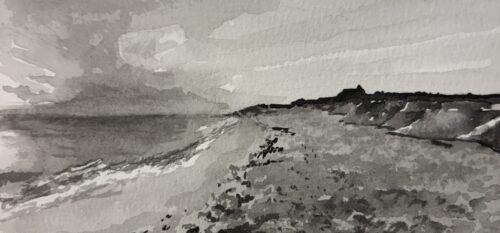
The beach stretches endlessly into the dark. It’s the early season, still too cold to go in the water. I can see boats with their lights on far in the distance. I scan across the water’s edge, catching glimpses of buoys bobbing up and down.
The air pulls tight against my skin, cold enough that every exhale feels counted.
The horizon has folded in on itself; the sky and the water have agreed to blur. The only distinction left is movement—the slow collapse of waves, breathing in a rhythm I can’t follow.
I come here to clear my head, to feel my thoughts fall into step with the waves. I walk the line where the tide reaches and retreats, almost letting it catch my shoes. Every few steps, the sand gives way and I sink half an inch, then rise again. My legs remember this path before I do. The rhythm feels like something to hold onto, even if it doesn’t lead anywhere.
I keep walking anyway, afraid of what the quiet might say if I stopped.
Far down the shore, an empty lifeguard chair glows white in the moonlight. A flag hangs from it, stiff with salt, edges hardened by days of wind. I think of the people who used to sit there—how they watched the waves for signs of life, or loss, or something that might break the surface. The wind presses against my mouth until I can taste the sea.
The water keeps moving, indifferent—as if it never promised to remember anyone at all.
The waves come in unevenly. They’ve forgotten their own pattern. One reaches farther than the rest, erasing half my footprints before retreating, leaving the job unfinished.
The air smells like iron and brine. When the wind changes, it brings something sweeter—decaying kelp, the ghost of sunscreen, the warmth of people who are no longer here. I close my eyes and for a second, I am fourteen again—still waiting for summer to begin. The illusion feels merciful. I let it hold me longer than it should.
I stop near the rocks where the sand turns rough. Shells crack under my feet, tiny breakings that barely register. The tide slides between the stones and pulls back, leaving bubbles that shine like eyes. I look at them until they burst.
The air hangs close, heavy with salt and static. I think back to my room—shut windows, stale light, a bed too neatly made. Out here, the world shifts just enough to convince me I haven’t stopped moving.
A breeze scatters the moon’s reflection. For a moment, it looks like the sky is breaking apart, and I feel the familiar panic—the sense that I’m missing something irreversible, that I should have done more when everything still felt infinite.
When I was younger, I believed that time built toward something—that all the waiting and wanting would one day make sense. But standing here, I can’t find the thread. Everything is motion now, an endless undoing. The waves don’t move forward or back; they just repeat, until even the shoreline can’t tell the difference.
A lone gull passes overhead, its dry cry slicing through the silence. It sounds like a door closing far away. I glance up too late to see it. It has escaped into the darkness, leaving only its echo behind.
I kneel and touch the water. It’s warmer than I expected. My fingers come away shining. For a moment, I think about how this same water has touched other people, other nights, other versions of me—and somehow, it’s all still one thing.
I know I’ll leave soon. I always do. But for now, the beach feels like a room without walls—a place where the world can see me, and I can almost bear to look back. It feels like forgiveness, though I couldn’t say for what.
The waves return, closer this time, washing away the mark where I sat. The ocean smooths itself over. The water doesn’t stay with me.
…
A month later, heat has learned to linger. The day is almost over, the sky already tilting toward gold. From the balcony, the water looks close enough to touch.
I slide the door open until the latch gives up its voice. The handle is warm from the day, and the metal railing still holds heat, as if the afternoon got trapped there and never left. The air is syrupy, slow. When I touch the rail, my skin sticks for a second before letting go.
Across the narrow gap between houses, porch lights burn through the haze. One hums like it’s thinking. Another flickers in time with a TV somewhere behind it—shapes of color I can’t make out. The air ripples between the slabs of wood, bending the light until it wavers.
Somewhere down the street, a grill pops. A man laughs. The sound fades as it travels. It’s summer laughter—full of possession. The kind that fills a night without meaning to. For a moment, I almost join in.
The sky above the roofs is still bleeding light. The ocean flashes between gaps in the houses—a sliver of brightness. The air smells like something once alive, the kind of sweetness that pretends it isn’t fading. I breathe it all in.
I rest my arms on the railing. Sweat beads along them, catching the glow from the porch light and turning it to static. Somewhere above, a mosquito finds my wrist and doesn’t hesitate to bite. I brush it away too late, the skin already rising around the mark.
For a long time, I stand there. The world ticks its small routines: the fridge cycling on, the AC clicking, a car engine rolling down the street like a distant wave. It should feel alive. Instead, it feels practiced—even the air has learned to rehearse its stillness.
I keep realizing how easily repetition starts to feel like peace.
When the silence finally shifts, it’s small but unmistakable: a thinning of sound, the air holding its breath.
Then they appear—shadows cutting clean lines through the sky, wings beating hard enough to move the temperature. The summer birds. Not flying away yet, just tracing the coastline. I always forget how heavy they sound, how unromantic. It’s not grace—it’s effort, wings beating like breath run out. The sound is all strain and distance, movement that barely hides their exhaustion.
I tilt my head back until the sky starts to blur. For a moment, I imagine following them—not north, not south, just somewhere else. But the thought evaporates before I can finish it.
Everyone else’s house receives the moment without interest. A screen door opens and closes. A windchime rings once, then doesn’t bother again. The moth that’s been beating against my neighbor’s light finally stops trying.
When the noise fades, the air still holds the outline of their passing. My hands return to the railing. It’s cooler now, almost kind.
I look around and start counting what’s still moving: a drip from the gutter, the soft motor of a fan, the low tide rearranging itself below the sound of the houses. Then what’s still: my breath, the railing, the outline of the sun against the window’s reflection. I can’t tell which list I belong to. Some days, I worry I’ve become scenery in my own life.
I think about how every summer day feels like it’s teaching me to hold still a little longer.
Inside, I hear the clatter of my friends downstairs. I trace the railing’s warmth with my thumb, leaving a faint print that fades before I pull away. The metal forgets faster than I do. I envy it.
I close the door softly, but the sound still startles me. In the glass, my reflection looks blurred, like something trying to remember its shape.
Outside, the moth starts up again, wings brushing against the light.
…
When I return, the light feels wrong—brighter, but colder. The beach looks smaller.
The tide has dragged the shoreline back a few feet, carving ledges into the sand where the water used to rest. The air smells sharper—salt without sweetness. A storm must have passed recently; the dunes are bruised with reeds, driftwood, and bits of shell that won’t shine no matter how the light tries.
I walk the same stretch I always do, but it feels borrowed now. Each footprint fills immediately, water finding any shape willing to hold it. Maybe that’s all I am—something held for a moment. The thought should scare me, but instead it steadies me.
The horizon is pale, washed out like a photograph that’s been looked at too many times. I can’t remember if it always felt this far away.
Someone’s taken the flag down from the lifeguard stand. I touch the wood. It’s damp, colder than it should be. There’s still a shape on the seat—an outline, or maybe residue.
The waves arrive heavier now, but are already falling apart. They collapse early, like they’ve begun to doubt themselves. Beneath them, I can hear pebbles tumbling, the sand resettling—the quiet sound of things undoing themselves.
When I close my eyes, I still see the birds from that afternoon—their black bodies carving the sky into pieces. The noise they made is gone, but the pattern lingers somewhere just out of reach. I wonder if they ever think about where they’ve been, or if instinct frees them from reflection. I wonder what it would feel like to leave without ever imagining a return.
The wind sharpens. I pull my jacket tighter, but the cold finds the gaps anyway. The sand keeps shifting under my feet, erasing what it touches, rewriting what it misses.
Across the beach, a few children run close to the waterline, their laughter high and bright. It carries farther than I expect, and I’m surprised I can even hear them. For a second, I think they’re calling to me, but they aren’t. Their voices break apart in the wind. Maybe that’s what time really is—the distance between a sound and the moment it stops belonging to you. I test the air, half expecting my own name to echo back and prove I’m still part of it.
I keep walking. The sand squeaks under my shoes, a tired sound, like friction pretending to be progress. The sky opens at the horizon; the light returns for a breath, silver and thin—the color of something you’d wish on but not expect to get back. It flickers across the surface of the water and vanishes.
I kneel and press my hands into the sand. It’s cold and coarse, damp enough to shape but too loose to hold. The next wave creeps forward and touches my ankles. I let it. The cold sharpens everything.
Above the water, the wind changes, carrying the faint scent of rain. The air feels hollow, as if the season itself is exhaling. I wonder when summer ended—or if it ever really does, only fading slowly enough to make you believe it’s still there.
When I stand, the horizon is gone again, folded into shades of gray. The sea has softened the edges of my footprints, leaving only faint shadows of where I stood.
I turn toward the dunes. The wind presses at my back. It could be guidance, or it could just be the world reminding me I’m still moving.
For a moment, I can’t tell if that’s proof of staying or of leaving.
Luke Wagner ’26 (lukewagner@college.harvard.edu) is the Managing Director of the Harvard Independent.