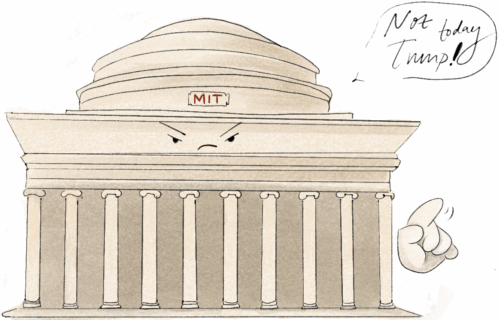
MIT Said No. Will Harvard Do the Same?
Graphic by Madison Krug

On Oct. 1, the Trump administration sent the “Compact for Academic Excellence in Higher Education” to nine schools across the country, including the Massachusetts Institute of Technology. After nine days of deliberation, MIT was the first institution to formally reject the deal, which would have granted it preferential access to federal funding. Brown University, the University of Pennsylvania, the University of Southern California, the University of Virginia, Dartmouth College, and the University of Arizona soon followed suit.
This deal comes as part of the presidential administration’s mission to reform U.S. higher education, freezing between $6.9 and 8.2 billion in federal funding for the nine implicated universities. The Compact is the result of a federal judge declaring Trump’s freeze of federal funds to Harvard College unlawful. With rumors of a deal brewing between the Trump and Harvard administrations, there has been speculation that this Ivy League institution is close to settling.
“What you have to do is paper it, right?” Trump asked Secretary of Education Linda E. McMahon during an event on pediatric cancer in the Oval Office on Sept. 30, regarding whether Harvard was close to reaching a deal.
In a letter sent in April to Harvard President Alan M. Garber ’76, the Trump administration outlined several key parts of the proposed agreement, including “merit-based admissions policies” and the cessation of “all preferences based on race, color, national origin, or proxies thereof.”
“It really limits the way that a lot of students can express their identity when it comes to college applications,” Harvard undergraduate student Dylan Szatko ’29 said to the Independent in response to Trump’s original requests and recent Compact. “Diversity, at the end of the day, is a strength, and I’ve seen that even coming here.”
Directed toward the nine universities, the Compact builds on the letter. Seven have rejected the presidential administration’s offer so far; only Vanderbilt University and the University of Texas have not yet declined. UT suggested that it might be open to signing on quickly. As of Oct. 21, Vanderbilt had not yet expressed a view on the matter. Each university was given until Nov. 21 to sign on to the deal.
The Compact contains 10 different sections, each listing a demand for the signing school.
“It’s about gaining control of the internal workings of universities in order to make sure that they can’t serve as sites of opposition to or disagreement with government action,” MIT Political Science professor Ariel White told the Independent. “It’s about getting universities to give up the typical legal processes and protections that they have when they interact with the federal government and leave them vulnerable to threats and further demands from this administration.”
The document would cap international enrollment at 15% of each incoming class, with no more than 5% from any single country. “We have people who want to go to Harvard and other schools; they can’t get in because we have foreign students there,” Trump said in an announcement on May 28.
“I certainly think that the idea of capping international students is a mistake,” White said. “[There is] this idea that international students are in some way taking away from domestic students, when in actual fact, they are often subsidizing the education of domestic students and certainly bring a lot of intellectual resources to campus as well.”
Three of the seven declining institutions have an undergraduate international student share over the proposed cap, with USC having the highest at 26.1%. While this agreement might not be the same if proposed to Harvard, similar to its peer institutions, this international student clause poses a severe restriction for the University, whose undergraduate student body is 27.2% international.
“Most of us want to stay here after graduation and contribute to the economy,” Daniel Erasmus ’27, an international student from Zimbabwe, told the Independent.
In a public statement on Oct. 18, Dartmouth President Sian Leah Beilock specified why they would not be accepting the Compact. “It would compromise our academic freedom, our ability to govern ourselves, and the principle that federal research funds should be awarded to the best, most promising ideas,” Beilock wrote.
Beyond international student stipulations, the Compact also requires that all U.S. university employees will abstain from any politically motivated speech or actions.
“I think that some of the features of this Compact, as written, do pose an existential threat to the research and teaching missions of our universities,” White said. “Just doing your research could nevertheless lead to real threats of reprisal from this administration.”
The Compact continues to delineate other requirements for some of America’s most elite universities. “Signatories commit themselves to revising governance structures as necessary to create such an environment, including but not limited to transforming or abolishing institutional units that purposefully punish, belittle, and even spark violence against conservative ideas,” the Compact states. This statement was included in response to the presidential administration’s opinion that Republican voices are silenced on American university campuses.
“I think that that’s absolutely reckless and dangerous, and it’s going to embolden a lot of far-right speech on campuses,” Szatko said. “It’s going to hurt minority students, students of color, LGBTQ students who are going to be faced with, like I said, emboldened harassment, discrimination, and universities are not going to do anything about it.”
While Harvard waits for its own deal to be finalized, a question remains: should it follow MIT and other universities in rejecting this deal or settle with the administration?
“I would be very disappointed if the University administration signs such a deal,” Szatko said.
“You can see that that’s like a sword of Damocles hanging over our head,” White similarly answered. “So you can see how schools who have signed on to the Compact will quickly find that the deal is changing on them and that they don’t have a lot of chance to push back on that because they’ve got this huge threat hanging over their heads.”
Aidan Gallagher ’29 (aidangallagher@college.harvard.edu) is comping the Independent.