अद्वैत
Graphic by Annabella Burton

“Do I look Indian?” I interject into our conversation with a hint of eagerness. It’s the middle of June, and my friends and I are sitting around the kitchen table, eating the dinner we had just cooked together. The stove is a mess with dishes out everywhere, as penne alla vodka and steak elegantly rest on the plates in front of us. It’s still light out, so the windows are open and my complexion is slightly bronzed from the summer sun.
The five of them, with their light hair and blue eyes, laugh at my question, chorusing back a series of “no” and “not really,” one after the other—words I did not want to hear. “If I were more tan, would I?” They look me up and down, briefly contemplating, and tell me yes. We go back to whatever we were talking about, eventually landing on my future Indian wedding, but I remain quiet for the next few minutes.
It’s rare that someone guesses I’m half-Indian. I’ve been asked countless times what I am, my facial features seemingly ambiguous. People never assume I’m fully white, with my name usually throwing them off. And even then, it’s unclear, and so it becomes a guessing game: Middle Eastern, Egyptian, South American, Jewish. There’s always a look of realization, or rather surprise, when I tell them that my mother is Indian, and then they look at me again as if trying to put together the pieces.
The lingering looks and second glances, the judgment and hesitation, even if unintentional, don’t escape me. It’s the most heartbreaking when it comes from those who are, in fact, fully Indian. But I can’t blame them, because even I know I don’t ‘look’ my ethnicity.
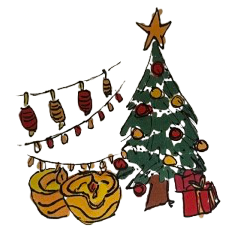
Growing up multiracial meant I was immersed in two of everything—cultures, religions, holidays, food, languages. Two sides, in conflict and in harmony. It meant tikka masala and dal at Thanksgiving, holiday lights going up in October, and Hindi classes on the weekends in elementary school. It meant believing in one god and multiple gods at the same time, and it meant that when I did pray, I would say both a Hindu and a Catholic prayer. It meant lighthearted arguments over whether Christmas or Diwali were more important, and my parents going back and forth over reincarnation or heaven. It meant a closet of lehengas and saris, trinkets passed on from my grandmother, Hindi words eloquently woven in conversation. But the coexistence and inescapable contradiction also meant it was confusing.
It’s difficult to grapple with an identity that you are never fully a part of, on either side. There’s an agonizing lack of belonging, a feeling of having to convince and explain your ethnicity rather than simply state it, when for many it’s just implicit. Appearance, affecting how people classify you, only exacerbates this. I can’t stop worrying about not “looking Indian enough” because it translates into people not recognizing the side of me in the way it is undoubtedly clear in others. It often feels as if I can’t fully claim my identity when I’m only half of it, begging the persistent question of am I even allowed to tell people I’m half-Indian?
Perhaps counterintuitively, this outsider feeling has only intensified since coming to college. Growing up in a predominantly white and homogeneous town, my relatively darker skin, features, and ethnicity stood out more. Next to my parents, my two younger brothers, with their Indian names too, and I looked very clearly the mix of them both. At Harvard, a much larger and more diverse place with a strong South Asian community, this sense of removal from my identity and the need to prove myself has stood out even more. It’s been here where I hesitate the most before saying I’m half-Indian, anticipating the surprise, and where people innocently assume I wouldn’t understand cultural references. Coming from a handful of Indian students in my high school, my mixed race has faded to invisibility.
Racial impostor syndrome, a term first coined by NPR, is a phenomenon experienced by many multiracial people that refers to “when your internal sense of self doesn’t match with others’ perception of your racial identity and gives rise to a feeling of self-doubt.” While I can recognize that this feeling is partially self-inflicted, the doubt also stems from others.
I remember walking the streets of London two summers ago with my friend, who is white. I proudly pointed out the tea bags and block-print clothing in the shop windows, telling him how they were influenced by India after Britain’s colonization. “You’re not really Indian, though,” he said, very matter-of-factly. What does that even mean? Am I not really white, then, either? Though the self-doubt and detachment are never-ending, it was the first time anyone so plainly denied my identity—a confirmation of my self-inflicted lack of belonging. It’s a conversation I’ve heard from those who are fully Indian too: people say half-Indian, half-white individuals are “always more in touch with their white side.” No one would ever tell me I’m not really white.
“Yes, I am,” I replied immediately, defensively. But I couldn’t help but wonder if he was right.
My name is of Indian origin. I celebrate Hindu holidays, pray in Hindi, and follow Indian traditions, I tell him. There I was again, explaining to him as if I was trespassing into somewhere I did not belong. This surprises him, the unexpected parts of myself that my appearance does not give away. Still, we go back and forth for ten minutes.
I had never so strongly felt that defensive urge to prove that I belong to my own culture, both to him and, maybe even more, to myself—something I’ve been subconsciously doing for as long as I can remember. When I came home that summer, I asked my mother for one of her gold Indian bangles, another physical testament to my identity.
Even now, I still do not know how to fully grapple with what it means to be multiracial and what it means to have a split identity. But I do know that even if I might not fully look it, I will continue to love and honor the half of my culture that has shaped me—the culture I uniquely celebrate with my two brothers and will pass onto my children.
This past Monday, my father called me to wish me a Happy Diwali. I watch my brothers light diyas over the phone, and I remember how we used to fight over who got to light them first. I play with my mother’s bangle on my wrist, which I now wear almost every day. And despite it all, I feel grateful to have been immersed in different cultures, to have had traditions so beautifully intertwined, the two worlds that made me who I am as a person.
Meena Behringer ’27 (meenabehringer@college.harvard.edu) is the Arts Editor of the Independent.