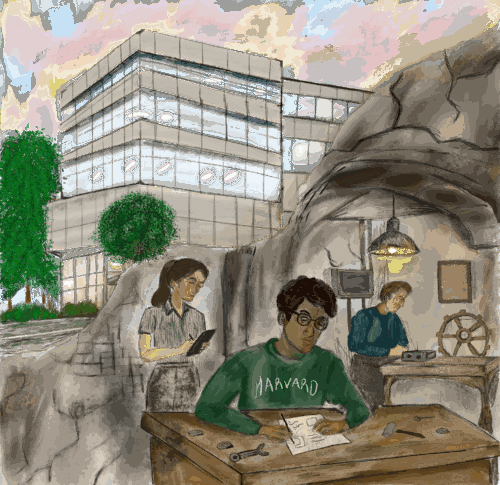
Harvard Engineering: You Can’t Buy Your Way to the Top
Graphic by Trischelle Afihene

“Today’s gift will help continue that legacy by making SEAS a 21st-century engineering leader. It provides a solid endowment for faculty development, research, scholarships, and financial aid.”
That was John A. Paulson’s—Harvard Business School Class of 1980—objective when he donated $400 million to the Harvard School of Engineering and Applied Sciences—now named in his honor—in 2015.
On paper, the school has made impressive advancements since then. It completed the $1 billion Science and Engineering Complex in 2021, worked with the University to plan the $750 million Enterprise Research Campus in Allston, brought in over 500 concentrators, and more. But there’s only so much buildings and branding can do when they’re not matched by investments in the faculty, staff, and students.
It’s hard to critique SEAS’s current budgetary structure without pointing out the financial stress it’s under. According to financial reporting for FY25, the School of Engineering receives about 33% of its funding from “sponsored support,” tied with the Medical School and second only to the School of Public Health, which receives 56%. Almost 47% of that sponsored support comes from the federal government, a funding source that has become unreliable as the Trump administration has continued to pressure Harvard and enact monetary freezes. The school also receives 41% of its funding from the University’s endowment, which is now taxed at a higher rate.
For students, these pressures could mean less research funding, growing uncertainty in course availability, and fewer relevant extracurricular options as the school looks to weather a potential budgetary shortfall.
While there is valid reasoning for financial restructuring at SEAS, much of the federal funding has been restored after multiple rulings, and the endowment tax only applies to realized investment income—dividends, royalties, and sold assets. Despite these financial struggles, Harvard SEAS left me questioning whether it is putting too much emphasis on high-level investments without bolstering the lower-level programs that support undergraduate concentrators and other students affiliated with the school.
Ask any student studying at SEAS, and they will recount some type of staffing-related problem they have experienced: classes suddenly reorganized because of a faculty shortage; clubs forced to fight the administration for funding; inability to get basic engineering training; the list goes on. This is no way to grow a school.
On Aug. 27, as students moved onto campus, undergraduates taking Eng Sci 51: “Computer-Aided Machine Design,” the introductory mechanical engineering course, received a Canvas notification from the professor: “Because of the unexpected limits on enrollment this semester, the course is currently capped at 30 students.” A course required for the mechanical systems S.B. track and a popular elective across engineering concentrations was suddenly capped. Students were left scrambling to be one of the lucky ones or rearrange their schedules to accommodate being dropped.
The notification continued by stating they were looking into offering the course again in spring 2026 (which had been standard in the past but was cut after spring 2025) and, because of this, SEAS, home to more than 1,300 undergraduate students across seven concentrations, effectively capped the mechanical engineering cohort for the Class of 2029 at 30 students. By comparison, the Class of 2022 had 84 concentrators in mechanical engineering.
In another blow, SEAS announced on Oct. 10 that it would lay off 25% of its unionized clerical and technical staff. On Oct. 21, the school announced it would cut nearly a dozen faculty and lecturers. These decisions didn’t directly impact students; however, the staff of SEAS are essential to its day-to-day operations. With cuts of this size, it’s hard to envision the school operating smoothly.
In an open email to professors and students, the Harvard Union of Clerical and Technical Workers stated that “SEAS administrators were unable or unwilling to give us specific data that would substantiate the need to make these painful cuts.” The school has already been struggling with understaffing, and it looks as though it will only get worse.
The union also shared an open letter addressed to Harvard University as a whole: “Slashing staff positions not out of necessity, but in reaction to vague and unrealized threats, will not strengthen Harvard’s future—it will weaken it,” it read. “It will leave faculty, researchers, and students without the critical infrastructure and support they need to thrive.”
These cuts don’t make sense in the context of the ongoing negotiations between the University and the Trump administration. Part of the proposed deal includes investments in a Harvard-run trade school and AI education. While not entirely under SEAS, much of the AI component would plausibly fall within the Computer Science concentration and graduate-level AI research. While the deal itself raises many questions, one thing is clear: Harvard needs to become a leader in AI education. SEAS will likely bear most of that responsibility. Cutting staff now feels like a short-term reaction that will create long-term problems for the school.
I would love to lay out a more specific request, but SEAS doesn’t make its finances publicly available. So I’ll make one general request to both SEAS and Harvard: Don’t forget us. When we invest $750 million in a new Enterprise Research Campus, don’t forget to fund the staff who train students interested in enterprise; ensure you hire enough to meet growth-driven demand. When we buy new classroom technologies or attract new faculty, don’t forget to support the clubs that turn classroom lessons into real-world engineering.
If SEAS wants to look to a future where it is a “twenty-first century leader,” it must continue its growth trajectory, elevate students working to build world-class organizations at the school, expand our course offerings, and work to stretch our budget in as many ways as possible. Cut only when absolutely necessary.
When I chose to declare mechanical engineering, I hoped to be entering Harvard’s newest school, one with powerful growth prospects and tremendous potential. And while I still believe that’s true, I can’t help but feel frustrated with the decisions that hamper its growth. There’s a saying: “If you build it, they will come.” But if the people inside feel unsupported, they’ll just leave.
Kalvin Frank ’28 (kfrank@college.harvard.edu) is excited to study mechanical engineering, but he wants to see the Department thrive.