Thoughts from New Quincy: After Innovation
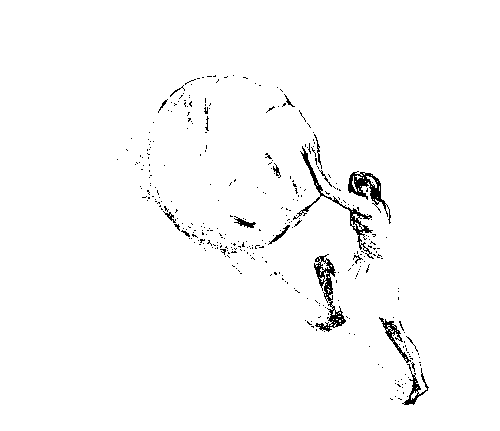
Graphic by Nuala Mernin

The world runs on updates. Phones, cars, sneakers—everything has a version number now. Each season promises an upgrade: a faster processor, a lighter fabric, a “new and improved” formula. You buy one, even when last year’s still works, and the changes are almost imperceptible. That’s beside the point. What matters is not the object, but the gesture of replacement.
Every September, Apple unveils another iPhone, another iteration of the same object that was polished into near-perfection years ago. The cameras shift, the bezels narrow, the adjectives change, but the object remains the same. The keynote isn’t about what the device can do; it’s about reminding us that time is still moving, that progress still exists, and that we are building for the future.
The logic of the update has crept beyond technology. It’s in how we shop, how we talk, and how we think about ourselves. We reinvent our routines, our wardrobes, our personalities—each one a limited release of the same idea. Even introspection has a launch cycle: new goals, new habits, new eras. Often, this cycle is marked by the New Year, but not always. Even the phrase “New year, new me” captures how deeply the update logic has entered the self—a promise of reinvention that feels obligatory, even when nothing has changed.
Innovation once meant the act of bringing something new into the world; now it describes the process of keeping the world running. It’s become a reflex—something we do because the alternative feels wrong. “Next-gen” has replaced “new,” and somehow that sounds truer: nothing really ends, it just updates.
Living in this rhythm feels more like drift than progress. Things keep moving, but never far enough to matter. Each update promises to fix what was missing in the last one, and somehow repeats the same emptiness. After a while, even improvement starts to feel monotonous—the same excitement rehearsed again and again. You don’t look forward to what’s next so much as brace for it.
What matters isn’t invention but momentum. Motion itself has become a sign of life, a way to prove that the machine still runs—even when it’s only looping back on itself. Modern capitalism perfected this rhythm: improvement isn’t about solving problems, but about keeping the future perpetually on preorder. The moment something works, it becomes obsolete.
This isn’t progress—it’s maintenance disguised as discovery. Silicon Valley turned it into a moral code: keep iterating, keep scaling, keep going. To slow down is to disappear. Capitalism then refined this ethic into an aesthetic. It no longer needs to change material conditions; it only needs to look as if it might. The visual language of innovation—muted gradients, frictionless interfaces, lowercase logos—projects a moral clarity the system itself no longer holds. Aesthetic form now carries the moral weight that institutions have lost; design performs the appearance of conscience.
That moral aesthetic has become a universal dialect of credibility. A rounded corner suggests benevolence; a sans-serif font implies transparency; the language of “beta,” “update,” and “reimagine” promises humility while guaranteeing control. The design of progress is its proof and its fallacy: if something appears new, it must be good.
Across industries, the pattern repeats. Cars become sleeker, apartments emptier, offices whiter. The vocabulary of reduction—minimal, efficient, smart—conceals the vast infrastructures of extraction required to sustain it. Minimalism has become the style of excess: a performance of restraint that signals moral virtue while consuming at an industrial scale.
Innovation, in this sense, is not a project but a mood. It operates through atmosphere, not achievement, through the promise that something new is always imminent. The world need not alter itself as long as it can sustain the illusion that alteration is perpetual.
What begins as an economic logic soon becomes a psychological one; the drive to innovate turns inward, demanding that individuals internalize the same imperative once reserved for markets.
If capitalism aestheticizes progress, it also personalizes it. We are taught to treat ourselves as prototypes—projects in perpetual beta, always subject to refinement. How often have you heard someone use the phrase: 1% better every day? To be static is to risk obsolescence.
This is the cult of novelty turned inward: the demand to update ourselves as proof of progress, to confuse reinvention with evolution.
The language of selfhood has absorbed the rhetoric of the market. We rebrand after breakups, pivot between interests, optimize our mornings with 19-step skincare routines and eight-minute mobility stretches. Each transformation is framed as growth, but it often serves the same function as the software update: a minor correction masquerading as reinvention. We don’t change to evolve; we change to remain legible.
This imperative extends to emotion itself. Even rest is reframed as productivity—sleep becomes “recovery,” leisure becomes “recharging.” The soft vocabulary of wellness conceals an older demand: to remain useful. The body must be efficient, the mind flexible, the soul adaptable to the next opportunity. In such a world, self-improvement is indistinguishable from self-maintenance.
The digital sphere has only deepened the illusion. Social media platforms reward constant revision: new aesthetics, new opinions, new performances of sincerity. The feed demands novelty, not stability. One’s value lies in the capacity to be updated. To linger too long in a single version of oneself is to risk disappearing from view.
This is not freedom; it is a more intimate form of discipline. Innovation has usurped the search for meaning with the comfort of repetition. The future, once imagined as a horizon, has collapsed into a timeline—scrollable, replaceable, endlessly refreshed.
Capitalism perfected this illusion. It learned to convert imagination into iteration, to transform the idea of the future into a commodity of the present. The promise of progress sustains the market even when progress stalls. Each new object or platform gestures toward a horizon that never arrives, a deferred utopia kept alive by marketing and repetition. The aesthetic of the new has replaced the politics of the new; the performance of transformation has replaced transformation itself.
We have inherited a vision of the future that is managerial rather than revolutionary. Its task is not to imagine another world but to optimize this one—to render it more seamless, more user-friendly, more governable. The result is an age in which innovation expands endlessly inward: the same tools, refined; the same desires, resized; the same systems, rebranded as solutions. The frontier is neither space nor knowledge, but an interface.
Yet even in this self-polishing world, the desire for something genuinely new persists. It surfaces in the exhaustion people feel toward optimization, in the quiet wish for duration over novelty, in the growing intuition that the next upgrade will not deliver what the last one promised. To imagine what comes after “new,” then, is not to imagine another device or another ideology, but another tempo of life—one that allows continuity, depth, and care to count as progress.
Perhaps the most radical gesture left is to imagine repair, even if it’s no longer possible. To resist the compulsion toward renewal—to build a world that measures time not in product cycles but in the endurance of what we choose to keep—would require unlearning the very logic that sustains us. Some moments gesture toward it: the return to craft, the defense of the analog, the refusal to upgrade.
These small acts do more than preserve the past; they test whether meaning can survive without novelty. Repair, after all, is not about restoring what was lost, but about learning how to live with what remains. It asks whether continuity itself could be a form of resistance—a way of staying still without being stagnant.
Still, maybe interruption is all that remains. The future will not arrive through another release, but through duration—when we learn to recognize what endures as what’s truly new.
Luke Wagner ’26 (lukewagner@college.harvard.edu) is the Managing Director of the Harvard Independent.