AI Advancements: Implications for the Human Creative
Graphic by Trischelle Afihene

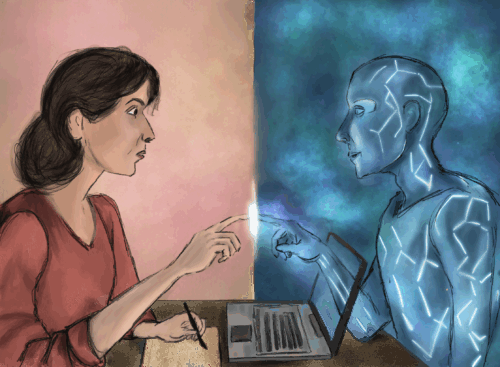
On Oct. 14, OpenAI CEO Sam Altman announced on X that the latest version of ChatGPT would be more personable—an artificial intelligence engine capable of responding in a “very human-like way,” or even acting like a friend. This news comes amid rising controversy over how far AI should go in mimicking personal expression and the subsequent threats that such generative technology poses to human creativity.
Debates on the future of education around AI have been ongoing at Harvard. The issue has become so prevalent that Harvard College Dean David Deming’s convocation speech this year mainly focused on AI and its implications and applications in wider society. Reports estimate that by 2030, activities that account for 30% of work hours across the U.S. economy could be automated. Generative technology advancements are no longer a purely academic concern for Harvard students, but a tangible threat facing creative spaces and the workforce that students are preparing to enter.
For Delphine Doreau, the former Program Director for Animation at Pulse College, Dublin, with over 30 years of international experience in the creative space, the distinction is clear: AI will never be able to replace human individuality. “I think the whole creative process is fundamentally human,” Doreau told the Harvard Independent.
This is an idea shared by neurologist Dr. Dean Burnett who cited AI’s lack of emotion as reasoning behind its inability to replicate human art at last year’s Walnut Unlimited’s Brainy Bar event. “AI does not have that [emotion]—it is all pure logic,” he said.
The notion that AI cannot replace the human experience was echoed by the words of an anonymous Harvard upperclassman and Sidechat contributor @whoeversmeltitdealtit. “When ChatGPT grows a digestive tract, it may be able to understand the unparalleled importance of defecation,” they said in an interview with the Independent. The upperclassman preferred to have their student identity remain anonymous to ensure that their online presence could stay unfiltered.
Sidechat is an anonymous social media app that allows students to post and comment within and outside their higher education community. @whoeversmeltitdealtit has been making and publishing reviews of mainly Harvard bathrooms and the occasional Harvard Square meals on Sidechat over the past year.
A typical review from their account contains a rating of a Harvard or Harvard-adjacent bathroom rooted in the typical criteria of cleanliness, privacy, smell, and size. Following the numerical ranking, @whoeversmeltitdealtit leaves a long-form comment to summarize the experience for any other users of the respective locale. The most recent review of the second-floor bathrooms at the Charles Hotel received a 7/10 rating: “Could definitely have been cleaner, but I cut some slack for high foot traffic. Good size tho.”
This Harvard student’s bathroom reviews represent a case for AI’s creative limits. The experiential content they produce seems inherently human in nature. Consider their self-developed theory on the correlation between bathroom cleanliness and floor level: “The emotional rollercoaster of fear, anger, confusion, joy, sadness, and relief could never be replicated by a machine,” they said. Nevertheless, as AI systems advance in their abilities to mimic personal and observational humor, the boundaries of what is—or will be—uniquely human continue to grow harder to define.
What is less clear among members of the creative world is the question of how much further AI can or will go. “AI won’t ever be a creative genius. Technical art, yes. Pretty pictures, OK. Thinking out of the box, never,” Doreau explained.
Though resolute in her surety that AI will ‘never’ be capable of thinking outside of the input data it receives, this is not a uniform view across the world of AI. Professor Lenore Blum, Distinguished Career Professor of Computer Science, Emeritus at Carnegie Mellon University, told the BBC in an interview this May that she believes that “AI consciousness is inevitable.” Similarly, the view that AI may one day become conscious is shared by Henry Shevlin, Associate Director at the Leverhulme Centre for the Future of Intelligence, University of Cambridge, who has argued that there will be “engineered conscious AI by the end of the century.”
Concerns about AI have permeated all facets of life, from academia to entire industries. However, @whoeversmeltitdealtit remains firm that humanity still has hope, at least in the creative sense. “I hope to one day win a ‘Poolitzer’ Prize in journalism for my investigative work and primary source reporting.”
Through their work, they hope to demonstrate that an urge to create absurd and niche ideas for no other reason than personal amusement exists. This impulse to direct genuine effort into something intentionally nonsensical reveals something AI may never grasp: that ‘meaning’ doesn’t always have to be ‘meaningful.’
As AI continues to advance through increasingly personable models, the question of where human creativity ceases and AI capability begins remains unresolved. “The minute the authenticity of the human experience is lost, you’re done. Here’s the line,” Doreau said.
Noah Basden ’29 (nhbasden@college.harvard.edu) wonders if his bathroom has been reviewed or not.