Harvard Students React to Larry Summers’s Campus Presence and New Epstein Records
Graphic by Cameron Bernier

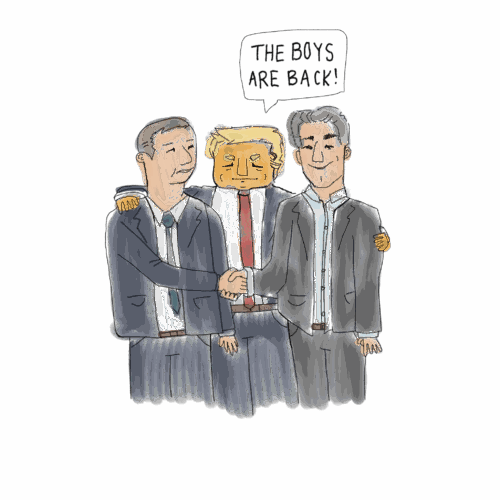
The United States House Committee on Oversight and Government Reform released more than 33,000 pages of Epstein-related records obtained from the Department of Justice from Sept. 1 to Nov. 12. Although much of the material reiterated information already made public in Jan. 2024, the timing and volume of the release reignited campus debate over how institutions should handle faculty affiliated with convicted sex offender Jeffrey Epstein.
“If evidence emerges that he was involved with any sexual misconduct, he should be charged and fired. I don’t think people who commit crimes to that degree should be anywhere near an institution like Harvard,” Nataly Delcid ’28 said in an interview with the Independent.
In January 2024, the United States District Court for the Southern District of New York unsealed nearly 1,000 pages of civil-case filings from Giuffre v. Maxwell. The contents mainly pertained to Ghislaine Maxwell, Epstein’s former romantic partner and associate, detailing her involvement in recruiting young women and personal knowledge of Epstein’s sexual activities. However, the disclosure also named dozens of people related to Maxwell and Epstein in various contexts, including former Harvard President and U.S. Treasury Secretary Lawrence H. “Larry” Summers ’82. Reporters and courts stressed that inclusion in civil discovery or deposition exhibits does not imply any wrongdoing.
Still, commentators on both the right and the left circulated selective excerpts to fit preexisting narratives. On social media platforms, some accounts mislabeled the trove as a “client list,” blurring the line between sworn allegations, witness mentions, and hearsay.
Meanwhile, official reviews have reiterated two key points: federal investigators concluded Epstein died by suicide, and a July 2025 Department of Justice and Federal Bureau of Investigation memo stated there is no “client list.” Those findings sit alongside sharp criticism of the Bureau of Prisons for failures that enabled his death.
Harvard’s 2020 internal review—a year after Epstein’s second imprisonment—found the University accepted $9.1 million from Epstein between 1998 and 2007, with no gifts after his 2008 conviction; it also documented more than 40 visits to Martin Nowak at the Program for Evolutionary Dynamics from 2010 to 2018. The University announced it would be closing the Program and suspended Nowak from advising undergraduate research for two years. The remaining $200,937 in funds were directed to anti-trafficking nonprofits My Life My Choice and GEMS. The report recommended tighter donor and visiting-fellow policies.
Summers and the November Document Release
Immediately following the release of the files, Summers still held his Harvard professorship and taught five courses across the Economics Department at the College and Harvard Kennedy School. He attended lectures following press coverage of emails released via Congress on Nov. 12, which showed that he corresponded with Jeffrey Epstein between 2013 and 2019 on a mix of personal topics and Harvard-related projects.
Summers appeared in class the day following his announcement, which Delcid sat in on. “Some of you will have seen my statement of regret, expressing my shame with respect to what I did in communication with Mr. Epstein,” he said before starting the lesson. “I’ve said that I’m gonna step back from public activities for a while for a time. But I think it is very important I fulfill my teaching obligations. And so, with your permission, we’re going to go forward and talk about the material in the class.”
Epstein and Summers’ email and text correspondence went on from Nov. 2018 to Jul. 2019, 10 years after Epstein pleaded guilty in a Florida state court to solicitation of prostitution from an underage girl. Summers, married both then and now, detailed a romantic pursuit of a woman he referred to as his “mentee.” At one point, Epstein referred to himself as Summers’ “wing man” for the PhD student he pursued.
“I believe that the most important aspect of a person in their work, especially in a university, is what they actually enact and what they say and do in regard to the university,” Brandy Figueroa ’28 said. “But I also do believe that a person’s personal life and their morality in general, and the morality of their actions and speech, privately, also is something that we should care about.”
“There’s people that are controversial because we don’t believe with their political system, right? But there’s also people who are controversial just because they’re bad. There are limits to what is useful and what actually contributes to intellectual vitality,” she continued.
“Why the fuck are you still here? Why are you still here?” said Aaron Samuels ’27. “I think it’s a general consensus that he represents the worst of Harvard.”
Summers Steps Back from All Public Commitments and Teaching Responsibilities
On Nov. 19, Summers alongside spokesman Steven Goldberg announced that he would step down from his teaching responsibilities, directorship of the Mossavar-Rahmani Center for Business and Government at the Harvard Kennedy School, and all other public commitments. “I am deeply ashamed of my actions and recognize the pain they have caused. I take full responsibility for my misguided decision to continue communicating with Mr. Epstein,” he said in a statement to CNBC. Also on Nov. 19 it was announced he had resigned from his board position at OpenAI.
Delcid questioned the motivations behind Summers’ stepping back. “I could see a world where he genuinely stepped down because he was forced to at least take a pause until he can make a statement, or prove that he’s innocent in some way. So I don’t know if stepping down is an admission of guilt,” she said.
Still, Delcid criticized Summers’ pursuit of a student whom he discussed in the correspondence. “The fact that he was getting advice from Epstein on this front a day before Epstein was arrested, is just like… I think there actually is probably enough evidence for Harvard to justifiably remove him just based on that email.”
“What role does the institution play in this, and now that we know this, or now that new things are coming to light, what does the school do after this?” Samuels asked. “What are they willing to do?”
On Nov. 18, Trump was questioned on references to him in Epstein’s emails. Trump claimed not to know anything about them, but asked, “What did it mean when he spent all that time with Bill Clinton, with the President of Harvard, you know who that is, Summers—Larry Summers?”
The records were released in the midst of an ongoing legal battle between Harvard and the Trump administration. “Unfortunately, the University has become really entrenched with politics and power plays,” Figueroa said. “I think that there should be repercussions for being affiliated in any negative way with Epstein, but I also don’t think that should be used to harm the University itself.”
“This is an institution separate from who Epstein was and what he did,” she continued. “The University should try to [protect] itself by, first of all, figuring out who would be affected, and doing damage control in any way possible.”
Epstein Emails Reference Trump
New references to Donald Trump in the Nov. 12 tranche added fuel to the discourse. The committee’s release included three emails from 2011, 2015, and 2019 in which Jeffrey Epstein mentioned Trump. Among them was a 2011 note to Ghislaine Maxwell, saying a victim had “spent hours at [Epstein’s] house” with Trump and calling him a “dog that hasn’t barked,” and a 2015 exchange with author Michael Wolff about an upcoming Trump interview; several outlets published the emails in full or summarized them. The White House downplayed the messages, stressing that being mentioned in correspondence is not itself an allegation.
“I would genuinely say I’m unfazed. I think that so many batshit crazy things come up in the news regarding Trump,” Delcid explained. “I think I’ve just been desensitized… I was pretty confident he had some sexual misconduct in his past, so I’m not overly surprised by some of the stuff that’s coming out.”
Figueroa shared a similar sentiment towards the President. “I never really had trust in Trump—I’m not totally shocked by this. It’s kind of to be expected. You don’t need these emails to realize what’s been going on,” she said.
“I already expected Trump to be on there,” Samuels said. “The majority of people have already associated Trump with predatory offenses—sexual predatory offenses.” He noted how this knowledge is often disregarded. “A good portion of people don’t necessarily care about it.”
Looking Forward
On Nov. 18, the House passed the Epstein Files Transparency Act in an overwhelming 427-1 vote. This comes after months of opposition from the Trump Administration and House Republican leaders. Majority leader of the U.S. Senate, John Thune, claimed that the bill would pass quickly through the Senate, and that Trump “sounds like he’s prepared to sign” and release the files.
While it is difficult to know how many of the files will not be redacted or if they will reveal any incriminating information about third parties, the public anticipates corroborating evidence of misconduct. “I think that there probably aren’t obvious grounds to impeach [Trump] on this front quite yet, but I think that it’s possible that with more evidence. He could be impeached or he could be forced to resign somehow,” Delcid said. “I do think that this would be one of the only things that would break his base and make him lose full support.”
“I’m very discouraged by how things are looking right now with Republicans and the Senate and in the House, and also just the people that are around and in the government right now as a whole,” Figueroa expressed. “I think that we can’t hope that representatives do what they need to do to, rightfully carry out whatever repercussions Trump should face if new evidence comes to light. So I think the only hope we have is the next election.”
“I was honestly just impressed that Democrats and Republicans released things. It has taken a very long time, so I was just a little bit proud,” Delcid said.
Courtney Hines ’28 (courtneyhines@college.harvard.edu) writes News for the Independent.