A Tale of Two Presidents
Graphic by Madison Krug

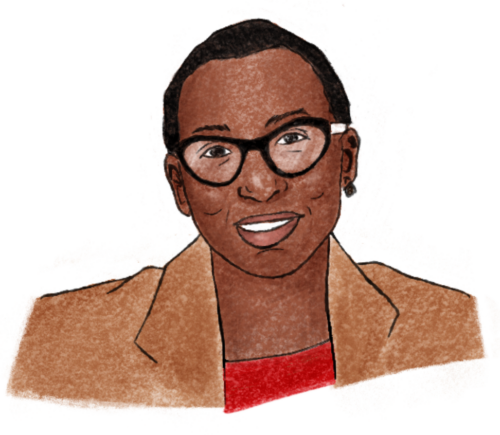
Let there be no mistake: Claudine Gay made mistakes. Her 2023 Congressional hearing on antisemitism was, by all intents and purposes, a catastrophe, and her subsequent plagiarism scandal, though more accurately described, in my view, as a political witch hunt, was a low point for the University. That much we can all agree on.
Billionaires bawled, Congress members signed letters demanding her resignation, and the media was in uproar. I wonder why this choir didn’t sing when it came to former University President Larry Summers. Jeffery Epstein’s “Wing Man,” Summers, who had already been embroiled in controversy following sexist comments in 2005, was allowed to slip out of the spotlight quietly. No lights, minimal cameras, little action.
He never faced coordinated political pressure, and the University’s donors didn’t shrink away as they did when it was Gay’s neck on the chopping block. I wonder why. The differing reactions to Summers and Gay highlight a pattern of selective outrage and responses to wrongdoing that respond not simply to misconduct but to the identities of the individuals involved.
Many would point to the most obvious differences between the two as explanations for the divergent reactions. Visual factors like race or sex are convenient narratives the media often jumps to, and while those things definitely played a part, the deeper explanation lies in priorities and perceptions.
That being said, the racial and gendered subtext in the treatment of these two public figures cannot be ignored. Summers, the white, former Chief Economist at the World Bank, President of Harvard, and Treasury Secretary with deep ties to the elite, was given time and institutional patience. Gay, a black woman who had just ascended to one of the most prestigious academic posts in the world, doing so amid a broader conservative backlash against DEI initiatives, was offered none of that grace, despite the University’s initial declaration of “unanimous” support.
This is yet another example of the double standards women and people of color face every day. We can’t afford to fail because there are no safety nets, and even when they exist, they seem to have holes just big enough for women and people of color to fall through. When mistakes by powerful white men are chalked up as faux pas, and mistakes by Black women are treated as incompetence, the pattern becomes hard to miss.
Still, the differing reactions go beyond what stands out to the naked eye. They reveal something about moral outrage and collective priorities. Gay’s lapse of judgment during her congressional hearing was treated as a crisis of immense proportions. You would have thought, from the number of tweets from a certain divisive billionaire Harvard alum, that she had committed an unforgivable act. In reality, her comment was a reactionary, albeit regrettable, answer that was promptly contextualized.
What is unforgivable is the lack of response from the institutions and voices that claim to stand for moral clarity and accountability. The issue is larger than Summers alone; it starts from the top. It is telling that our nation’s President labeled the Epstein files a “hoax,” choosing partisanship over institutional integrity and justice for the victims, many of whom were children.
The President would rather play politics than pursue potential further accountability for those unprotected by status. It’s a damning reflection of where we are as a country. We chose this.
It should be noted that Summers has no allegations of criminal wrongdoing regarding his connection to Epstein. This distinction is important because my point isn’t to manufacture guilt by association but to critique the asymmetry of scrutiny. The lack of scrutiny on Summers’s relationship with Epstein was disastrous from the start.
The University also categorically made mistakes in its handling of Epstein and his relationship with Harvard. Epstein was convicted of sex crimes in 2008, yet was given an office by the university in 2010, which he visited more than 40 times. Were there no alarm bells? It wasn’t until 2019, when the full scope of his crimes became public, that the University opened an investigation into its relationship with him.
Even in 2008, it wasn’t as though his conviction was a secret; he was a registered sex offender granted access to Harvard’s resources. This wasn’t an oversight but gross negligence. When Epstein’s crimes became impossible to defend, only then did investigations begin. Eleven years too late, long after the damage to his victims had been done.
That’s the real indictment; that’s what we should be outraged about. This is not to trivialize Gay’s missteps, but she erred, apologized, and contextualized her comments almost immediately. Summers, on the other hand, maintained a relationship with a registered sex offender and failed to express his concerns early on.
Though Summers apologized for what he described as a “misguided decision to continue communicating with Mr. Epstein,” this apology only came after his email correspondence was revealed to the public. Why is it only now that he feels “deeply ashamed” in the face of criticism? Where was his shame when he decided to prioritize a personal friendship over the standards expected of the positions he held?
This idea of politics over protection is especially relevant to the Harvard student body. We, as students, are the people unprotected by status or tenure, and we should be able to study in a space where those in power aren’t tempted to use it for their gain at our expense.
Institutional hypocrisy doesn’t just undermine the University’s principles; it actively erodes trust. When the University applies its own accountability measures unevenly, it teaches its students that protection and university support are conditional and that speaking out comes with risks. If there is uncertainty around the systems set up to safeguard students, it breeds a culture of silence in the face of misconduct. We have a right to know that no matter our status, we are all treated and protected the same way.
Summers’s life has been marked by the best of times and the worst of times, but there will be another Larry Summers; there may never be another Claudine Gay. Men like Summers can stumble and be replaced. Women like Gay must work twice as hard to reach the same positions, and when they fall, the world takes notice, and they fall twice as hard. We can only hope that in the future, wisdom prevails and foolishness is held to account, so that our “best of times [and] worst of times” become lessons learned, not realities repeated.
Noah Basden ’29 (nhbasden@college.harvard.edu) doesn’t know enough Dickens for the references he tries to put into his pieces.