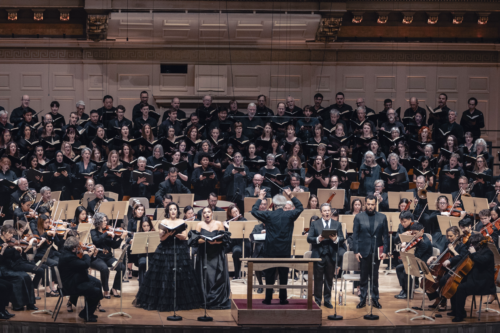
Verdi Requiem, an Unforgettable Experience
Graphic by Christiana Zembrowski

Photo by Paul Mardy
On the afternoon of Nov. 23, I joined over 2,000 people in Fenway’s Symphony Hall to hear the Boston Philharmonic Orchestra take on legendary Italian composer Giuseppe Verdi’s “Messa da Requiem.” The colossal venue went silent as Benjamin Zander walked out to begin his pre-concert talk. Zander, who came to Boston from England in 1964 on a Harkness Fellowship to study at Harvard, has since become a local fixture, founding both the Boston Philharmonic Orchestra and the Boston Philharmonic Youth Orchestra.
Before the music began, Zander spoke for 45 minutes about what the audience would hear, explaining how Verdi’s intervals build emotional meaning and how the Requiem has moved listeners for nearly 150 years, both secular and religious. His reverence carried into the next day, when he welcomed me into his home, opened his color-marked score, and revealed just how much care and preparation go into helping newcomers and seasoned listeners feel the piece’s full grandeur.
“The Verdi Requiem is one of the greatest pieces of music, one of the greatest works of art created, and although it is a piece about death, it leaves you with a great sense of courage and lust for life,” Zander told the Harvard Independent. “The music is full of love of life, varied and powerful and tender at the same time. Everybody comes out joyful.”
Verdi’s “Requiem,” a vast musical setting of the Catholic Mass for the dead, has a history as grand as its sound. Inspired by the 1873 death of writer Alessandro Manzoni and an earlier failed plan for a joint memorial mass for Rossini, Verdi ultimately composed the entire work himself. Though built on liturgical text, the piece centers on the biblical Day of Judgment, using musical drama rather than doctrine. A non-believer, Verdi treated the liturgy as shared emotional language, channeling fear, longing, hope, and our confrontation with mortality.
When I walked into Symphony Hall with no knowledge of this history and unable to read a single note of music, I was curious about what an hour and a half of Verdi would sound like in a space that grand. From above, the hall unfolded like a carved wooden bowl, holding a stage packed with players and singers. When Zander concluded his talk, the warmth in his earlier explanations shifted into something more electric. The room grew still as Requiem—the first of the seven movements—began, and the chorus murmured the opening line: “Requiem aeternam,” Eternal rest.
The Movements
The iconic “Dies Irae” movement delivers the Requiem’s first major rupture. The bass drum hit with a force you could feel in your chest, strings plunged downward in a rush, winds added piercing intensity, and the chorus erupted in terrifying cries—all amplifying a sense of helplessness before something immense. Zander had warned that this music was meant to frighten 1870s audiences; even today, it still does.
One of the most moving moments in the “Dies Irae” came with the “Recordare,” the duet between mezzo-soprano Daniela Mack and soprano Ailyn Pérez. Their voices rested beside each other with a balanced steadiness, bringing a rare calmness into a work defined by extremes. Pérez’s clarity and Mack’s warmth held the space with ease.
After the turbulence of “Dies Irae,” the Offertorio (Offertory) arrived as the first real point of release. Its three-part structure shaped the flow of the movement: an opening led by the violas and cellos with a gentler warmth, a middle section that shifted toward more unsettled harmonies, and a final return to steady calm as the lines folded back into one another. Winds and strings passed notes between them with ease, and the chorus entered with a firm, centered tone that carried cleanly across the hall.
Momentum changed again in the “Sanctus” (Holy), one of Verdi’s most intricate fugues, which came together with tight precision. Each entrance was crisp, and from the balcony it was easy to hear the layers build into a bright, full sound. There was a widening sense of space, a serenity settling briefly before the final movements.
The “Agnus Dei” (Lamb of God) unfolded as one of the most vocal-centered sections of the night, its shape carried largely by the two soloists, chorus, and woodwinds. Pérez and Mack led it in unison octaves, their voices matching with striking precision while the soprano line set much of the movement’s tone. The woodwinds supported them with a light, steady foundation, giving the paired voices enough space to project the clarity and focus the writing demands.
A quieter atmosphere settled in the “Lux Aeterna” (Light Eternal), shaped by the lower strings in a register that emitted an ominous, dark tone. The movement unfolded almost like a brief exchange, with mezzo-soprano Daniela Mack, tenor John Osborn, and bass Maharram Huseynov trading lines. Near the end, a lone flute lifted the texture with a hopeful line, soon joined by other winds, ending the section on something close to a high note before the Requiem’s final turn.
Everything converged in the “Libera Me” (Deliver Me), the longest and most dramatic part of the Requiem. A whispered opening restored the hall to silence, and Pérez’s entrance carried the same intensity she sustained throughout the evening. The chorus moved between near-silence and full sound, giving the movement its shape. The final rising line worked like a send-off, lifting upward without landing, echoing the text’s closing plea.
When the last sound faded, the hall stayed silent long enough that I wasn’t sure anyone would be the first to move. After the final note was played, it felt as if everyone’s breath had been carried out with that final cry, leaving the audience suspended in the same stillness the piece ends on. I had never felt a performance hold a room that firmly. Walking out into the November air, I kept replaying moments in my head—the weight of the “Dies Irae,” the calm of the Recordare, the final plea of the “Libera Me.” It was the greatest live musical performance I had ever seen, and I left feeling overwhelmed in a way I didn’t expect when I first stepped into Symphony Hall.
Zander often says that great music can reach anyone, even people who have never read a note on a page. After hearing the Requiem in a hall that was full and attentive, I understood exactly what he meant. The scale, the sound, and the unity of the orchestra, chorus, and soloists created an experience that made the Requiem feel both monumental and deeply human.
His approach to explaining music traces back to his time at Harvard, where Zander served as a tutor in Lowell House and enrolled in the celebrated course HUM 6: “Interpretation of Literature,” which analyzed poems in great depth. The class was taught by Reuben Brower, and his brother-in-law, Neil Rudenstine, would later go on to teach it as well. That detailed, line-by-line approach to close reading shaped the way Zander learned to think about musical interpretation. “I came here because I wanted to study how I could make what he [Rudenstine] does with literature, with poetry, relevant to what I do with music,” Zander said. “We would take a poem and look at every word, every inflection, and really get into the meaning of it.”
He also worked closely with students, including a young Yo-Yo Ma ’76, whose pianist at the time was Zander’s first wife. Those connections continued for decades, forming a long relationship between Zander and the musical community in Boston.
His work, recordings, and educational projects can be explored at benjaminzander.org, the site he continues to build as part of his musical legacy.
The full performance is available to stream, and the Boston Philharmonic Orchestra and the Boston Philharmonic Youth Orchestra have more concerts scheduled throughout the season. Details, recordings, and upcoming dates can be found at bostonphil.org.
Philipos Alebachew ’29 (philiposalebachew@college.harvard.edu) will add this piece to his Spotify rotation.