The Nature of Change
Graphic by Neshama Ryman

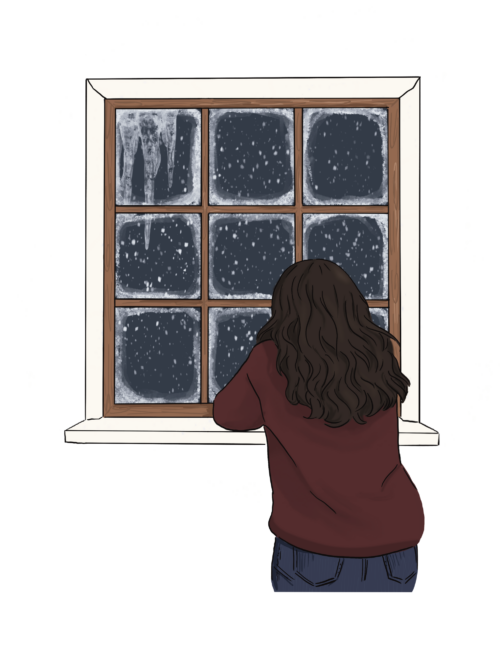
When I landed at Los Angeles International Airport this past December, I immediately noticed the way that Southern California smelled. As the automatic doors slid open with a hiss, I was hit with a wave of nostalgia—as well as a literal wave of hot, dry air. Growing up in the Greater Los Angeles area, I am well acquainted with this wind. It gives me nosebleeds in the summer, static shock on my clothes in the winter, and perpetually dry skin. Yet, it was ineffably pleasant. As the sun bore down on me and I itched to take off my sweater, I realized I missed the air that I had never noticed before—smelling so nice, so clean, so much like home.
Over the next four weeks of winter break, the daily high temperature reached the 80s—although this does not happen often in early January, this heat was certainly not unprecedented. Cloudless skies shone above me as I took walks along the coast and in the hills. I listened to a lot of The Beach Boys and even regained a bit of a tan.
As winter break came to an end, I began to dread returning to a sun hidden behind thick clouds and brutal snowstorms back on campus. Putting on my winter coat that I had not touched in weeks, I was reminded of what my father’s cousin told me after hearing I had been accepted to Harvard. She lived in Cambridge for seven years while getting her undergraduate and doctoral degrees from the University. Having grown up in Florida, she felt homesick and miserable during Massachusetts winters. She warned me not to take seasonal depression lightly.
After returning home from my first semester at the College, I finally understood what she meant. Without being aware of it, I had slipped into a monotonous and gloomy routine at school. These past few weeks in California have made me happier, although the relaxed nature of an academic break is a confounding factor. Going outside is easy and soothing; I do not have to put on a hundred layers or worry about my hands going numb from the cold; it is not pitch dark a few short hours after lunch; I am not constantly chasing daylight hours. Life feels like life, not a fight for survival.
A vitamin D supplement cannot replicate the feeling of sunlight on skin. Maximizing sunlight hours cannot replace the feeling of grass under bare feet.
But years of living in indefinitely agreeable weather had denied me the experience of seeing change before my eyes. I grew up, changing into multiple iterations of myself, while my surroundings stayed stagnant.
I used to perceive change only through comparison: “It’s not as hot as last week,” “I’m taller than I was six months ago,” and “I like who I am more than who I was last year.”
Of course, change is incremental. People do not grow taller overnight, nor do they completely revamp their interests, personality, and values in the blink of an eye. Time has to elapse in order for us to determine whether or not something has changed. If the rate of change is distance over time, we cannot observe change if time equals zero.
However, watching the weather change in Cambridge, I came to realize how small that denominator can be—how change can occur imperceptibly. I watched as the days slowly slipped into autumn, then winter. The first yellow leaves were almost unnoticeable. Warmer colors crept into my peripheral vision and receded just as slowly as they came. Rain became a wintry mix. The only suddenness was the first snow, but even that accumulated, snowflake after snowflake, while we were sleeping.
As the seasons changed before me, a lot of things began to make sense, like the jazz standard “Autumn Leaves,” which I always thought was cheesy and overdramatic. Contrary to the vibrancy of stereotypical fall colors, I realized that autumn was indeed a time of mourning and heartbreak. I used to think that “Here Comes the Sun” was the most overplayed and overrated Beatles song, but after a month of 4:30 p.m. sunsets, I am sorry that I ever took the sun for granted.
When the skies become gray and frost covers the ground, our bodies change accordingly—circadian rhythms shift and serotonin levels drop. Undeniably, seasonal depression is more than just being in a bad mood; it is a physical reaction. However, the parallels between weather phenomena controlled by the Earth and the emotions controlled by our brains console me. Feeling melancholy during the winter is universal—people around me, people from centuries ago, trees, clouds, and the sun—we all experience it.
Living in four seasons has compelled me to be more conscious of my surroundings and of myself. Throughout the fall semester, I gradually acquired the sense that, day by day, I was changing ever so slightly. While the heat of home is nostalgic and comforting, it is also a physical reminder of the many previous iterations of myself that I left behind without realizing.
Seasonal depression, though miserable in the moment, reminds me that humans are inextricably a part of nature, despite trying to convince ourselves that we are not. In art from all eras and cultures, humans link their emotions to the fluctuations of the seasons and the mannerisms of nature. We construct skyscrapers, monuments, computers, vehicles that run on dinosaur bones—but we cannot conquer our minds in the same way we have conquered the landscape. When the trees lose their color, we cannot help but lose our color, too.
Ellie Guo ’29 (eguo@college.harvard.edu) is happy to be back in New England.