The New 2016?
Graphic by Clara Lake
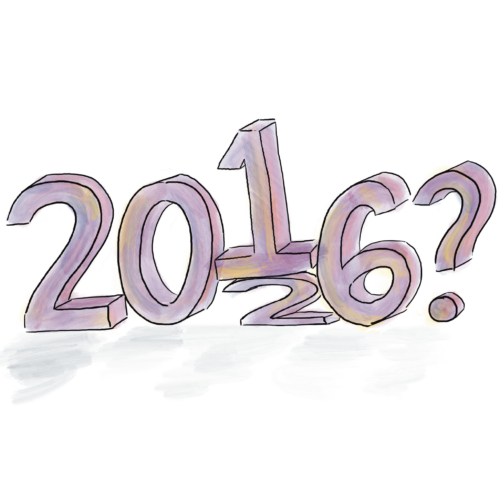
While many spent their winter break watching home videos on DVD players or sorting through old photo albums, this private nostalgia transitioned to public social media this new year. On Jan. 1, 2026, Instagram feeds were suddenly filled with the long-forgotten dog-ear Snapchat filter, quirky poses in front of Los Angeles’ iconic pink wings, and neon Triangl bikinis with black lining. It all looks… familiar?
As time moves forward, the internet seems to be travelling backwards, insisting that “2026 is the New 2016.” For years, social media has curated a “vibe” that people seem eager to recreate in the real world—one defined by low stakes and casual self-expression rather than polish or performance. With this, 2016 has now become less of a decade past and more of a feeling, representing a seemingly simpler time.
2016 belonged to a pre-pandemic world, before digital algorithms dictated taste, and before the line between burnout and productivity turned hazy. Truthfully, many of the Gen Zers attempting to relive this bygone era probably barely remember it—current college freshmen were only in second grade. Still, these internet trendsetters are desperate to recreate the past.
But the appeal of 2016 goes beyond specific trends or historical moments. Rather, it acts as an emotional shorthand representing a time before social media required the heightened self-awareness and strategic posts of today’s online climate. Perhaps this reveals a greater cultural trend. As a society, people are striving to return to an internet that felt communal instead of polarizing—blurry posts, unfiltered moments, and inside jokes posted for viewership from friends. There was little need to appear cohesive or impressive, and feigned “wellness” or “productivity” content was scarce.
This nostalgia has not appeared out of coincidence. Social uncertainty in the United States has been on the rise for almost a century, recently amplified by COVID-19 and election tensions. Political polarization, economic instability, and a media environment built on monetization has forced a societal change. Looking back to a time before social media was an algorithmic platform for comparison is less about wanting the past back and more about needing relief from the present. As online political discourse has become increasingly dominant, the same platforms once used for escape now amplify anxiety and division, pushing people to seek comfort not in civic engagement but in the illusion of a simpler past.
At the same time, the structure of the internet encourages this backwards glance. Platforms such as Instagram and Tiktok easily allow content to resurface. Trends no longer move forward linearly, but instead recycle through algorithms that favor familiarity over novelty. We’ve seen it with low rise jeans and headbands, and now an entire year. What emerges is not a replica of the past, but a filtered version of it, detached from its original context.
This loop creates an illusion that people are desperate to believe. Posts are reminiscent of an era that felt lighter, but what is being recreated is not the experience of 2016 itself. While feeds are once again filled with side parts, users are still crying over an unsatisfactory number of likes. Though the intent may be pure, the trend inherently adds to the distrust and insincerity it is trying to get away from.
Yet the desire to believe in this illusion is not naive, it is simply human. In an online setting that allows for disengagement through nostalgia, the relief that comes from these posts is real. Posting something unserious or outdated can feel comforting because it reintroduces familiarity into an environment with constant change. Humans are drawn to what feels recognizable, especially during periods of uncertainty, and the aesthetics of 2016 offer a shared cultural memory that feels safe to return to.
However, as difficult it is to separate social media from reality, 2026 can never truly be the new 2016. The political, social, and personal context that shapes the present cannot be undone. Nostalgia can gesture backward, but it cannot erase the conditions that made the past feel different in the first place.
This transition is visible for us as students, now on college campuses instead of lower and middle schools. In a space defined by achievement like Harvard, the longing for 2016 reflects a desire for lighter expectations. The resurgence of 2016 aesthetics can feel like a break from pressure, which is beneficial in theory. Still, it is a shallow attempt at an escape. Posting an unserious photo may offer momentary relief, but ultimately fails in challenging the systems that demand such optimization.
The trend declaring that “2026 is the New 2016” reveals more about the present than the past. The resurgence of 2016 aesthetics signals a collective yearning for connection and simplicity. While this year will never truly mirror such a time, the desire to believe it could speak volumes about what we have lost over the past ten years.
Over the past ten years, people have increasingly been expected to exist as a brand. Where the internet once allowed people to be combinations of interests and moods, it now asks us to flatten ourselves into named identities. Authenticity is diminished when people are curating their content for an audience rather than living authentically. Human nature is too complex to be reduced to labels like “granola” or “emo.” Watching people compress themselves into stereotypes should sadden us enough to inspire a shift.
True change does not come from posting an outdated filter, but from embracing people’s dualities and true self. The challenge, then, is not to resurrect the past, but to build a culture that no longer needs to escape into it.
Paige Cornelius ’28 (paigecornelius@college.harvard.edu) agrees that a cultural reset is overdue.