The Rot and Guilt of Winter Break
Graphic by Cara Cronin

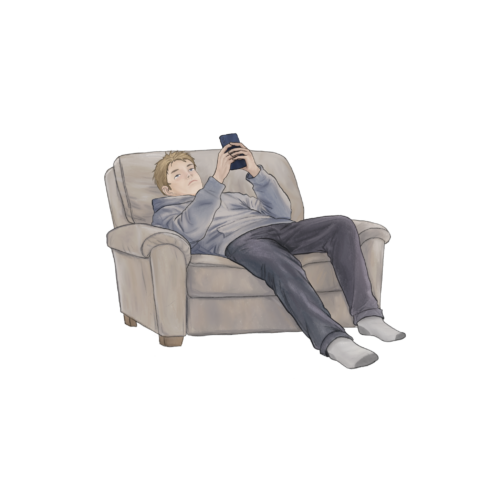
As the fall semester came to a close last December and exams piled up, it felt as though the world was crashing down. But there was one light at the end of the tunnel: Harvard’s January Term. Better known as J-Term, this period consisted of a luxurious six-week break with no homework, tests, or student organization commitments. I imagined my first J-Term as a time filled with family and friends, traveling, or working for a fraction of what I had just paid in tuition. As a first-year student, the concept of moving from secondary school’s standard two weeks of winter break to Harvard College’s six sounded blissful.
In the weeks leading up to this mid-December recess, I discussed the holiday with an upperclassman—how long and enjoyable it seemed. While he agreed that having a hiatus this long seemed gratifying, he was the first to introduce me to the term “winter break rot”: feeling like a corpse as the weeks pass. Winter break rot, as I would discover, was less about rest gone wrong, and more about the uneasy guilt of freedom without structure.
Now, having been through my first college winter break, I can attest to the truth of the term. In the frenzy of the last weeks of the semester, I kept my rest plans light, thinking I would finally be able to resume my life back home. This decision catalyzed the rot, not through laziness, but by stripping away the structure that had told me exactly who I was supposed to be every day for the past four months.
At Harvard, even on days when I didn’t feel motivated, I still had places to be. Rest felt earned because it came after something—a paper, a practice, a long day of socializing. At home, there was none of that. The only thing that “needed” to happen is whatever I decided needed to happen. That kind of freedom sounds amazing until it becomes reality. The days became wide open, and instead of feeling like an opportunity, it started to feel like a prison—a blank with no clear way to fill.
As time passed, the guilt set in. That was the part no one mentions when they joke about rotting. It is not just lounging around; it is the feeling of wasting time, wasting the chance to rest properly, and wasting the money paid to be in school by not doing something “productive,” even though the whole point of the hiatus is to not be productive for once. Somehow, I managed to feel guilty about something I was told to do. Spending time on social media, binge-watching TV, and sleeping late started to feel like crimes against myself.
A big part of it, I think, comes back to the “split life” problem. When I am at school, I live like a college student. I make my own decisions and schedule, my friends are close by, and my identity is built around the routines I have created there. But when I come home, it is like stepping back into an old version of myself that I have outgrown. My room is the same, my town is the same, my parents are the same, but I am not exactly the same.
Back at home, this independence did not disappear, but its meaning did. The same tasks felt mundane rather than intentional. My parents still ran the household. Meals appeared whether or not I planned them. The structure existed without my input. I was too independent to feel fully at home, but not independent enough to feel like I was not home. That in-between space was and remains odd. I wanted to feel productive, but the usual markers of productivity no longer felt earned. The guilt is not about doing nothing; it is about not knowing what counts as doing something anymore.
It did not help that everyone at home still had their lives running full speed. My parents worked. Siblings had their own schedules. Friends from high school were scattered. In high school, days off meant everyone was on the same calendar. But, being back at the same time did not mean living that same life now. So even when I tried to make plans, half the time it felt like trying to coordinate a reunion tour with people who have already moved on.
I found myself missing the smallest parts of college life—the things I did not even appreciate while I was there. Sitting in a lounge doing nothing with friends, just existing in the same space. The comfort of background noise, of people living their lives. At home, quiet is not always peaceful. Sometimes, quiet is just empty. And when the quiet stretches on, it becomes easier to do nothing at all, to rot. What starts as boredom turns into days spent waiting for something to happen, and that passivity is what makes the guilt sink in. I am aware that I chose not to fill the time, and that awareness makes the stillness feel like failure instead of rest.
So after having my gym session for the day, I questioned what to do. Trying to find something to fill the blank page with, something to point to so that I could say I did something today. Anything to spend less time doomscrolling. What made it worse was that the rot did not even feel restful. I was not choosing to relax; I was avoiding the discomfort of deciding how to spend my time. The longer I stayed in that in-between state, the more aware I became of it, and that awareness is where the guilt lay. I was not exhausted enough to deserve rest, but I was not motivated enough to do anything else.
But somewhere in the middle of break, I realized the goal did not need to be the complete elimination of the rot. The goal was to keep it from swallowing the entire six weeks. Looking back, I did more to feel proud about than guilty: mountain biking, skiing, playing hours of games with my 94-year-old grandmother, and hiking with my family.
While these moments did not fill the entire break, I spent time doing what I love with the people I love. This gap between semesters was not all that I thought it would be, but such is life. I have given myself a chance to sample bits of myself from high school and realize I am a different person now. After all, is that not the point of college?
So, while I definitely had days where I scrolled too much and felt guilty for it, I cannot say this break was a waste. I got to be home in a way I will not always get to be. The guilt does not mean I failed at break, just that I am learning what freedom looks like without built-in structure. I am heading back to campus more rested than I want to admit, more grateful than expected, and with a better understanding that, while the rot is very real, it does not define the whole break.
Aidan Gallagher ’29 (aidangallagher@college.harvard.edu) is sad to leave his dog at home, but so ready to be back at school with friends