Exploring Worldwide Hometowns: Campbellton, Canada
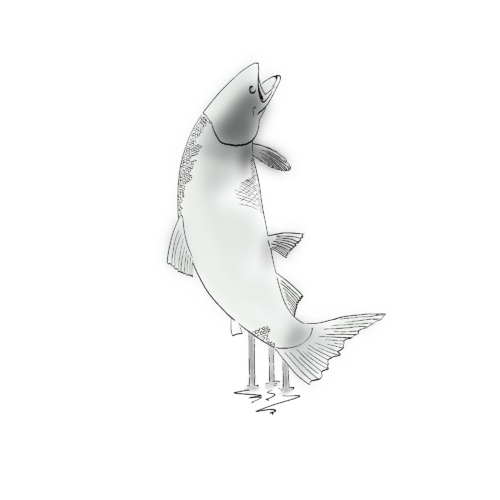
Graphic by Kerrie Zhu

When I step off the train, I am immediately struck by a certain stillness. Despite it being the middle of the day, barely any shops are open—unlike the rest of Canada, Campbellton still shuts down for Sunday church.
I’ve made this trip dozens of times, chaperoning my little brothers back and forth across the 20-hour trip from our dad’s home in Toronto to our mum’s house in Atlantic Canada. With the closest major airport a four-hour drive away, the train is the most efficient option. At nearly minus 22 degrees Fahrenheit, the cold bites at every inch of our exposed skin as we sprint from the platform towards the warmth of mum’s car.
As we jump in, “Sur Mon Épaule” by Les Cowboys Fringants plays over the radio. To my right, the snow-powdered Appalachian mountains (yes, the Appalachians go into Canada) rise against the horizon. One in particular, Sugarloaf, is painted with two white crosses commemorating a duo of young women who fell trying to climb it in the 1950s. To my left, icebergs float lazily across the Restigouche River before sinking into the grey Atlantic. The roads are lined with 10-foot-high chain link fences interspersed with signs warning of moose crossing.
Everything moves slowly here. Traffic moves 10 km/h below the speed limit: nobody is ever in a rush to get to their destination. Drivers routinely yield the right of way at four-way stops. There’s no such thing as a quick trip to Le Dep, the convenience store, without getting pulled into a 20-minute conversation with the cashier about the weather and how your parents are doing.
Walk into any local shop or restaurant, and you’re met with a standard “Bonjour, hi,” gracefully allowing you the choice between English and French for the remainder of the conversation. Between friends, a less formal “âllo” may be used before transitioning into chiac, our quirky English-French hybrid that would make a Frenchman wince. In New Brunswick, c’est totalement normal de mixer entre les deux langues. We speak French with an English accent and English with a French accent until we’re completely incomprehensible to outsiders.
Winters here tend to drag on. Clouds hang low in the sky, the sea is grey, and the sun sets at 4:00 p.m. As I step out of the car, I am immediately knee-deep in snow—and no, this is not an exaggeration. Good winter boots are a must. If this winter’s storm in Cambridge scared you, try being in Campbellton from November to April. Coal and wood-burning furnaces are, in most homes, the only respite from frostbite.
In the summer, though, the city comes alive, especially leading up to Aug. 15. La Fête nationale de l’Acadie is the biggest day of the year—Acadians are the French-speaking people on the East Coast of Canada, and no, we are not Quebecois! In August, tourists from across Canada congregate in Campbellton and other Acadian cities to celebrate our history and culture. The Acadian flag flies above most homes, French-Canadian songs are sung, and everyone gathers downtown to eat donair, the national dish of Acadie: round beef wrapped in a pita with mixed vegetables and donair sauce, which provides a sweet-tangy flavour.
Earlier in the summer, we celebrated Campbellton’s other renowned event: the Salmon Festival. Campbellton’s only “landmark” is a statue of a salmon because fishing is our biggest historical industry. “SalmonFest” is the only ten-day stretch of the year when the city’s only hotel is completely booked out. Despite the name, the festival itself offers few activities related to salmon, instead resembling a typical small town carnival—live music, comedy shows, dirt bike expositions, and bilingual children’s events.
Aside from these two festivals, though, Campbellton is far from a tourist destination. Last summer, I wanted to go to Victoria’s Secret to buy a new swimsuit. The only problem? The closest Victoria’s Secret to Campbellton was in Maine—more than a 10-hour drive away. Like many small towns, we lack all but the most basic chain stores and a few local businesses. Without the bustling malls and restaurant scenes of bigger cities, if you’re not a nature-lover, Campbellton is not for you. In the summer, kids ride dirt bikes and ATVs through the mountains or sneak on private beaches, where my four-year-old sister has a habit of trying to poke at washed-up jellyfish. In the winter, we ski, snowboard, or taunt other kids with the threat of a snowball fight.
Of Campbellton’s approximately 6,000 residents, most are young children or retirees. Young adults tend to flee to bigger cities in New Brunswick, like Fredericton or Moncton; to hubs like Toronto or Montréal; or, like me, out of the country entirely. Those who choose to stay are met with the options of working for the government or the local cannabis plant—some even start their own businesses.
Walking through my front gate, I’m immediately greeted by my brother’s pet ducks, Ham and Cheese, and our 160-pound sheepdog. My half-sister has gotten even bigger since the last time I saw her, somehow, but my mum hasn’t changed much.
Despite its flaws, going home feels like a sigh of relief after the bustle of Boston living. The stillness in the air permits me to slow down: nothing makes for better meditation than watching the Atlantic waves crash against the rocky beach.
Lucy Duncan ’28 (lduncan@college.harvard.edu)would give an arm and a leg for a proper donairin Boston.