Strategy and Uncertainty: Inside the U.S. Response to Iran
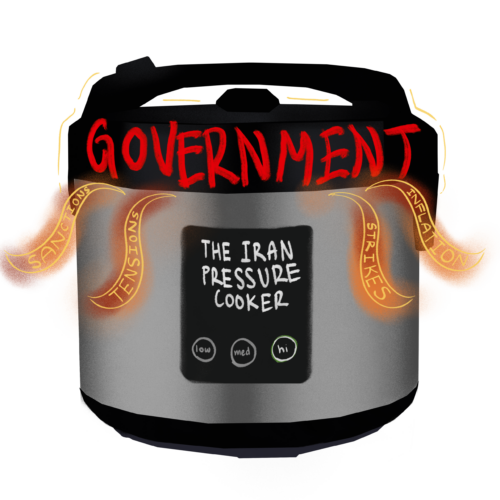
Graphic by Justin Ma

On March 10, the John F. Kennedy Jr. Forum at the Harvard Kennedy School hosted a conversation with former Deputy U.S. Special Envoy to the Middle East Morgan Ortagus, moderated by Institute of Politics Interim Co-Director Ned Price and Harvard Undergraduate Iranian Association President Bahar Moradi ’27. The discussion centered on the Trump administration’s recent strikes on Iran, examining the strategic rationale behind American military action, evolving nuclear threats in non-allied nations, and the broader question of stability in the Middle East. Over the course of the evening, Ortagus offered a defense of the administration’s approach, framing the conflict as the culmination of decades of tensions.
Moradi opened the conversation by contextualizing the unfolding crisis in Iran, emphasizing both the Iranian economic collapse and the human toll of its government’s response.
“Within days, protests had spread to over 100 cities and transformed into the largest anti-regime uprising inside Iran since the 1979 revolution,” she said.
The protests Moradi referenced began in late December 2025, when a sharp collapse of the Iranian rial and soaring inflation triggered demonstrations led by shopkeepers and merchants in Tehran before spreading across the country. What began as an economic revolt soon evolved into a broader political uprising, with protesters demanding systemic change after years of repression and declining living conditions.
In response, the Iranian government launched one of the deadliest crackdowns in its history, deploying security forces, shutting down internet access, and using violent force against demonstrators. These tactics resulted in thousands of deaths and tens of thousands of arrests. The unrest unfolded alongside rising geopolitical tensions, culminating in U.S. and Israeli strikes on Iran in late February 2026, further intensifying both domestic instability and regional conflict.
Ortagus framed the strikes not as a reaction to a single moment, but as the culmination of decades of conflict. “People tend to forget that just in the past few years, Iran has been openly engaging in acts of war against the United States,” she said.
She pointed specifically to recent threats against U.S. officials. “During the Biden administration, the Iranian regime did something unprecedented, which is they were plotting to kill and assassinate on American soil both former and current administration officials,” she noted. “They were actively plotting to assassinate President Trump during the campaign … and those are, of course, acts of war.”
U.S. officials have identified concrete evidence supporting these concerns. According to prosecutors, an operative from Iran’s Islamic Revolutionary Guard Corps was tasked with recruiting individuals to carry out the assassination in November 2024, though the plan was ultimately foiled by law enforcement.
For Ortagus, the justification for the strikes came from a broader regional pattern demonstrated by Iran. “They have been the cause of tumult and chaos in the region,” she said. “If you look at every country that has had to endure the Iranian regime and their negative influence, look at Yemen, Iraq, Lebanon … you look at failed state after failed state.”
Over the past few years, Iran’s influence across the Middle East has often operated through allied armed groups, deepening instability in neighboring countries. In Lebanon, Hezbollah—long backed by Tehran—has functioned as both a political party and an armed force outside full state control, dragging the country into repeated conflict with Israel. In Yemen, Iranian support has strengthened the Houthis’ military capabilities, allowing them to project force well beyond Yemen’s borders and disrupting shipping in the Red Sea.
The conversation then shifted to one of the most contested justifications for the strikes: Iran’s nuclear program. Pressing Ortagus, Price questioned inconsistencies in the administration’s messaging and the urgency of the threat.
“The one [justification] that we seem to hear most frequently from the administration is a nuclear threat—the same nuclear threat that nine months ago was totally obliterated that we heard over and over again from the President,” he said. “And within the past couple days, people … have now been saying they were days, hours away from having enough enriched uranium for a nuclear weapon.”
In response, Ortagus argued that the administration’s claims referred to specific targets rather than the entirety of Iran’s nuclear capacity. “I think the President, when he talked about obliterating the Iranian nuclear program, I think it was specific to the sites that we struck, which have been, at least from the public estimate, rendered inoperable,” she said.
Still, she maintained that Iran’s broader ambition remained unchanged. Rather than signaling a shift in strategy, she suggested the regime’s actions followed a familiar pattern of rebuilding after setbacks. “It’s not a surprise to me that the regime spent their time after the 12-day war reconstituting their ability to try and get to a nuclear weapon … that’s been their modus operandi for decades.”
The issue ultimately reflected a deeper set of priorities within the Iranian government. “The Iranian regime has consistently put the needs of Hezbollah and Hamas and the PMF in Iraq and ballistic missile and nuclear weapons production over the needs of their own people,” Ortagus explained.
Beyond strategic and military considerations, Ortagus also framed the conflict in human rights terms, shifting the focus from state-level threats to the lived realities of ordinary Iranians under the regime.
“We have to remember that their principal threat is to the beautiful Persian people of Iran who do not deserve to live under tyranny,” she said. “I think some of the bravest people in the world that I’ve encountered are these young women in Tehran that will stand up for their right to simply show their hair and to be heard and to be accounted for.”
The protests Ortagus referenced are part of a broader record of resistance led by Iranian women over the past several years. Following the 2022 death of Mahsa Amini while in police custody for allegedly violating Iran’s dress code, women across the country removed their hijabs in public, cut their hair, and took to the streets in one of the largest protest movements in decades. Human rights organizations estimate that hundreds were killed and thousands arrested, underscoring both the risks of dissent and the central role women have played in challenging the regime.
Ortagus also emphasized that the administration viewed the strikes as limited in scope and distinct from past U.S. interventions in the region. “Their objectives are very different from the Iraq War … there is no intention by this administration to have a prolonged multi-year campaign like we saw in Iraq and Afghanistan,” she said. “The president sees this as removing a threat, especially the threat from the Iranian Navy, from ballistic missiles.”
The conversation ultimately turned to one of the most uncertain questions: what comes next for Iran’s leadership. Moradi pressed Ortagus on whether the administration’s vision for change was realistic.
“Just yesterday, during a press conference, Trump floated the idea that a leader from within the regime would be the most ideal future for the leadership of Iran,” she said. “But given that the nuclear program as well as crackdowns on innocent civilians has been deeply embedded in the regime’s survival strategy for decades, is that realistic—or is he essentially asking for a transformation that the system itself cannot really produce?”
Ortagus responded by drawing a clear boundary around the administration’s stated goals.
“The President and the administration … would say the next leader of Iran—and whatever the new regime looks like, if that happens—is up to the Iranian people,” she said.
At the same time, she cautioned against the idea that outside powers can engineer local political change. “All politics is local … and I don’t think the West imposing leaders in the Middle East is going to work,” she said, pointing to past failures in Iraq and Afghanistan. “There have been a lot of lessons learned … about our ability to reshape governments and societies.”
Nashla Turcios ’28 (nashlaturcios@college.harvard.edu) writes News for the “Independent.”