Cystic Stories and the Need for Faith
Graphic by Sarahluna Sassine

Describing my gap year as an annus horribilis is cruelly ironic, but given the circumstances surrounding it, it is an accurate reflection of what was the most tumultuous year of my life.
The phrase annus horribilis itself was brought to prominence by Queen Elizabeth II in her own reflections on the year 1992, which she described as a year that she wouldn’t “look back [on] with undiluted pleasure.” Similarly, 2024 was not a year that I will look back on with “undiluted pleasure,” and yet, I rediscovered something within myself that almost made the months of pain worth it. As much as my journey of faith has been transformative for me, I would rather have done anything other than two major surgeries and months of recovery to get to my current point.
I like to think doctors work very hard on their poker faces, not allowing themselves to reveal the emotional weight of the news they are about to present to their patients. So, imagine my surprise when, following a routine check-up the week before I was to begin my freshman year, I wasn’t met with the typical doctor’s poker face. I will say, there’s nothing like being diagnosed with an extremely rare congenital cyst that’ll get you to sit up straight in your chair—a luxury I wouldn’t be afforded for eight months following my first surgery.
This isn’t meant to be a sob story, but a story of what was gained, not lost, over my leave of absence.
After four official days on campus, I was back in the hospital. I like to think that for my short time at the College, I—like Bill Gates and Mark Zuckerberg—should be able to claim the illustrious title of a “Harvard Dropout”… or maybe not. Humor aside, I want to illuminate something more serious in this piece: an investigation into the case for belief in oneself and in the higher power during trying times.
I grew up around faith from a very young age. Before I really knew what Christianity was, I knew that at my dining table, before we could eat, there would be a few seconds of silence. You can imagine that, as a child, those few seconds preventing me from scarfing down whatever was in front of me were excruciating—yet I waited. I didn’t understand why, but it was just what we did. It wasn’t until I was in my roughest moments that the “why” was revealed to me.
My “why” was faith, and if I’ve learnt anything from this experience, there’s no need to go out and seek it. Faith finds you.
Not Christian faith, nor that of Judaism or Islam, nor any other specific religious group, but the belief in something greater than yourself. It finds you in your weakest moments, when you are on your knees, about to wave the white flag. It is in these moments of near surrender that its invisible hands reach out and lift you from the depths of despair.
I distinctly remember the day its hands came and lifted me. They did not find me in the pews of my local church, but alone in the early morning hours at Mount Auburn Hospital. At this point in my recovery, I was practically bedridden, unable to walk without intense pain or the assistance of a walker, and generally hating life. To add insult to injury, I was woken up nightly at 1 a.m. for pain management medication, and by 3 a.m., the elderly man I shared a wall with would begin the ritualistic swear-filled bellows of his discontent with his treatment. Suffice it to say, I was not sleeping a lot or doing a lot of anything for that matter.
It was during one of these sleepless nights that faith found me. I describe it as my “get up and go” because it literally was. I decided, midway through one of my neighbor’s rants, that I had to get better so I could walk out of this hospital and finally get some rest. I had to believe I would get better for it to happen, and it worked. I prayed to have the strength to get up the next morning for my walk and walk just one more step than the day prior, and every day, I would. There were nights when I’d already hit my maximum pain medication limit, and at that time would, unashamedly, cry my eyes out. Nevertheless, by the next morning, I’d be up getting my steps in.
I eventually did leave the hospital on my own strength—albeit with a cane replacing my walker and about 30 pounds lighter than I had been before I got sick—by believing in something greater than myself that got me there. Perhaps I just tell myself that it was faith that did it, whereas the reality could very well have been the sheer exhaustion of hearing my resident geriatric scream for the umpteenth night in a row (I am convinced that he decided that nobody was sleeping if he wasn’t, and every night I’d lie awake—not communicating with God, but with the better part of my conscience that resisted getting up and giving him a piece of my mind). I choose to think it was the former rather than the latter.
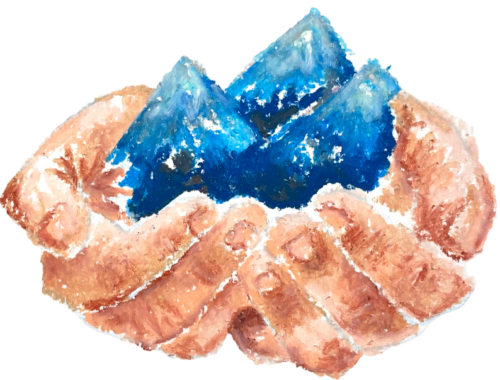
The Bible speaks of the power of faith in Matthew 17:20 when Jesus said to his disciples: “Because of the littleness of your faith; for truly I say to you, if you have faith the size of a mustard seed, you will say to this mountain, ‘Move from here to there,’ and it will move; and nothing will be impossible to you.” The essential message I take from this is that you don’t need a lot of faith to do a lot with it. Belief in anything can result in changing everything.
So, I implore you to plant your mustard seed and tend to it. Grow a garden of faith in whatever you believe in and then show up for it. Champion the causes that are near to you, be the first mover, and others will follow. What you believe in matters far less than the fact that you believe in something at all.
I left the hospital and left behind the most traumatic moment of my life so far, with no particular wisdom gained but this: a mustard seed is enough. It was enough to get me back on my feet, out of the hospital, and to college within a year, and it will be enough for you, too.
One additional piece of essential wisdom: catheters are not your friend … just saying.
Noah Basden ’29 (nhbasden@college.harvard.edu) wants to thank his Cambridge family for all the support throughout his illness.