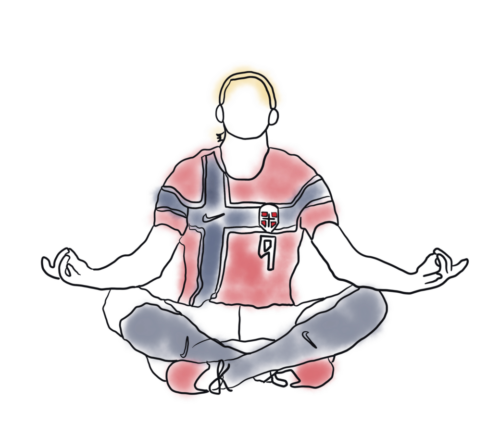
The Striking Viking: How Erling Haaland Became the Face of the World Cup
Graphic by Amelie Lima

Every four years, the FIFA World Cup elevates players who somehow become bigger than the tournament itself. The spotlight usually belongs to a seasoned veteran like 39-year-old Argentine Lionel Messi or a hot new breakout star like 19-year-old Ivorian Yan Diomande. It is more difficult for someone to capture the world’s attention through sheer force of personality.
This summer, the world fell in love with Norwegian striker Erling Haaland. By the end of Norway’s improbable run, his speed, strength, and precision felt almost beside the point. Standing at 6-foot-5 with long blond hair and the build of a Viking warrior, one would expect Haaland to be known simply as an intimidating striker. Instead, he gained 32.1 million social media followers and was dubbed a “golden retriever” and internet boyfriend to all.
How, then, is it that millions of people, many of whom had never watched a full soccer match before, suddenly became passionate fans of Erling Haaland?
Haaland arrived at the World Cup as one of the world’s most prolific strikers; he had built a reputation for himself as a relentless goal scorer at his club, Manchester City. Norway itself was hardly expected to dominate. The nation, after all, had not appeared on the World Cup stage since 1998, four years after Haaland’s own father represented the national team. For decades, Norwegian soccer had existed in the margins of the sport. This year, the team became impossible to ignore.
On paper, Haaland’s performance in the tournament was remarkable: he finished with seven goals, tying for the third-highest goal total at the World Cup with England’s Jude Bellingham, behind only France’s Kylian Mbappé and Argentina’s Lionel Messi. Norway as a team advanced farther than almost anyone would have predicted.
Had that been all, Haaland would be remembered as just another talented player who rose to the challenge during the World Cup. What transformed Haaland from an athletic star into a cultural phenomenon, though, was not anything that happened on the pitch—it was everything that happened off it. By the end of the tournament, his athletic performances felt secondary.
After Norway’s astonishing victory over Brazil, Haaland grabbed the drum and led the now-famous Viking Row celebration for his teammates and supporters. Days before, he had embraced Southern culture by posing in a cowboy hat and boots at Wild Bill’s Western Store in Dallas, Texas after Norway’s round of 32 win. Videos of the celebrations and his own playful social media posts began to circulate alongside his goals, and he suddenly became as much a meme as a highlight reel.
Norway’s fanbase swelled right alongside Haaland’s own popularity. Casual fans who could not have named a single Norwegian player a month earlier quickly found themselves cheering for the underdogs, painting their faces, and drumming along to the Viking Row from their living rooms. As the World Cup progressed, Haaland became not only the team’s star, but Norway’s greatest advertisement.
Much like most celebrities, elite athletes are often expected to project a carefully controlled image. Every interview sounds rehearsed, and every celebration feels calculated. Success can thus create a distance between professional athletes and the people watching them. Haaland, however, seems to operate in the exact opposite way: he is a character.
This authenticity quickly became Haaland’s appeal, and social media helped him reach an even bigger audience than the 1.5 billion viewers already watching the World Cup. After Norway eliminated Brazil, he posted a smug locker-room selfie captioned simply, “Well well well.” Days later, when Google added a Viking Row animation to searches of his name, he leaned into the joke himself, posting on the platform X. “One thing to do today… search my name on Google,” he wrote. Rather than projecting a polished, serious image, Haaland was more than happy to engage with the internet’s excitement around him.
His response to the attention was just as lighthearted and playful off the field. When asked about his growing popularity in America, Haaland, embracing the moment and energy instead of trying to sound calculated, answered simply: “I like the Americans.” “I think they are kind of hilarious as well. They are funny. So I like the way they are,” he said.
The World Cup has always been about more than soccer. Every tournament leaves behind something that defines it. In many ways, that impression often says more about the world watching it than the game itself. Sometimes it is pure skill. Sometimes it is resilience. This summer, it was joy.
Norway’s run eventually came to an end, but by then the results did not seem to matter. Long after people forget exactly how many goals Haaland scored or which round Norway reached, they will remember his grin after another celebration, the drums that echoed through the crowd, and the sight of one of the tournament’s best players also being the one having the most fun. To Erling Haaland: Americans like you too. We like the way you are.
Adin Hootnick ’29 (ahootnick@college.harvard.edu) hopes world leaders will bring Haaland along to lead peace talks.