How Ducks Avoid Drowning
Graphic by Tess Harris

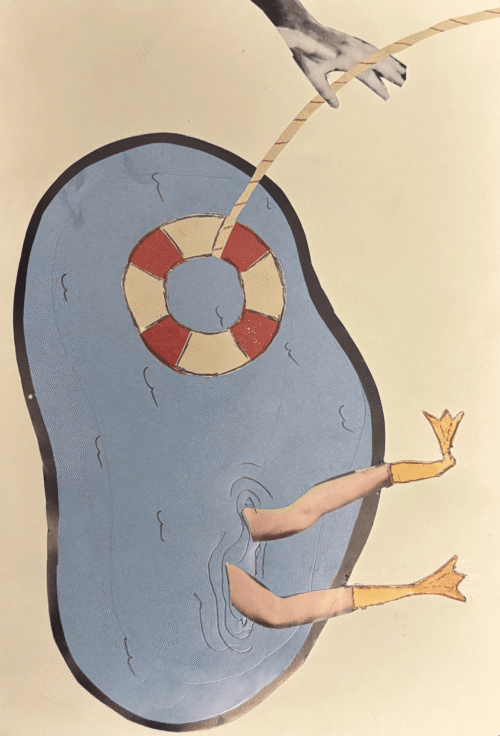
What does it feel like to drown? It takes a while for the realization to hit—you might not reach the surface again. Eventually, you gain awareness that the subtle waft of air flowing in and out, a sensation you once took for granted, is now gone. Contrary to your instincts, breathing deeper doesn’t help; it only makes the choking worse. Fear has yet to sink in. You flail relentlessly, not even aware that you should be trying your best to get someone’s attention. You open your eyes (stupid), hoping that if you can see someone, they will see you too. All the while, your chest grows heavy with the water filling your lungs, but you never think to stop inhaling—in any other situation, no breathing means no living. Still, that panic and utter loss of control extend beyond the water.
The first time I nearly drowned, I was seven years old. We had only been in the small Massachusetts town for about a year, eager to build community and make new friends. A neighbor had invited my sister and me to her pool party, the most popular gathering on our street at the time. All the neighborhood children attended every year. I wore a pink polka-dot bathing suit, one my mom had bought for me, long before I started to hate the color pink. My sister was really the one who knew people there; I was just her annoying little sister, desperate to play like mermaids and hunt for plastic torpedoes. I lay in the sun, holding onto a pool floatie, trying to tan my “untannable” skin like all the high schoolers. The next second, I was under. I felt it, the epiphany that I was going to die. I could not reach the surface no matter how hard I tried. Eventually, I closed my eyes and admitted defeat.
I did not pass out, and obviously, I did not die. My somewhat absent-minded sister had realized that I was, in fact, drowning, and she pulled me up with the help of a friend. I started crying, my face red with embarrassment. I thought I would be the laughingstock for years to come, the silly little girl who had gone in the water without knowing how to swim.
That’s the problem with this story, though. I did know how to swim—years of lessons at the YMCA and vacations at pool resorts proved it. And yet, I was so close to drowning completely. That humiliated me most: the idea that something I knew so well had failed me, that it wasn’t enough to keep me afloat. I have not drowned since that day—a major success in my eyes—but perhaps that is because now I try not to go too deep in the water.
Since I was little, I have wanted to be perfect, in every way possible. That is probably why even my swimming mishap affected me so deeply. I felt no pressure from my family or friends. This was an entirely personal mission. I often made mistakes, but I saw perfection as a goal to reach, not a state of being, so I was completely fine with setbacks. I had big dreams of being a top student and getting into my dream schools, and I put in the effort to get there. By the time I made it to Harvard, success felt more like an expectation than something to revel in.
At a place like Harvard, the feeling that you are falling behind is unrelenting, and from the start, it is all too clear why. It feels like some people are built to manage it all, born to handle the never-ending pressures. As a first-year, I experienced imperfection across the board—academically, socially, physically, and mentally—and yet I was doe-eyed and hopeful that the next week, the next semester, would offer a chance to achieve the goals that once came so easily to me. Now, barely a month into my sophomore year, I still find myself dissatisfied.
I posed this concern to my father when he came to visit me for brunch. Last year, I often felt as if I was drowning, and this year there has been some improvement. I am staying afloat, but now I feel stuck as the slowest swimmer. I told him how every day, no matter how much I accomplished, I could never feel satisfied because so much remained to be done. He shook his head and set me straight. At this school, there will always be someone above you—doing more, getting more opportunities, being better-liked, smarter, anything at all. It is all about personal progress. I pushed back because, while I was no longer trying to be perfect (that was feeling more and more like a pipe dream), I still wanted to feel accomplished. And I wanted that accomplishment to feel as easy as it looked for those around me and as easy as it had been for me before—though I suppose those were much gentler waters.
“How much do you know about ducks?” he asked me. The answer, naturally, was nothing. I raised an eyebrow. What he told me next has been spinning in my mind for days.
When you see a duck, it looks majestic. They are built for the water, after all, and seem like they float easily across the surface. But underwater, it’s an entirely different story. In his eyes, everyone here is a duck, paddling frantically with their feet all for some semblance of effortlessness and speed. That doesn’t change the fact that ducks sometimes slow down, take breaks, rest, and recoup. But they always paddle again.
Turns out, what I thought was my father’s original, sage advice is a phenomenon that originated at Stanford University. As the Stanford Student Affairs website explains, “The Stanford Duck Syndrome is the idea that students are struggling to survive the pressures of a competitive environment while presenting the image of a relaxed student, like a calm duck gliding across a fountain … We all go through ups and downs, and it’s important to acknowledge the obstacles and seek support rather than paddle furiously beneath the surface.”
While I deeply resonated with my father’s advice, I take issue with the way the phenomenon has come to be known. Ducks, despite their anatomical differences, are fundamentally made for the water. They don’t drown if they stop paddling. It is simply how they navigate their environment, and it’s not as if they are afraid to drown. I agree with what my father said—everyone here is a duck, and being a duck is a huge part of who we are. We always will be, and that is often how we got here in the first place. What matters most is being transparent and normalizing the fact that everyone can and will paddle. That is the way we support each other, not by writing off the concept as harmful. There is no “rather” here. Acknowledge the obstacles, seek support, and paddle furiously, trusting yourself to stay afloat.
I often think back to the first time I drowned. I wonder if I could have done anything differently. Perhaps I could have focused more on my balance instead of basking in the sun’s warm rays, or stayed closer to the deck instead of letting myself float to the middle, where the water was deeper. Candidly, I feel the same way about the metaphorical drowning of my freshman year. I used to think that the reason I sank was that everyone else was better suited to the environment, that I was not meant to be here. When my dad told me about this analogy, I was confused at first, but eventually I understood what he meant.
Living in regret gets tiring after a while, especially when you are so focused on how others are doing. The point of Floating Duck Syndrome isn’t that everyone is secretly hiding what it means to try, driven by a shameful fear of failure. Instead, the metaphor of floating ducks should stand for how everyone continuously puts in the effort needed to succeed in an environment you were made for, despite the ups and downs and shaken feathers. Any progress is a step in the right direction, no matter how far you paddle each day.
And the most important part of “duck”-hood? If I want to truly swim, I can no longer avoid the water.
Sucheta Srikanth ’29 (suchetasrikanth@college.harvard.edu) is comping the “Harvard Independent” and thanks her neighbor for the hazardous lesson.