Vive Les Étudiants
Graphic by Sarahluna Sassine

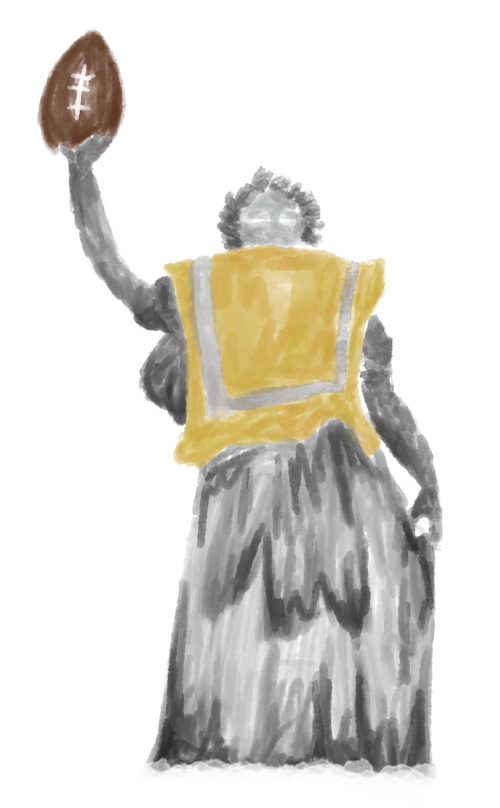
Flames, shattered windows, and riot police have dominated the media coverage of the recent protests sweeping France, particularly Paris. These acts have given the movement the unsavory but headline-grabbing label: riot. It is understandable why the media condemns, but pushes, videos of shops being looted, cars burning, and Paris seemingly in shambles. The coverage reinforces the vilification of a protest meant to disrupt everyday life. Furthermore, American interests have entered the stage during the first-ever regular-season NFL game on French soil.
The French student protests began on Sept. 17 at a high school in a Paris suburb, then quickly spread throughout the city and nation in solidarity. The protests have continued to gain national momentum and international attention. Students’ demands include educational improvements such as addressing staff shortages, overcrowded classrooms, deteriorating infrastructure, and Parcoursup—the online platform French students use to apply to higher education, which students say is confusing to navigate and unfairly favors some applicants.
These protests are not limited to the underprivileged areas of France. They extend beyond class, race, and immigration issues, and they are not solely a youth issue. Students mobilized these protests, but teachers, parents, public sector employees, mayors, elected officials, and other protest organizations, such as the Gilets Jaunes, have supported them.
Many Americans are already familiar with France’s long history of revolutionary action, but you do not need to go back to the 19th century to find precedent for these demonstrations. In May 1968, university students led what is now considered one of the largest and most disruptive protests in French history, and the movement still influences French revolutionary culture. The 1968 protests transformed social structures, government interference in social freedoms, and educational infrastructure. Most importantly, these protests united ordinary people across lines of division, pointing blame not at their neighbors, but at their government and the systemic frameworks of their society.
It is no mystery why so many are invoking the 1968 student protests today.
Yet most media does not cover the students’ demands; instead, it turns a vision of unity and mobilization into a picture of dystopian upheaval and destruction. By foregrounding looting, which is undoubtedly devastating for those affected, it shifts focus away from the masses’ agenda. This frames activism as radical and villainizes it.
American media has also covered the protests sweeping France. The widespread civil disruption has raised international safety concerns. Videos show tourists navigating the barricaded streets of Paris with suitcases in hand, orchestras being tear-gassed, and protesters being met with water cannons. Yet, for many American audiences, the unrest takes on another dimension as the beloved sport of football touches down on French soil for the first time.
The Pittsburgh Steelers and New Orleans Saints played the inaugural regular-season game in France on Sunday, Oct. 25. Leading up to the match, the game drew heavy press coverage, both promoting it and covering security logistics.
Amid protests, civil unrest, and the NFL game, French police have been stretched thin and implemented a weekend curfew. However, the NFL said it was confident in the event’s safety and did not expect to need broader resources.
Many pre-game events were disrupted or canceled, including the closing of the Paris “NFL House” and even major tourist attractions like the Louvre. Fans who hoped to attend events were left wanting, but many reported a positive time despite the unrest. These visiting fans’ experience has assured many that all of Paris is not, in fact, engulfed in flames.
The NFL is the world’s highest-grossing sports league. When the behemoth visits a city, it creates an economic boom, generating millions of dollars in revenue, thousands of viewers and visitors, and a positive host relationship with the city. Yet while the NFL brings millions in revenue to Paris, residents and students still struggle with high living and education costs.
The contrast between the masses and the international enterprise is stark, especially since the Stade de France sits in Seine-Saint-Denis, France’s poorest and youngest département.
With the closure of the NFL House, less commercial foot traffic circulated throughout the district—one of the hardest hit by the protests. While NFL expansion also aims to expand economies and relations abroad, businesses in marginalized districts are more likely to cater to tourists and viewers than to residents. Ticket prices ranged from €90 to €500, while over half of France earns less than €2,092 per month after tax.
Before the game, an American-based fan account dedicated to the Steelers released an AI video that quickly went viral on social media. The video slowly zooms into the back of a Steelers football player; a protester carrying the French flag ablaze runs through the foreground, while a group in the background bursts through a fiery storefront window towards a hijacked police van where another waves the French flag. In the background, a barricade and the Eiffel Tower are falling apart.
The scene, now posted by several football-associated accounts, is vivid and tells a story about how Americans perceive what is happening in France. When monuments, storefronts, cars, and streets are on fire, they provide a shock value. However, beyond the arson, a key aspect of these protests is the deliberate disruption of events. This disruption is meant to draw attention to their cause, but shock-value headlines and coverage benefit media corporations and fuel divisiveness.
Echoing the current protests, the 1968 French Open at Roland Garros also saw logistical chaos. Spectators and players struggled to reach matches, forced to find alternative routes amid fuel shortages. Photos from the 1968 protests also depict flames, overturned cars, streets filled with civil protestors, and police retaliation.
Yet now, when people look back on 1968, they do not see it as a disgraceful riot. They see it as a pivotal moment in French revolutionary history and an example of what civilian protest can accomplish.
The violence, looting, and burning on some fronts of the student protests do not directly align with the movement’s aims. Still, these actions often sit at the forefront of mass mobilization. However, there have also been large numbers of arrests and reports of police violence against the protesters. Classifying the protests as riots raises questions about which narratives are prioritized. Tourism is a vital pillar of the French economy, but the country also faces a national debt crisis. As American organizations like the NFL expand, they inevitably become entangled in French affairs, but they also offer economic stimulus. As these sectors converge, the student strikes highlight which interests receive institutional support and global media attention.
Student protests continue to gain international traction as civil unrest spreads across Europe. History has shown that united movements like these can be a formidable force for change. Ironically, the NFL game’s success amid the protests shows that everyday life in France is not as apocalyptic as the media makes it out to be. Yet instability and uncertainty around civil unrest can become a spectacle that distracts from the progress dissent has built.
Sophia Gonzalez ’28 (sophiagonzalez@college.harvard.edu) hopes French students can learn in equitable conditions and encourages readers to look beyond the headlines.