Christmas? Already!?When is it appropriate to start putting up the stockings?
Graphic by Nuala Mernin

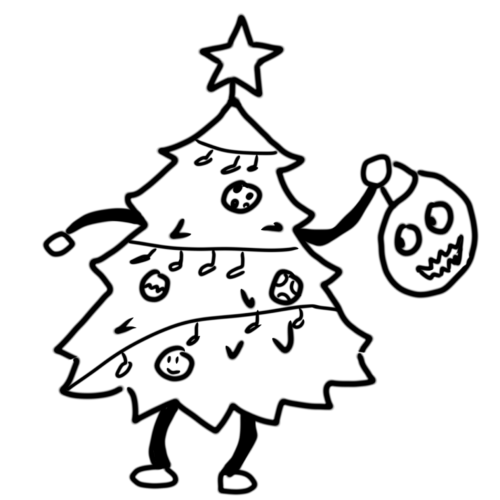
Every year, right as we turn from October to November, it seems as if everyone immediately forgets about the spooky season and catches a festive holiday fever … Here on Harvard’s campus, I remember walking through Brattle Street in late October and turning my head to see that MUJI had already installed a Christmas tree. Or take the quick switch in theme at LoveStruck Books & Cafe. Before Oct. 31, you could see witchcraft-inspired decorations: cauldrons, herbs, and ghosts. However, it felt like as soon as the calendar date changed to “November first,” it all turned, by its own witchcraft, into red-and-white candy canes, snow, pine trees, and presents. The CVS in Harvard Square hung up a letter to Santa Claus of Nov. 1 asking him to drive away the bats and spiders, and Santa took the request so seriously that he cloned himself and stood guard over the displays for the rest of the month.
I see it as quite problematic to prepare for Christmas and New Year’s starting the moment the calendar turns to Nov. 1. Sure, holiday cheer is a feeling most of us start to chase the second Santa Claus withdraws to the North Pole on Dec. 26. However, opening the basement boxes of twinkle lights and candy canes so early not only kills the mood and feeling of uniqueness of celebration, but it also exposes the impatience of society and overconsumption. Of course, end-of-December holidays are not just about “stuff,” but let’s not sugarcoat its manifestations in modern society.
The spirit of the celebration is the most important part of any holiday. When we think of Halloween, we immediately think about carved pumpkins, harrowing monsters, decorations with lights, candy corn, and intricate costumes. When we think of Easter, most envision a bunny and pastel colored eggs. Christmas brings visions of family warmth, sparkling evergreen trees, red and green ornaments, and, of course, a fireplace with stockings. This process makes one thing clear: curating the correct vibe is the key to a successful holiday, no matter if it is Kwanzaa, Christmas, Hanukkah, St. Patrick’s Day, Halloween, New Year’s, Eid, Diwali, Navaratri or your birthday.
However, it is hard to keep up when the so-called “holiday season” starts two months before the holiday itself. If the decorations are up at the beginning of November, and Mariah Carey’s iconic voice echoes from dorm doors, the vibe is great for a week or two, even for a month. But this excitement inevitably fades within a few weeks; what was once celebratory becomes mundane—and almost annoying. For most of us (excluding the die-hards who host Christmas in July), we somehow lose the drive of the holiday season everyone awaits with such impatience. How is it beginning to look a lot like Christmas when the leaves have not yet fallen off of most northern trees?
It seems to me that the reason is simple: people like Christmas a lot. This desire compels them to start celebrating earlier. As the days shorten and rain instead of solar rays blanket the darkening concrete, people crave Christmas magic. But autumn is not the time for “Frosty the Snowman.” What is left for winter then?
Thanksgiving is arguably the only American holiday that unites the whole family around the table with only the intention of expressing gratitude for the year and the people they love—a wholesome tradition. Cooking turkey with a myriad of sides and sharing it with the family is wonderful, and people travel great distances to spend the day with loved ones; I am sure many of you readers will be doing the same this upcoming week. But if we keep the accelerated cadence of the holiday season, Christmas decorations will adorn family room mantles before the turkey is defrosted. Thanksgiving seems less worthy of celebrating. Whether you value one over the other, Thanksgiving fades into the background of Christmas, devaluing an already underappreciated tradition that is actually quite beautiful.
In keeping with American culture, it would be remiss to ignore the mass consumerism that underlies this issue. For companies, any holiday or major event is a chance to make money, a pillar of capitalism. Best Buy and Cracker Barrel started selling Christmas merchandise in September; Hobby Lobby, Dollar General, Costco, Walmart, and The Home Depot started putting up Christmas collections in August! Even the U.S. Postal Service started “Operation Santa” on Sept. 14, launching the season early.
The holidays provide an opportunity to produce endless streams of themed merchandise: decorations, plushies, flavors, and aromas, depending on the field the company occupies. The longer certain time-specific themes trend and stay on the market, the more merchandise will be sold. If they don’t sell, the corporations could face major profit losses. It doesn’t take a genius to see that, for these businesses, it is advantageous to extend Christmas as much as possible; this gives people more time to buy the new trendy items. Still, this wears on consumers’ patience.
Yet, despite everything I said before, I do not believe that this commercialization is entirely bad. There are some benefits in starting the Christmas season early, including sales. Many stores run sales on major holidays like Christmas. This allows people to shop for gifts early without worrying that the delivery will be late. This also lets ordinary people save on basic household needs that are discounted.
Still, this shifts the timeline of the holidays. Go-getters fall prey to these early sales, stocking up on decorations and gifts while the weather is still in the high seventies to avoid high prices and long lines. And for those who want to dedicate their mid-to-late December to such preparations (as designed), shelves are picked over by mid-December, thanks to the large number of people who want to bring the magic of celebration early. Target holiday pajamas are on clearance by Dec. 20, and Old Navy is readying their spring collection before the ball drops in New York. The last-minute rush that often characterizes this holiday is now gone.
Thinking about celebrating Christmas early? The verdict is simple—don’t. It ruins the vibe; the drawn-out festivities feel like nothing special by the time the rest of us in society pull out our lawn reindeer. And Thanksgiving dinner will be overshadowed quite literally by the tree looming in the foyer. So as you drive past the glowing sleighs and snowmen staked into front lawns or catch a glimpse of discount ornament packs at your local supermarket, stop for a second, and remember Thanksgiving and the bliss of short-yet-rewarding holiday seasons. Don’t let the red-nosed reindeer overshadow the turkey … at least until the first (of December).
Anna Gunko ’30 (agunko@college.harvard.edu) is finally a member of the “Harvard Independent.”