The Price of Keeping the PeaceWhat Yoko Ono and Marina Abramović reveal about the exploitation of women.
Graphic by James Foss

I entered my “Women Creators in Music” class on Monday morning, excited to uncover female artists society has overlooked. Professor Brigid Cohen sat in the chair my professor usually occupied and was introduced as a musicologist and scholar who studies Yoko Ono. Ono is a singer, songwriter, and peace activist often discussed in relation to her late husband, John Lennon.
Cohen led our class in reenacting performances from Ono’s 1964 book, “Grapefruit,” which consists of “instruction pieces” meant to serve as forms of therapy or self-care.
My definition of art shifted as my peers and I played telephone and giggled while whispering into our peers’ ears. We then walked outside, each lighting a match and watching the flame disappear as the stick shriveled. The class discussed these experiences, noticing that turning the mundane into rituals can become a sensory pleasure.
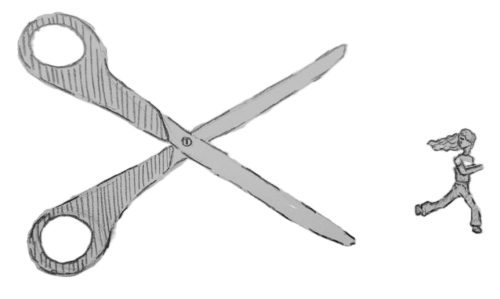
The next work of Ono’s was brought to the class’s attention, a piece we were unable to recreate due to both physical and emotional constraints. “Cut Piece” started playing on the big screen, and I sat in discomfort as a man walked up to Ono and cut off her blouse, revealing her sitting in her bra for the audience to watch. The piece brings up the tension of how women are expected to react to exploitation, and whether there is any truly liberating approach.
The directions for the performance, featured in “Grapefruit,” are as follows:
Performer sits on stage with a pair of scissors in front of him.
It is announced that members of the audience may come on stage—one at a time—to cut a small piece of the performer’s clothing to take with them.
Performer remains motionless throughout the piece.
Piece ends at the performer’s option.
What began as a simple invitation to participate in art became an unsettling demonstration of what people will take when another person offers control. Some audience members cautiously removed strips of fabric, while others were bolder, cutting off entire articles of her clothing. Notably, Ono remained still and silent as the performance unfolded, refusing to resist despite gradually becoming more exposed. Her silence is essential to the work, as it forces viewers to confront the consequences of giving others unrestricted access to another person’s body. In this way, the piece becomes less about Ono herself and more about the people who choose to exploit her vulnerability. Some audience members giggle as they snip, and these sounds of mockery and abuse become the soundtrack to this societal commentary.
Ten years later, Marina Abramović conducted a similar, though more extreme, experiment. In her 1974 performance of “Rhythm 0,” Abramović placed herself beside a table containing 72 objects, ranging from a rose and a feather to knives and a loaded gun. The objects were carefully chosen to include items of pleasure, pain, and even some capable of causing death. Abramović described the performance as “six hours of real horror.” The public cut her with a knife, drank her blood, carried her around half-naked, and eventually put a loaded gun up to her neck. Most significantly, when the demonstration ended and Abramović began moving, the participants fled.
Both performances challenge the notion that people are inherently good, revealing unsettling truths about human behavior. When given unrestricted power over another person, some individuals choose cruelty rather than compassion. In both pieces, not every participant engaged in harmful acts of mistreatment, yet they were complicit as bystanders. What started as small snippets for Ono or doodles on Abramović’s skin turned into more unthinkable acts that other audience members allowed to happen.
While both pieces point to broader patterns of human behavior, their creation and performance by female artists complicate the gendered aspects of social relationships. Although neither performance proves that women are uniquely vulnerable to cruelty, they reveal how these dynamics of power and exploitation reflect broader gendered expectations about women’s passivity and endurance throughout all of society. By placing their bodies at the mercy of strangers, Ono and Abramović exposed the ease with which a woman’s vulnerability can appear to others as opportunity.
Even more uncomfortable than watching “Cut Piece,” however, was Ono’s description of it. In an interview with the Museum of Modern Art, Ono explained that the performance was intended, in part, to reflect women’s shared experiences of mistreatment. “We’re all going through this, but don’t fight, let it happen,” she told Christophe Cherix, the MoMA’s chief curator of drawings and prints. She reasons that “by not fighting, we show them that there’s a whole world, which could exist by being peaceful.”
Candidly, I walked out of the room when this discussion began, overwhelmed with the tension of how women are expected to respond to the horrific events that they experience. I struggle to reconcile advice that seemed to conflict with feminist empowerment and such a moving performance, exposing the exploitation of women’s bodies. If women are already expected to tolerate exploitation, is encouraging them to endure it peacefully truly liberating?
Ono’s intent is not to limit women, but to draw on the Buddhist idea of giving, in which generosity does not depend on reciprocity. In this way, Ono creates a situation where the act of giving reveals the choices and desires of those who receive it. However, the message risks reinforcing the historical expectations that have constrained women’s autonomy. The expectation to create peace falls on the person being mistreated, suggesting that perpetrators can act without restraint while the victim must quietly carry the burden.
This is not to say that these performance pieces exemplify a woman who has lost all agency, as both artists intentionally surrendered physical control. Their vulnerability was not imposed upon them, but created by them. Through this lens, the women’s apparent passivity was not an absence of power, but a deliberate exercise of it to expose behaviors.
In the complex circumstances of the real world, there is a distinction between a woman choosing not to resist and society expecting her not to. Women have long been socialized to be accommodating and agreeable, often at the expense of their own comfort. This makes responding to the inappropriate comments, unwanted advances, or sexual misconduct that women often face difficult, as many women feel pressure to remain polite rather than risk being confrontational. Even more deeply rooted is the desire to please others and remain well-liked, which leads women to engage in situations they are not comfortable in to “keep the peace.”
It places women in a lose-lose situation. If they speak out, they are criticized as difficult and dramatic; if they stay quiet, they endure assumptions that they could have simply left or “just said no.”
Perhaps the worst part of viewing these performances is that I was never shocked by the audience’s behaviors. Disturbed, disgusted, and disappointed—but ultimately, unsurprised. We have witnessed people with political power and at elite institutions face allegations of sexual misconduct, while institutional failures and unequal power dynamics can make accountability difficult.
This class, therefore, gave me a new way to understand not only art and how it represents women, but also how women are expected to exist in society. Ono’s activism demonstrates a striving toward a peaceful world, but it may undercut a woman’s expression in the process.
I too wish for a society of peace and togetherness, but I will not argue that we’ll achieve it by asking women to tolerate more. Instead, it must begin by urging men to take less.
Paige Cornelius ’28 (paigecornelius@college.harvard.edu) is learning that keeping the peace may not always be worth it.