Spinning Flags and Catching TossesA conversation with the founding member of the Harvard University Band Color Guard.
Graphic by Sam Park

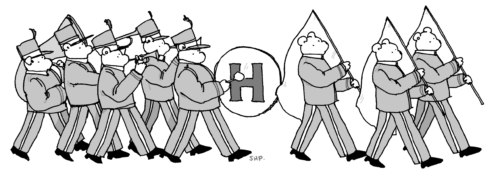
At every home football game, the Harvard University Band takes the field for its halftime performance. As they move from formation to formation, you might notice several performers who carry flags instead of instruments. While the band fills a massive stadium with sound, the color guard fills it with pops of color.
Color guards descend from the military tradition of soldiers carrying banners or flags of their regiment and traditionally traveled with the military band. The legacy lives on in civilian color guards, which toss wooden rifles and plastic sabers.
After World War I, America saw the growth of competitive collegiate marching bands, which eventually became a staple of football games and culture. Although public universities and high schools often have robust guards that compete nationally, Harvard is one of only three Ivy League schools with a color guard. This was a recent addition to the University’s marching band, established in 2025 and completely student-organized—from the choreography and supply management to the initiative to start it.
To learn more about the budding organization, the “Harvard Independent” spoke with its founding member, Khang Nguyen ’27.
What do you think is unique about color guard?
KN: To me, guard on the field has always been a very musical thing, except you don’t technically play an instrument. There is a very cool thing about formations being there for the marching band in general, with all the different instruments and marching in rows. While that is visually cool, I think adding more colors and more dynamics to that with color guard and all the different kinds of equipment that they have, too, it adds a really nice visual element to the musical aspect.
Why did you feel like Harvard needed a color guard?
KN: I did color guard in high school, and I thought it would be really cool to include it here. When I was an incoming first-year student, I was looking at the band website, and there was no color guard mentioned.
On my very first game that I attended here, it was the Harvard-Brown football game my freshman year. There was one baton twirler. The thing is, I don’t think she went to Harvard even, but she was basically the visual element of the band at the time. And I thought, well, that’s a really cool thing, and that is something that guard could also do.
What was it like founding the color guard?
KN: I knew a lot of people just across the years in the band. Some were from classes, some were roommates, some were just teaching fellows in courses I took, and being in the band, they always wanted to have more people. But I personally don’t play any instrument in the band, and I’m a very strong advocate for the color guard. The thing is, there was not that strong of a color guard presence at Harvard. The equivalent of a guard, I would say, is the prop crew, but they don’t necessarily do these formations and these moves in the same way.
Forming the guard itself, it was difficult because I couldn’t really find undergraduate guard interest. It wasn’t until I realized that there are also graduate members of the band that I looked into the graduate level, and there was some interest in the design school, the ed school, even the medical school. And so we gathered a group. The very first guard that we had was primarily graduate students. They’ve all since graduated, and now it’s primarily undergraduate. But we still have graduate students come back for some games that the alumni show up to.
How do you see the color guard evolving after you graduate?
KN: I hope, wishfully as always, that the numbers will go up, and the interest remains. I find, when I think about this, I think of myself entering college. It makes me feel a lot better that there is interest about this thing that I care about, this thing I enjoy.
I hope that people who choose to go to Harvard and did guard in high school realize that there is a community for them, and that that is something that they can continue to pursue alongside its academic interests. It’s not something that they have to pick and choose.
What experience has been the most fun, memorable, or fulfilling?
KN: During the Harvard-Yale game, the band has traditions. We have student leaders, but the transition period is during the Harvard-Yale game. We recognize our old staff and thank them for all of their service and welcome the new staff during then. It’s always a very fun time there, especially with all the good energy that Harvard-Yale brings.
Forming the guard, I’ve been able to make a lot of more new friends. And they’re now [they’re coming to guard from] all the different avenues in life, especially the grad students that I’ve met. Some of them were interested in guard, but actually never did guard. It’s never too late to do guard, even though they didn’t start it in high school. That was very rewarding to see all these skills develop, and then seeing people who appreciate it still, even after they’ve left college.
***
One of the distincitve aspects of collegiate football is its close connection with the marching band and color guard. Unlike college football, the NFL rarely features marching bands during halftime. Yet a band and color guard—formidable in sound and striking in visuals—contribute more to team spirit than they often get credit for.
Ellie Guo ’29 (eguo@college.harvard.edu) once played in her high school marching band.