Hands to Yourself
Graphic by Karishma Kodali

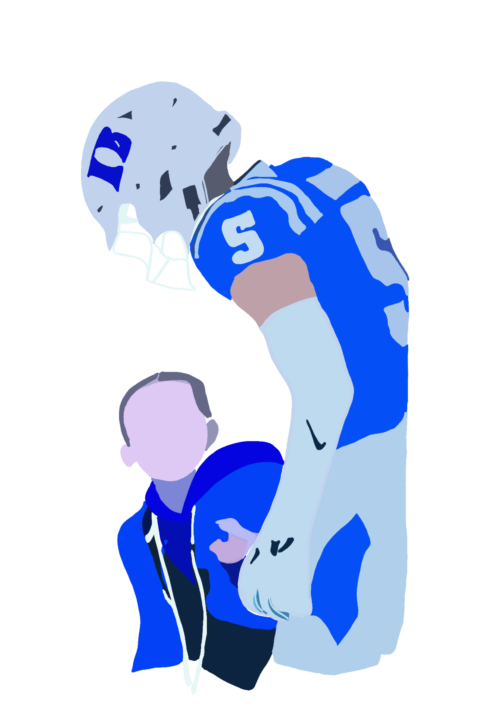
A five-second video has broken the internet. In the third quarter of the Oct. 17 Duke-UNC game, redshirt junior DeShawn Stone lay motionless on the turf after an injury, as his teammates surrounded him. A female member of Duke’s training staff, Grace Dietrich, ran onto the field to assist Stone. She placed her hand on defensive back Kimari Robinson, who stood between her and Stone. Robinson aggressively swatted Dietrich’s hand away. Robinson stayed to watch Stone receive medical attention.
Stone later walked off the field himself, but the video sparked a much larger conversation about Robinson’s behavior toward the female aide as well as the treatment of women in heavily male-dominated areas like sports. Manny Diaz, Duke’s head football coach, called Robinson’s behavior “below [the] standard” he wanted Duke players to meet.
Fans across social media expressed outrage, calling for Robinson to be suspended or removed from the team. Critics have noted that athletic trainers, such as Dietrich, are medical professionals and should be able to provide care without hurdles. As of now, the team and university have not commented on a suspension.
The incident clip went viral on Saturday, before Robinson made any public statements. He apologized on Sunday, the day after the game, after the video had gained traction and received news coverage. Robinson said he had spoken to the trainer before going public on X, where he wrote, “I want to publicly apologize to the member of our training staff for how I acted toward her during Saturday’s game. The injured player on the ground, DeShawn Stone, is like family to me, and I was scared he might be seriously injured.”
“But worrying about him doesn’t excuse how I treated her. I should have controlled my emotions, and I didn’t,” he continued.
The public seems largely split into two camps: critics and sympathizers. Critics claim that Robinson only chose to apologize after the clip went viral, reflecting a broader pattern of problematic behavior toward women in which men apologize solely in response to backlash. However, his apology deserves nuance—he provided context without using it to excuse his behavior, suggesting he tried to convey sincerity regardless of how fans and onlookers interpreted his actions. Sympathizers are more open to his perspective—watching someone you love be unresponsive is extremely jarring, and his emotions may have run high in the moment. Commentator Jason Whitlock, a former ESPN personality, argued that Dietrich initiated physical contact with Robinson and that Robinson was merely responding.
While both sides may have some truth, another detail complicates the story. A second video has surfaced showing Robinson swiping at a stadium staffer before Duke’s away game against Georgia Tech on Oct. 10. This detail could undermine the analysis that he simply feared for Stone and instead paint him as someone who regularly struggles to manage his anger, especially with people he is meant to work with.
It is necessary to consider the role that gender serves in understanding the player’s conduct. Dietrich is much smaller than Robinson and was trying to do her job on the scene when she was physically contacted. Critics of Robinson noted that Dietrich appeared visibly afraid after he swatted her away.
The high-stress, high-adrenaline nature of sideline athletics, particularly combined with the gender imbalance of male sports, can create situations where the authority of female professionals is undermined. Female trainers often face resistance when trying to earn players’ respect and direct them away from urgent medical situations. A former female trainer described her experience on X, saying that male college athletes regularly referred to her as “baby,” “boo,” and “mama,” which she found inappropriate, and explained that coaches had done nothing to resolve the issue.
These incidents are not isolated; they reflect a systemic issue. Athletic trainers are already prone to misdirected sideline aggression, and female trainers report additional barriers. Eighty-eight percent of female athletic trainers reported experiencing discrimination from employers, and 90% also reported unfair treatment from co-workers, fellow students, and colleagues. Women make up 55% of National Athletic Trainers’ Association members, and nearly 90% of surveyed members said an athlete, parent, or coach has questioned their competency.
Sympathizers of Robinson have claimed that Dietrich was not actually helping, saying she was only bringing a bottle of Gatorade, pointing to the broader devaluation of athletic trainers’ work. However, other doctors and sports medicine professionals have stated that athletic trainers are critical first responders on the field who are disrespected and underpaid. While emotions run high on the field, it is unacceptable to mistreat people who are simply trying to help, especially when they are already perceived as less and treated with less respect than you.
Actions like Robinson’s in sports serve as a microcosm of the difficulty of existing as a woman in high-stakes, male-dominated fields. From corporate boardrooms to heated discussions in college classrooms, women and gender minorities often find their credentials minimized and their boundaries ignored. Crises often reveal who can express unregulated emotions as intensity and who has their professional standing and safety undermined. Until organizations can enforce basic standards of respect at all times, including in high-stress situations, women and gender minorities will continue to bear the cost of misdirected aggression in professional environments.
Anika Gupta ’30 (anikagupta@college.harvard.edu) and Salma Gheith ’30 (salmagheith@college.harvard.edu) are comping the “Harvard Independent.”