The Beasts We Face
Graphic by Lola Selberg

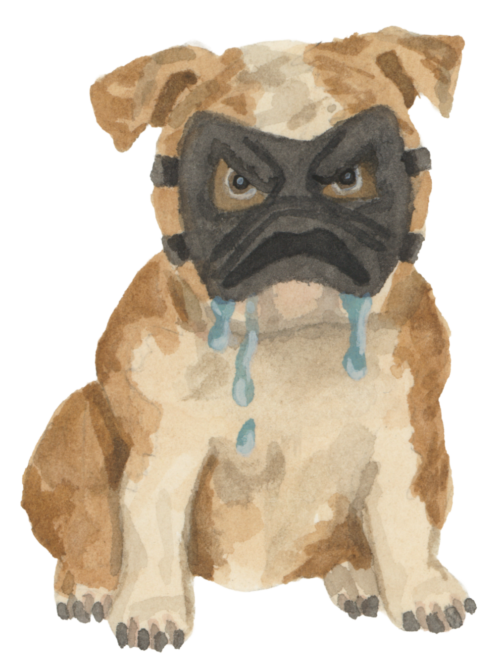
As we near the end of the regular fall sporting season, highlight reels will play, and hype will build for each game’s victors. But scores, plays, and players cannot determine the true winner—who watches the game just to watch the game? No, the only real measure of victory is intimidation. But ritualistic chanting, synchronized dress, and fresh air all pale in comparison to the spookiest beast: the mascot. The figurehead bears the vital responsibility of making innocent onlookers scream. After all, what is scarier than a teenager in a fur suit?
However, I cannot, in good faith, attest that all mascots achieve this objective. The biggest disparity in athletics and education today remains the unequal spookiness and scare factor between college sports mascots. While it may be a bigger challenge to consider the valid spookiness of all mascots, we can, at a minimum, look at a few mascots’ success in this field. Join me in evaluating the fear factor of Ivy League sports mascots.
9. The Penn Quaker
Not a shiver runs down the spine at the thought of the Penn Quaker. Perhaps in Pennsylvania they haunt the night, but to any outsider, the Penn Quaker is simply an oddly dressed man in a great hat—“great” being generous, and not the operative word. The Penn Quaker inspires no dread or fear in opponents, audience members, or civilians alike!
8. Touchdown
Cornell’s Big Red Bear has never truly been red, but it was a bear for a long time. From 1915 to 1939, the University featured live American black bears at football games and occasionally at campus events. However, (not to point fingers) Touchdown IV (the bear, of course) caused some disturbances on a road trip, effectively ending the tradition. Cornell was so embarrassed by the debacle that it was mascotless until 1970. Now, there is just a student in a suit—talk about a downgrade. Tell me, are you more afraid of the bear or the student? Perhaps the student is the rational choice, given Cornell enrollees’ tendency to hunt their own mascot. Rather counterproductively, it seems the people and beast are not yet unified enough to pose a viable threat. Perhaps a bear loose on the field, chased by undergraduates with hunting permits, is just as effective at sowing fear in the crowd.
7. Bruno the Bear
Another bear? With some of the nation’s brightest minds, one might expect more creativity. That is not to say Bruno, hailing from Providence, Rhode Island, and Touchdown are without distinction. One may infer from his name alone that Bruno the Bear is more domesticated than wild. He seems rather polite—a nice young gentleman who merely supports his peers and does not need a shiver, shake, or quake from the general populace.
6. John Harvard
Honestly, what is scarier than a random man from hundreds of years ago? I am certain his ghost still haunts West Cambridge, waiting for the perfect moment to exact revenge for all that has been done to his statue (for those who are unaware, let me tell you that the faded toe is not just from sweaty hands). However, fear of repercussions should sit in the hearts of the Harvard students who defiled the man, not the opposing team—which is why our dear John does not top this list. In fact, John Harvard might quickly find allegiance amongst the opposition. Perhaps that is why we shout “Go Crimson” instead of “Go John.” Such treason is certainly taunting his spirits.
5. The Princeton Tiger
At first glance, the Tiger may seem a worthy, wrathful beast, but let’s look closely at how the real tiger actually behaves. Tigers spend most of their time sleeping, and that’s not a great look. How are you expecting to be taken seriously if your mascot is falling asleep on the field—even if just for a short catnap?
4. The Yale Bulldog
As painful as it may be to admit, dogs can be scary—sometimes terrifying. But is a Bulldog the epitome of the fierce beast? It’s fair to fear the slobber, but the average passerby would accept it and move on. Perhaps we are simply too desensitized to fear this beast truly. A dog has teeth and claws, and the ability to attack—yet we willingly let it into our homes and hearts. The dog may strike when we least expect, when we are least prepared. Complacency is terrifying in its own right.
3. The Columbia Lion
Any New Yorker can tell you, the Lion belongs in the library, not on the field. While I applaud the effort to find a predator, are not lions just really big, fluffy cats? If I scratch the lion’s chin, will it fall asleep in a sunbeam? I suppose this issue is moot as the sun sets earlier and earlier, but the initial concern remains. Yet I must confess some fear of the Columbia Lion, especially its artificial blue hue. Is this the effect of climate change, or just animal cruelty? Either way, the eerie impact of our actions on the world’s innocent, big, fluffy cats haunts me.
2. Dartmouth Big Green
While it may be easy to write off Dartmouth as lacking a mascot worth considering, much less fearing, that assertion misses a vital aspect of terror: the abstract. A defined animal or figure offers ease and the comfort of the recognizable, but an abstract mascot offers the opposite. The simple letter ‘D’ excels in ambiguity, which breeds fear and resentment. Could the ‘D’ stand for destruction, death, decimation, deceit, debt? We may never learn what the ‘D’ means, but we can certainly cower at how it makes us contemplate our existence.
1. Keggy the Keg
What is this? More Dartmouth? A second, not-so-secret, unofficial mascot. Overindulgence is scary, is it not? In fact, few things are scarier than alcohol. A mascot promoting this ruffian lifestyle is beyond spooky; it is downright distressing. Moreover, a single glance at Keggy the Keg makes it clear that the beast in question has made a deal with some god or devil without so much as a flinch. It will reach into your soul and destroy something deep within you; please do not look it in the eyes.
So, what did we learn today? Evidently, just because a league is old does not make it worthy. Each of these universities, their athletic departments and teams, had free rein to pitch and perfect an impeccably terrifying mascot, and they fell short. The time has come; we must push mascots to do what they are meant to do: spook and scare, or, for some, exist outside the realm of colors and letters.
Star Binyamin ’30 (starbinyamin@college.harvard.edu) is comping the “Harvard Independent.”