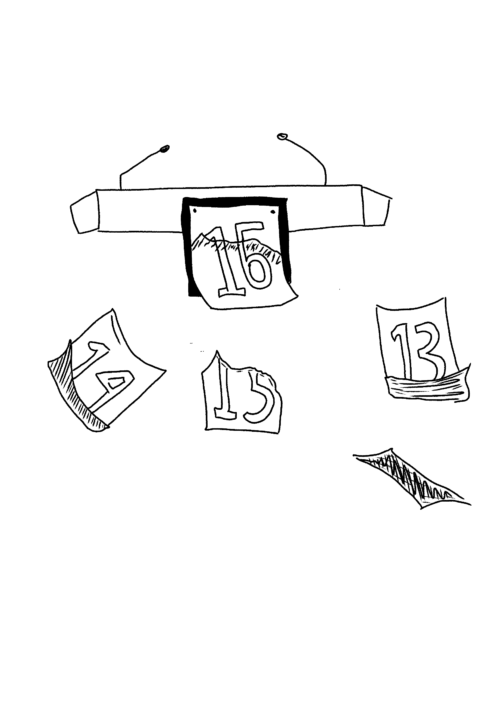
“What, Like It’s Hard?”
Graphic by Tess Harris
Katie Zacharia made American history this month with her five-day tenure as White House press secretary. Although she served the shortest term of any press secretary in history, her five days in D.C., and her life leading up to them, tell us what the Trump administration values, prioritizes, and rewards.
On Oct. 9, Trump took to Truth Social and named Zacharia as Karoline Leavitt’s successor. Leavitt resigned in August 2026 to spend more time with her young family. “[Zacharia is] a loyal and brilliant supporter, right from the beginning,” Trump wrote in the post. Less than 48 hours after the announcement, several controversial items from Zacharia’s past began circulating online. According to a “CNN” KFile review of her social media presence, she avidly followed and publicized several conspiracy theories. These include, but are not limited to, warnings to her audience that “the radical left Hollywood elitists are sick pedo cannibals” and calls to suspend habeas corpus and the right to know why you are being detained. Journalists also found internet activity and posts that supported a third term for President Trump, and a retweet claiming that 81-year-old Joan Rivers was murdered for saying Obama was gay.
Katie Zacharia is an American political commentator and communications professional. She studied at Pepperdine University, earning a Bachelor of Arts in political science and a Juris Doctor from Pepperdine Law School. Zacharia began her political career as an intern for the Republican National Committee and served as a White House intern during George W. Bush’s administration in 2006. After law school, she lived in China for two years and worked as an associate for the Beijing-based Zhong Lun Law firm from 2011 to 2013. After returning to the United States, Zacharia appeared as a political commentator and legal analyst on networks including Fox News and One America News.
Zacharia’s only briefing, her first as press secretary, lasted just 14 minutes, during which she mistakenly referred to her husband, Tyler Zacharia, as the president, misspoke more than a few times, and slowly read through the administration’s latest accomplishments. She did take three questions afterward.
Zacharia’s claim to fame is her numerous television appearances, where she often uses “lawyer” and “attorney” interchangeably. Under federal law, no single, all-encompassing statute defines the word “lawyer.” It merely refers to someone who has graduated from law school. In contrast, “attorney” is short for attorney at law and refers to a licensed professional who has not only graduated from law school, but also passed a state or federal bar examination and is legally authorized to advise clients, draft legal documents, and represent people and organizations in court.
However, when asked which state she passed the bar in, Zacharia answered, quite surprisingly, China. Legal experts and scholars from China immediately pounced on the claim, and after conducting research, explicitly stated that Katie Zacharia was not a licensed lawyer in the United States or China.
While lying about credentials on a resume is abhorrent on its own, it is arguably worse that no one in the Trump administration looked into this before hiring her. Zacharia’s five-day tenure is not just a story about an unprepared professional. It diagnoses how this administration operates—television presence and unwavering (well, maybe not even that) loyalty to MAGA are sufficient qualifications. Hires do not need to be prepared, and when it all goes wrong, you can always blame it on the press.
Soon after her press briefing, the watchdog organization Campaign for Accountability filed a complaint with the California State Bar, citing around 18 television appearances in which Zacharia calls herself a lawyer. On Oct. 15, just two days after her first briefing, she confirmed on live television that she had never passed any bar exam in any country. In the same interview, she also criticized China’s lack of proper toilets, drawing attention to and sparking discontent in its foreign ministry. The next day, Oct. 16, Trump said he told her to reconsider continuing in her role, while a White House official claimed she was “transitioning out of her role.” However, Trump has denied firing her.
All of this is extremely avoidable: don’t hire a fake attorney, a conspiracy theorist, and someone who has lied about their credentials on national television. So what motivated the current administration? Trump’s own announcement seemed to point to a few answers—she was loyal from the beginning. The conspiracy posts themselves certainly were not disqualifying; the President has promoted similar theories himself. This all points to an administration that values complete deference to authority and groupthink over anything else. One can lie, cheat, and still land the position. It is no surprise, as this administration was never merit-based.
No one ever questioned the job “interview” itself … because there was none. Zacharia fit the formula that has caught many people’s attention before (and no doubt will again): a loyal, televised conservative commentator. It was later revealed that she tracked President Trump’s public schedule and Truth Social activity so she could be on air when he was most likely watching.
Zacharia was called from the Oval Office, flown to D.C., and reportedly offered the job the day after her “interview,” without extensive formal vetting. On “Fox,” she said nobody asked whether she had passed the bar before offering her the position. Trump introduced her as an attorney, even though any formal vetting would have caught it. Similarly, no one seemed too concerned about her social media presence. Journalists found her post history less than two days after the announcement. If a reporter could find it that quickly, why could the White House not have?
The answer is simple: they could have; they just do not care. Credible institutions vet, especially the most powerful government in the world. The process includes extensive background checks, research, and interviews. Skipping this part is a choice, and it directly reflects what the institution values. Almost every other White House official in other administrations has been extensively vetted through the chief of staff, the counsel’s office, and numerous background checks. Zacharia got the job via an executive assistant’s fond recollection of a Fox episode and a phone call.
Before leaving the position, Zacharia was asked what she would do differently. “I would absolutely be very well prepared on the briefing,” she said, implying she wasn’t comfortable with the briefing information in the first place.
Several other moments during the briefing suggested this: she cut the briefing short, told reporters they could “ask President Trump,” and did not answer questions about Ukraine intelligence sharing.
Although she left her position, Trump maintains the media treated her unfairly. “I said, ‘Is this for you, Katie? Because honestly, you don’t need this. You don’t have to be treated that way. I would call it fake news, but generally the media has been very rough,’” he recounted.
He framed it as being in her best interest not to represent the administration. Reports seem to conflict on whether she resigned or was pushed out.
Loyalty seems to run in one direction. “Fox” turned on her, pressing her on whether or not she still had the president’s confidence. Her exit statement praised Trump, and, appropriately, she was seen wearing a MAGA hat just days after being removed from her position.
Many administration supporters, and Trump himself, have said she was hired as a spokesperson, not a lawyer. This may be true, but misrepresenting credentials on national TV for years is a credibility problem, and credibility is basically the whole job. Others said she has a law degree and technically worked at a Beijing law firm. She may have worked at a law firm, but the issue is that she let herself be called an “attorney at law,” and then she claimed she passed the bar in China.
The press secretary is the public’s daily line into the White House. With the press already limited, who answers questions, and how they choose to answer, matters more than anything. It signals how seriously the administration takes accountability to the public. This administration gave the job to someone whose interview was a news segment, who was never vetted or briefed, and who was gone before this week’s bread went stale. The podium is empty, and the White House is yet again without a press secretary. Trump said that he is in no rush to fill in the position. This might be the most honest answer the briefing room has given all month.
Salma Gheith ’30 (salmagheith@college.harvard.edu) is excited to see who the next press secretary will be.