I Don’t Wish You Just Success
Graphic by Janelle Souro

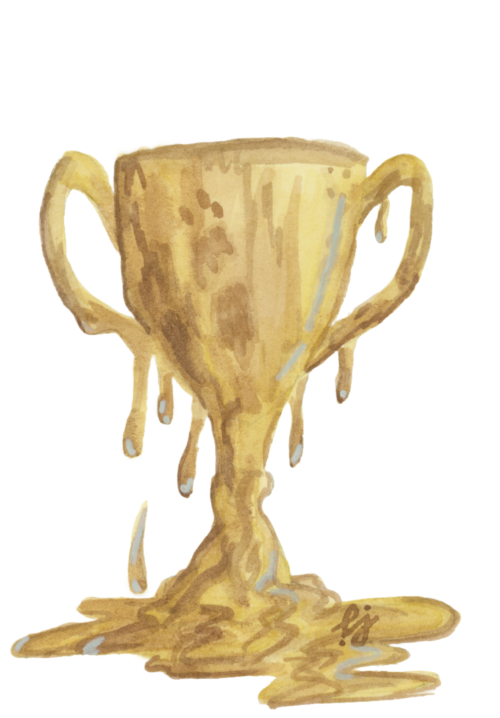
Earlier this year, I found myself roasting in the Tercentenary Theatre—otherwise known as the Yard—for my older brother’s graduation. The speeches went on and on and on and … you get the gist. There were just so many speeches—a lot of boring ones, some funny ones (thank you, Conan O’Brien ’85 and Ronny Chieng). What united most of them, though, was their focus on the future and this notion of wishing all the graduates success.
A nice message to hear, I’m sure; however, success should not be the only goal of the Harvard graduate, nor any person, for that matter. Success is good; living a full life is even better. In a way, achievements are the reward and byproduct of a life well lived. In that vein, to the graduates who went and the ones to come, I don’t wish you just success, though I hope for it; I wish you to live a full life in all senses of the word.
But first, we have to better understand what success looks like in this context. I would argue that success is usually defined rigidly by Harvard’s metrics, rooted in the idea of being the “best”: the highest-paid and most praised. This definition isn’t only proposed by the institution but by the students themselves. We talk endlessly about the big names, the Gateses and Zuckerbergs, and strive to accomplish more and change the world. It is admirable, but we’ve allowed the extreme outliers to become our baseline.
Why aren’t we celebrating, for example, the graduates who, when shown all the riches the world has to offer, choose to go back home and become a public school teacher? Or the graduate who simply wants a steady job and time to spend with family and friends? Is that so bad? I think not. I bet they get much more sleep than those in investment banking do, even if they have less money in their pockets come payday.
I say all of this not to dissuade people from the merits of ambition and hard work. Hard work is valuable, and it is only fair that we get rewarded for our efforts. However, we have allowed prestige, salary, and recognition to stand in front of the larger question of what it means to live a good life. I, like many of you, sacrifice far too many hours of sleep in pursuit of success, and I often ask myself: Is this what life is meant to be like? Work, work, work, and then … work some more. We retire and then, finally, are allowed to start living the life we always wanted. That doesn’t sound too fun to me. So, think on that and “tell me, what is it you plan to do with your one wild and precious life?” This line is from Mary Oliver’s 1992 poem “The Summer Day,” and it is also the essential question I ask all of you now.
At Harvard, we are always working toward our post-college lives. No dinner goes by without someone mentioning an info session or a consulting club meeting at some god-awful time of night. It’s telling that people never smile when they talk about these things. I can say from experience: there’s nothing to smile about in Harvard Undergraduate Consulting on Business and the Environment.
It’s always the next thing, then the next thing: constant motion, never stopping to just be. I am a workaholic in recovery, a title of which I am oddly proud. At one point last semester, I did something I had never done before: I took five minutes with no distractions, no phone (can you believe it?!), and I just sat with my thoughts. Meditation is the wrong word for it, but my room felt still that day. In that stillness, I came to a realization about myself. I didn’t know what I wanted to do with my life, but I knew that it wasn’t what I was doing at the time.
So, later that night I slipped out of bed—actually quite difficult as a freshman sleeping on the top bunk—picked up a pen, and started writing the first article of what would evolve into this column: “John Harvard’s Left Foot.” Originally, the column was titled “John Harvard’s Left Foot (Don’t Lick Me).” That little parenthetical addition would eventually be vetoed by smarter individuals than I, but I have actually seen someone lick the shoe, so it isn’t entirely ridiculous. In any case, through writing, I found a new passion and a new drive for exploring the world outside of consulting and finance and all the things that first-years swear up and down they’d never sell their souls for.
Writing gives me the same feeling I had as a child when I was convinced I would play pro soccer. The mere mention of football would get my nine-year-old heart pumping a mile a minute, and my eyes would dart around looking for something spherical to kick about. I don’t have the same physiological reaction when someone mentions writing, but that fire of childlike curiosity still burns each time I pick up the pen.
I recently read James Doty’s “Into the Magic Shop,” a book on life, death, neuroscience, and just about everything in between. In the book, a line speaks to what it means to live fully: “The heart of a child is wide-open.” A lovely sentiment, yet it is not only the heart that is wide-open; their minds are, too. Children dream big dreams because they don’t know what the real world is yet—there’s something beautiful about that. They aren’t limited by salary or expectations; they simply let their imagination build the future they want. And so, I asked myself: When did we stop dreaming?
We wish each other success because it’s a measurable metric, and loving what you do and chasing your dreams isn’t. It’s funny that even my nine-year-old self, rocking the latest Tomáš Rosický Arsenal kit, with a ball at my feet, knew the difference and, more importantly, knew which one he preferred. This isn’t to say you should chase dreams that aren’t compatible with reality. As we all know, bills don’t care about aspirations. Still, there is a difference between a dream that’s been adjusted and one replaced by coffee chats and a recruiting timeline.
So, yes, I’ll never play for Arsenal, but I do play for Club B—and I am so proud of that. And yes, I may never win a Pulitzer Prize, but I’ll keep on writing for the Indy. Neither of those will make it into a commencement speech, nor will they pay the bills, but at least my dreams are still there, just in a different form.
So, tell me, what is it you plan to do with your one wild and precious life?
Noah Basden ’29 (nhbasden@college.harvard.edu) wants to hear your dreams and what you would do if money were no object … no, seriously, my email is right there … click it … I dare you!