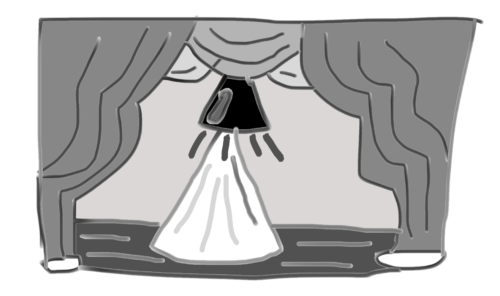
How to Enjoy a Live Theater Performance
Graphic by Andrew Ge

To my dismay, recent surveys show that only around a quarter of American adults report having attended a live art event in the past month. However, with the Harvard-Radcliffe Dramatic Club starting its fall season, students will have plenty of opportunities to escape becoming part of this deadly statistic.
I have too often heard arguments against attending shows: it is too expensive, it is too time-consuming, or theater was never “for them.” One reason I hear most often is that they take up a considerable block of one’s evening. And to that I say, relax and don’t worry about your impending p-set for roughly two hours. The world does not revolve around deadlines. Frankly, people who make these feeble excuses are missing out on a lot. To encourage those who may be reluctant to go to a theater performance, here is a (semi-serious) guide to enjoying one.
Before you buy tickets, remember there is no shame in going alone. Never let your fickle friends prevent you from advancing your artistic literacy. If you show up in business casual attire with a notebook and a pen, your fellow theater-goers will assume you are someone important, such as an art critic, and may think highly of you instead of thinking “what a loser.” Even if you don’t go undercover, people will not think you are pathetic, friendless, jobless, or weird.
Watching a show with a friend can be a fruitful experience, too. When you leave the theater, make sure to loudly proclaim the complex themes and fine details you noticed during the performance so other attendees know you’re erudite. Here are some examples of pretentious phrases you can holler in the lobby: “The actor’s micro-expressions were so precise”; “I was intrigued by the director’s choice to make it feel as if we are the complicit bystanders to the main character’s descent into corruption”; or, if you are a music nerd, “I thought the pit handled that meter change exquisitely well.”
Now it is time to plan how you’ll get tickets. Especially if this is your first time going to a live theater performance, look into the main themes and topics of the available productions. However, I don’t recommend Wikipedia plot synopses for this purpose, as I have often accidentally scrolled too far and spoiled a character’s death. Instead, find publicity blurbs on a show’s official website, or cover the bottom third of your screen as you cautiously scroll through Wikipedia.
Once you have your show in mind, now it is time to plan admission. Although a professional Broadway production can set you back over a hundred dollars, many cheaper options are available. The first option, which the “Harvard Independent” absolutely does not endorse, is “second-acting”: sneaking into a musical during intermission by confidently walking in and hoping for an unsold seat. The other option, which is less thrilling—I mean, less illegal—is to take advantage of local theater performances, which will often sell better seats for a fraction of the cost. A great example is HRDC, the on-campus theater group. Their shows never fail to impress.
On the day of the performance, I suggest dressing up—just a little bit—to feel like a real patron of the arts. Opera glasses are a little obsolete these days. Make sure to grab a Playbill on your way to your seat, and laugh sensibly at the cast’s and crew’s bio blurbs. Soon enough, the lights will dim, and you will hear a pre-show announcement asking you to turn off your mobile device, which is to be taken more seriously than your professor’s requests to do the same.
Then comes my favorite moment in all of live theater: the house lights go pitch dark, almost to the point of total blindness. You and your fellow audience members are waiting in anticipation for something to happen.
A spotlight. A lush orchestral overture. An actor starting to monologue.
As the show progresses, you’ll encounter mildly humorous moments you will not find extremely funny; that’s okay, because no one asked for your non-professional opinion on the show’s humor. Do what everyone else does, laugh at the top of your lungs, and move on with your day. If you feel the need to cough, sneeze, or unwrap the loudest cellophane known to man, try to do so quietly or at least during a forgettable filler scene.
Before you know it, it will be time for a brief 15-minute intermission. If you want to go to the bathroom, good luck, because the line will somehow be three times the theater’s capacity, and you’ll get to the front as soon as you hear the chime signaling the end of intermission. Otherwise, you can take this time to make small talk with strangers or try to work out your p-set in your head, if you’re still thinking about it.
Now for Act Two. In many shows, the second act is shorter than the first to accommodate our dwindling attention spans. Modern musicals often have a dramatic “everything goes wrong” number in which the main character loses everything before reaching some sort of semi-sweet resolution. I’m a sucker for it every time.
When it is time to congratulate the cast, actors will typically bow alone or in pairs. You will be clapping until you cannot feel your hands, but it is well worth it. Most shows will also acknowledge their crew members and pit musicians by gesturing to the wings and the orchestra. They are not doing some sort of aircraft safety demonstration; keep clapping and show your love for the people who work behind the scenes (that is me, so you had better).
Congratulations, you just experienced the magic of live theater. Now you can go home and thoughtfully read the entire Wikipedia page to catch up on any plot points or deaths you may have missed. Bonus points if the article has a “themes and interpretations” section so you can tell your friends how unforgettable and intellectually stimulating the experience was. And if you really want to do a deep dive, scroll through Reddit for thorough analysis you never asked for but didn’t realize you were missing from your life.
Jokes aside, theater is not inherently more artistically valuable than movies, novels, or television shows. But it is unique: there is no rewinding, pausing, or jumping ahead—comforts we have grown much too accustomed to with digital streaming. Take advantage of student productions while you still live just a ten-minute walk from a theater.
Ellie Guo ’29 (eguo@college.harvard.edu) swears she’s not pretentious.