Who Can Question the White House?
Graphic by Tess Harris

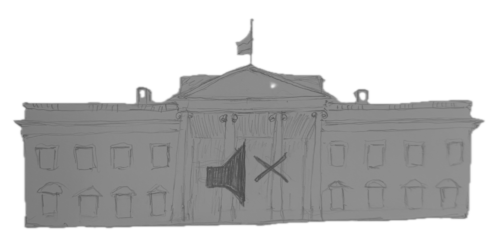
On Friday, Sept. 18, President Donald Trump announced on Truth Social that he would be banning three news outlets from the White House: “CNN,” “MS NOW,” and “Politico.” Although the U.S. District Court for the District of Columbia has temporarily restored the outlets’ access while the lawsuit continues, the ban has raised concerns that the White House could use press credentials to retaliate against critical coverage.
“I am proud to announce that, effective immediately,” Trump wrote in a post on “Truth Social,” “I am banning Fake News ‘CNN,’ ‘MS NOW’ (who recently changed their name from MSNBC due to lack of viewership and credibility!) and ‘Politico’ (The recipients of an illegal and ridiculous $8 million subscription, a record, directly from the United States Government, under Crooked Joe Biden, to keep them ‘alive.’ Seems like corruption to me!), from the White House as a result of their constant ‘reporting FAKE NEWS!’” He warned, “Other Fake News Media Outlets to follow.”
Over the following weekend, reporters from “CNN,” “MS NOW,” and “Politico” tried to enter despite the announcement, but they were denied access to the White House after their press passes were revoked. “CNN” had been scheduled to cover Trump at the United Nations General Assembly in New York.
The president’s limits on media access are highly contentious, as a free press is often seen as a cornerstone of American democracy.
“The importance of being present in the White House should really be looked at from the view of the public,” David McCraw, the New York Times’ lead newsroom lawyer and lecturer at Harvard Law School, told the “Harvard Independent.” “If you want to think of it this way, reporters act as [the public’s] eyes and ears in places of power and ask hard questions.”
According to McCraw, this issue matters beyond the walls of Washington, D.C. Journalists force transparency in opaque times, educating the public on otherwise nebulous national happenings. “That is one of those things that happens that advances democracy because leaders should be held accountable, and that’s an overall good for the public to have.”
Three days later, the outlets issued a joint statement, announcing that they would sue, alleging violations of their First Amendment rights and their Fifth Amendment right to due process.
“The White House can never control what should be reported on,” Conor Fitzpatrick, chief supervising attorney at the Foundation for Individual Rights and Expression, said in an interview with the “Harvard Independent.”
“What should be reported on is entirely up to the press under our First Amendment, and the White House cannot kick people, cannot kick press organizations out, because it doesn’t like what they’re reporting on or how they’re reporting,” Fitzpatrick continued.
Other organizations have also supported the barred outlets. “ABC News,” “CBS News,” “CNN,” “NBC News,” and “Fox News Media” released a joint statement opposing restrictions on access based on a news organization’s reporting. Separately, the “Washington Post” announced it would hold photographs of presidential events until midnight Eastern Time on Sept. 21 to join other newsrooms in a show of solidarity. The Reporters Committee for Freedom of the Press, the White House Correspondents’ Association, and other media organizations also submitted an amicus brief supporting the outlets’ request to restore access.
The Justice Department opposed the outlets’ request for immediate relief. In a Sept. 22 filing, administration lawyers argued that White House access was a privilege. They alleged that the outlets had published sensitive or classified information and failed to meet professional standards. They also contended that the outlets had received adequate due process because they were allowed to contest the revocations after their passes were withdrawn.
“I think a court would be deeply skeptical [of the Justice Department’s argument], and I believe that the judge in this ongoing case has already expressed skepticism,” Katie Fallow, the deputy litigation director at the Knight First Amendment Institute, said to the “Independent.”
Speaking to reporters before boarding Air Force One on Sept. 21, Vice President JD Vance defended the restrictions. “He’s not banning media outlets. What he’s doing is saying we’re not going to give you special access to the White House if you engage in what is effectively propaganda.”
“I think the government’s justification, the Trump administration’s justification, here is plainly pretextual,” Fallow pointed out. “It’s not what Trump said repeatedly when he said he was going to kick these news outlets out of the White House. He said he didn’t like their negative coverage.”
The case was assigned to U.S. District Judge Timothy Kelly, who issued a temporary restraining order on Sept. 24 requiring the administration to restore the press passes of “CNN,” “MS NOW,” and “Politico” employees for 14 days. Kelly found the outlets likely to succeed on the merits of their Fifth Amendment due process claim because their passes were revoked without adequate notice or an opportunity to challenge the decision.
“One of the things that has been pretty clear in the law is that a press pass, once it’s issued, can be taken away only if there is due process,” McCraw explained. “So when an administration says, ‘We’re going to take away your press pass because we don’t like the way you covered something,’ that is fundamentally a denial of due process.”
Kelly was nominated by Trump in 2017 and previously sided with “CNN” in November 2018, when Jim Acosta, then “CNN”’s chief White House correspondent, had his press credentials revoked.
The White House’s restrictions have continued to draw criticism from news organizations and free speech advocates. “I would describe it as attempted censorship,” Fitzpatrick said. He said the administration is using its authority to shape coverage and punish outlets for coverage it disliked, warning other news organizations. “This could be you if you report the news in a way that we don’t like.”
The press ban dispute follows the broader debate on the current administration’s relationship with the press, including Trump’s public attacks on journalists who have challenged his claims. Trump and his allies have accused major media outlets of bias and censorship. At the John F. Kennedy Jr. Forum last Feb., former White House press secretary Karine Jean-Pierre pointed out that the Biden administration took questions from outlets even when it disagreed with their coverage. “Where is the healthy back-and-forth? Where is the accountability?” she asked.
Questions have also been raised about the legality of the president’s ban. Fallow discussed how this dispute raises First Amendment concerns that go beyond the administration’s authority to issue press passes. “There’s something called the public forum doctrine,” she explained. “And what the First Amendment means in those instances is that the government cannot kick people out of those forums because it doesn’t like their viewpoints.”
Kelly’s temporary restraining order is set to expire on Oct. 8. “CNN,” “MS NOW,” and “Politico” sought a preliminary injunction from the federal court on Sept. 28 to preserve their access beyond that period.
“That’s not a final ruling,” McCraw noted. “And it was decided solely on due process. It’s possible that in the fuller order, the court will ultimately get to the question of First Amendment rights.”
In the meantime, the dispute has left open the question of how far an administration can go in restricting access to journalists whose coverage it opposes, and what that could mean for the public’s ability to scrutinize those in power.
“I think one of the key points here is that regardless of whether someone likes or doesn’t like the media outlets that President Trump targeted, that this is a power that, if allowed once, could equally be used by the other party,” Fitzpatrick said. “That’s why the First Amendment has to be neutral, and it has to be nonpartisan, because every tool of censorship that one party uses can be turned against them when the balance of power shifts.”
Audrey Cheng ’30 (audreycheng1@college.harvard.edu) is seeking a preliminary injunction against her classes.