Smells Like School Spirit
Graphic by Karishma Kodali

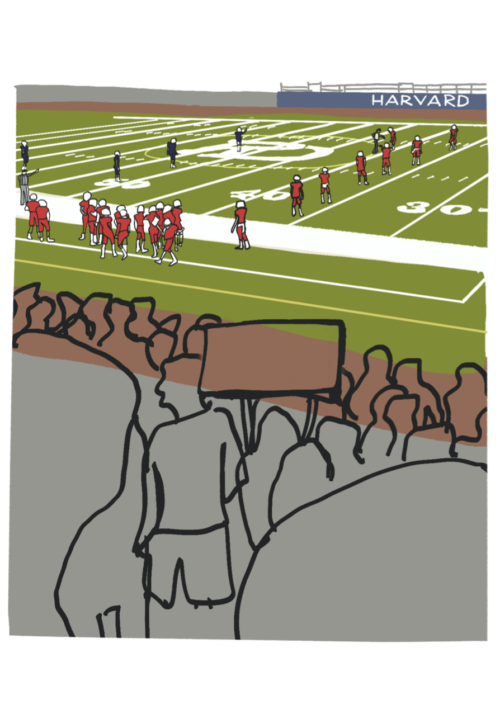
Back home in Nashville, crisp fall air always signaled that football season was coming. But the game itself was never the important part. Tailgates, homecoming parades, and student section cheers became the backdrop to every conversation and hangout. Seas of high school students, families, and alumni alike, decked out in bright red and glittery gold, would descend upon 1724 Wilson Pike Circle for Friday Night Lights as the Ravenwood Raptors took on yet another unwitting opponent.
Baked into our football culture was indisputable school spirit. From kindergarten on, it was only natural to feel pride and belonging simply because of your home institution. My high school even had its own motto—G2BARR: Great to Be a Ravenwood Raptor.
The spirit of G2BARR was not just limited to football, either. As we excelled in athletics, arts, extracurriculars, and academics, we carried that same school pride into every endeavor.
Imagine my surprise upon arriving at Harvard, a school with (arguably) the biggest fame, name recognition, and branding of any institution in the world. The Ivy League, with all its stereotypical imagery, sorely lacked the spirit I had grown so used to.
The first Ivy League game of the football season during my first year, Harvard/Brown, lived up to its hype. Students trekked to Cambridge from Providence, flocked to the tents set up next to the stadium, spent the day tailgating hard, and enjoyed a thrilling matchup. It is safe to say that was one of the most memorable days of freshman year. I expected the same level of production to carry into the rest of the season. However, successive games came and went without fanfare or anticipation. This struck me as odd—why did we not care?
The last game of the season, Harvard/Yale, was the lone exception to a season of disengagement. Our school organized a week of festivities, including free merch stands, food trucks, watch parties, buses to Connecticut, and plenty of student tickets to encourage as many as possible to engage with the most anticipated Saturday of the year.
It does make sense that the University invests so heavily in Harvard/Yale—the historic rivalry is as iconic as the Ivy League name itself. Furthermore, it gives us something to build community around. We are no longer divided by House, year, or any of the other characteristics that often leave our student body segmented and categorized; we are just the Crimson. After my first Harvard/Yale game, I noticed a big uptick in unity, even among people who had never met before. We shared our disdain toward the Bulldogs, frustration over the terrible luggage pickup system at Yale’s Coxe Cage after the game, and elation at a fantastic (albeit very wet) tailgate.
Those feelings, however, seemed to go as quickly as they came. We all settled back into our usual patterns, groups, and habits once the shuttles dropped us back off at our respective domiciles across campus.
This year, I hoped for a similar level of hype for the next installment of Harvard/Brown. But for a game that nearly rivals Harvard/Yale in anticipation, the school’s communication was sorely lacking. Though both weekends were away games, H-Y had hundreds of student tickets available, organized buses, and several messages from administrators about travel arrangements. This year: nothing. I scoured my email (even searching my trash) for an email I was sure would tell me where to buy a ticket for the game.
The effect of this was pretty remarkable. Last year’s tailgate felt like the entire Brown undergraduate class had migrated for 36 hours to set up shop in Cambridge. I resolved to head down to Providence, but getting people to come felt like pulling teeth—though I eventually convinced one of my roommates to make the trek with me. Committed to enjoying the “mini” rivalry weekend, I hopped on the commuter rail and attended the game anyway, even though I had to buy a $50 ticket on SeatGeek while standing in the throng of people rushing to enter Centreville Bank Stadium. After arriving, it was clear most Harvard students stayed behind: our student section looked barely 100 people strong.
In comparison, Brown students were committed (to the tailgate, at least). I spent the entire game in the opponent’s student section, searching for the electric energy of cheers and chants a football game brings. I cannot say their section was super packed either—but there was definitely a stronger showing.
Our campus has made recent efforts to improve belonging among a rather unconventional school culture, with changes like extended hours in community spaces. Yet, it feels as if the administration is overlooking an easily unifying initiative: investing in school spirit.
Searching for school spirit, I have opened a new tab more than a few times, navigated to Delta Air Lines, and perused weekend options for a BOS-TYS round-trip ticket. The Southeastern Conference, better known as the SEC, is known for its commitment to good football, with season-long student ticket passes and school-wide tailgates every weekend from late August through mid-November (even into December playoffs!). I should not have to outsource spirit through a two-and-a-half-hour flight to Knoxville when we have a remarkable football team right on campus.
The fix is simple. Harvard needs to make it easier to have fun. Sure, we are all busy people, but we can clearly make time for what matters most. Every game could be as fun and highly attended as our famed rivalry match. And if the administration, which is tasked with fostering student life, can make these events matter, student engagement will follow.
It is not just in our interest—it is in the administration’s interest, too. Yield rates, or the percentage of admitted students who choose to enroll, are a key benchmark of how much people actually want to come here. A recent article in “New York Magazine” pointed to schools like Vanderbilt as increasingly attractive options for prospective students compared to Ivies. As a Nashville native, I understand where the hype is coming from. Vandy offers not just the education but the spirit that comes along with a bought-in student body. If Harvard wants to keep the appeal it has held for more than three centuries, we have got to improve upon our culture and spirit on campus. This is just one easy step in that direction.
We also do not have to limit it to sports. We have every reason to have pride in our identity as Harvard students. It does not take much to learn the lyrics to “Fair Harvard,” wear a crimson sweatshirt, and support our peers at every musical, cultural festival, sporting event, and student performance.
My hope for our school is that these moments of Harvard pride are less rare than in the past. We have got all of the resources we need to bring the stereotypical college experience to Harvard. Now, it is time to make that happen.
Seyi Amosun ’29 (samosun@college.harvard.edu) wishes she could have seen the Texas-Tennessee game at Neyland Stadium.