The Unsexy Panopticon
Graphic by Ella Cohen

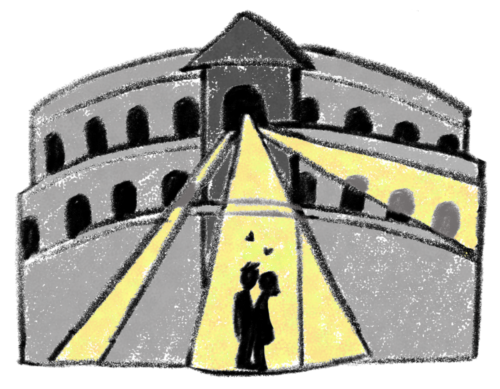
Our jaded elders like to describe Gen Z with a list of “don’ts”: Gen Zers don’t drink. Gen Zers don’t leave the house. Gen Zers don’t know how to work. Gen Zers don’t know how to socialize properly. Gen Zers don’t have sex. All of these don’ts, whether you view them as good or bad, have begun to characterize our generation as a bunch of internet-addicted, antisocial, puritan homebodies. I don’t dispute these assertions—who am I to argue with the statistical data? But the “what” is not the interesting part. It is the why.
Most younger Gen Zers have solidly grown up in the internet era. Even for the oldest of us (currently 29—born in 1997), iPhones and Google have been foisted on us in academics, social lives, and everything in between.
The result is what I call the digital panopticon: an internet-enforced version of the theoretical prison designed by philosopher Jeremy Bentham and later analyzed by Michael Foucault. In the original design, inmates are located in a circular structure where their cells face a central watchtower manned by guards. They interact only with the watchtower—not neighboring cells or other prisoners. They operate under the assumption that guards could always be watching them, but they never know when. Bentham argued that this uncertainty would drive self-regulating behavior.
Foucault extended this theoretical design to the panopticon’s development in broader society. Today, individuals take on the role of both the surveillant and the surveilled. With broader knowledge of others’ comings and goings, people internalize the rules, expectations, and stigmas set by society—even if they are not being observed in reality, the possibility of being observed always remains. This level of conformity drives individuals to regulate their behavior, even in private.
The internet has only reinforced individuals’ tendency to think about the possibility of being watched and act accordingly. For instance, sharing locations has become the norm. For most friends, it’s expected to share your location, whether via Snapchat or Find My. There are objective safety reasons for this, especially for many young women in college. However, there’s also the understanding that you can always be watched. Nowhere you are going is a secret anymore—and if you are in the market for a covert hookup, a nosy Nellie can put two and two together just by seeing where your phone is heading.
Social media only amplifies this feeling of being watched. It does not just affect your behavior in the moment. Every action, online or offline, can be enshrined in a string of zeroes and ones for perpetuity—texts, images, and posts live forever in internet history. For those seeking to explore their sexuality and connect with others online, there may be an added fear of the permanence of these actions in a way that does not show up in real life.
This has hindered several avenues of sexual exploration for the 21st-century youth. Messages to a significant other, once communicated over a phone call, letter, or in person, are now sent over text and snaps. Anything even slightly NSFW could be screenshotted and shared with unwanted eyes. For those who would rather not test the sexual waters via the internet for fear of its permanence, there is a big barrier to entry there.
Growing up, it often felt as though “revenge porn” or the nonconsensual sharing of nudes is something that girls—in particular—should be wary about. However, it is a matter that affects us all, regardless of gender identity. When I was in high school, during intense school rivalry weeks, “Barstool” Instagram accounts would post a spree of the most humiliating snaps, DMs, and messages leaked from (male) players and students on the opposing team. It was incredibly trivial, and anyone would admit that the original messages were downright embarrassing. But is not that what being 16 is about—making publicly embarrassing mistakes in your love and sexual life as you grow into a young adult?
At Harvard, and at colleges across the United States, the digital panopticon has evolved into a new form: Sidechat (or YikYak or Fizz). Instant, anonymous, and universal. These apps give any college affiliate a chance to share details about other students as just another anonymous poster. While being posted about and becoming the subject of the latest rumors carries a significant social burden, there is virtually no barrier to entry for someone to type a sentence and hit post. We have essentially created our own prison of constant surveillance. Everyone has a phone, and anyone can make a post about you at any time. The panopticon no longer needs to be an intricate circular prison in a thought experiment—it is already in our pockets.
These days, it is clearer that what you do can be weaponized against you in seconds. There is no going “off the record.” If an action you take can be instantly relayed to potential employers, family members, or partners, you have even more impetus to restrain your behavior. For something as personal and intimate as sex, it only makes sense that Gen Z as a whole would take a step back.
Sex is normal and a natural part of being human. I see other things impacting our generation’s tendencies to engage in sexual activity, like the vulnerable state of female reproductive rights, a resurgence in conservatism, discourse around the threat of sexual assault, and stigmas around normal parts of human interaction. But, at a minimum, I argue that the digital panopticon is somewhat intertwined with some of these things. At worst, it may even drive them.
Then again, why do we care? Why does it matter what other people do with their sex lives? At the end of the day, maybe this whole conversation is derived from our tendency to observe and police people’s behavior, just as the panopticon does. I implore members of older generations to think about a bigger lesson: perhaps there is no merit in defining whether a deviation from the “norm” of sexual activity is good or bad. The choice to have sex is ours, and the societal pressure to “do what our parents did” is no different than the societal pressures of self-regulation by the digital panopticon. We are individuals with our own agency. Now, we are opening up the conversations about our sex lives and owning that too.
Seyi Amosun ’29 (samosun@college.harvard.edu) is a chronic Find My location stalker.