On the Same Ship With Your Situationship
Graphic by Taylor Bierwerth

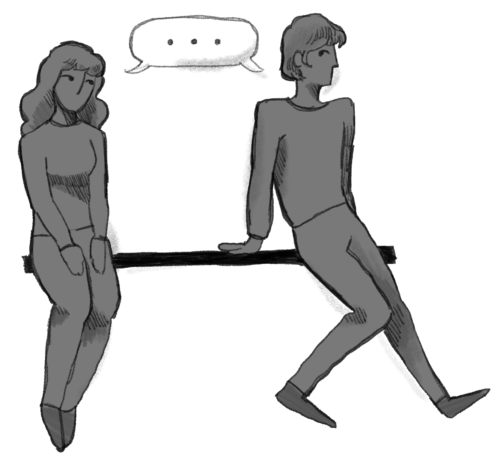
Imagine you’re seeing someone casually. You’re talking, but haven’t put a label on what you are yet. Now imagine that you see them multiple times a week to work on problem sets or for club meetings. If being in a situationship is not perplexing enough, try having one in a shared space (or don’t, actually).
Since most Harvard undergraduates take multiple classes each term, spend a lot of time in student organizations, and eat, sleep, and study in their Houses or dorms, this is a very likely scenario. But is it really a good idea to be involved with someone you do work with? The dilemma between staying professional and following your heart can be hard, especially when a failed romance can make you feel out of place in a community you care about.
What is it about sharing a space that makes people develop feelings? Whether it’s a burgeoning romance between classmates or an office scandal waiting to be revealed, something about those close to you is so appealing—first, the undeniable temptation of forbidden fruit. Many people are attracted to others because they cannot attain them, or because being in a relationship with them is prohibited. For example, “Romeo and Juliet,” one of Shakespeare’s most popular plays, centers around the forbidden romance trope. The thrill of the chase, the rush of adrenaline, the rebellion and rule-bending—all for love’s sake.
Another potential reason is the “epidemic of loneliness,” a term Surgeon General Vivek Murthy popularized in a 2023 advisory. The aftermath of the COVID-19 pandemic, a modern focus on the individual over the collective, and a rapid increase in technology use are causing people to feel more isolated than ever. Classes, student organizations, and houses are great places to get to know others, since they often make up part of a Harvard student’s social circle. A situationship with someone they already know from one of those places can offer the sense of closeness they crave in a relatively easy way.
You could argue that one modern-day option for meeting potential suitors is dating apps; however, many people do not have very positive experiences on such platforms. Studies discuss the mental health effects of swipe-based dating apps. Instant gratification and easy rejection can take a significant toll on individuals’ self-esteem. In a July 2022 survey of American adults, 35% of respondents said online dating algorithms could not predict love, while 21% said they could, and the rest were unsure. On top of that, these platforms are used more casually and don’t serve those seeking commitment well. Although dating apps make meeting people easier in general, they aren’t a perfect option for a fairy-tale ending.
What makes situationships in shared spaces so complicated is separating work from life. This is already quite hard in a proper relationship. That said, those in a comfortable relationship would likely communicate more openly with their partner. Setting boundaries and discussing vulnerable topics is, in theory, easier compared to a situationship. Here, you two could walk a thin line between work and life. For instance, negative feedback on one’s work could be taken personally, or asking for favors could create tension.
That is not the only thing, though. Depending on people’s roles within the organization, power dynamics could also shape the situationship. Some might see them as working in their favor, while others might get uncomfortable. If power dynamics make one side feel constantly insecure and push them to always perform at their best, it can damage the individual and the relationship.
When we talk about shared spaces, unfortunately, we cannot only consider the people involved and call it a day. Whether it is kept secret or not, people can sense a new couple. In some organizations, this might not be an issue; members may be friends who respect each other’s privacy or simply do not care.
However, gossip will certainly spread like wildfire in some cases. This could affect both the situationship and the organization’s dynamics. Something as simple as agreeing with your situationship in a discussion could be taken as an attempt to impress them, even if you genuinely agreed.
There is also the aspect of what happens when the situationship dies out. In my experience, ending a relationship was not as simple as stopping contact with someone. I went to a small boarding high school of about 250 total people in a rural area. All students took the same classes. That meant living in close quarters with everyone—including your situationship, or even more uncomfortably, your ex. Breaking up meant breaking up with their whole friend group, which also happened to be most of yours. People take sides, things get awkward, friendships end, all because of the butterfly effect from this situationship.
At Harvard, a situationship can end before the semester does. When boundaries, side-eye, and power dynamics come into play, things can go downhill faster than you expect. Yes, chemistry is tempting, but spending the rest of the year avoiding eye contact during lab is less so. Yet, if your heart beats for a special someone, maybe you are better off bending the rules a little to be with them. Not me, though. So, to all the people I had crushes on before: I would totally date you, if only we weren’t in the same club or class section. Maybe next term?
Delfin Urundul ’30 (durundul@college.harvard.edu) admits that her class crush motivates her to go to lectures more than the attendance policy.