Books Made Me Gay
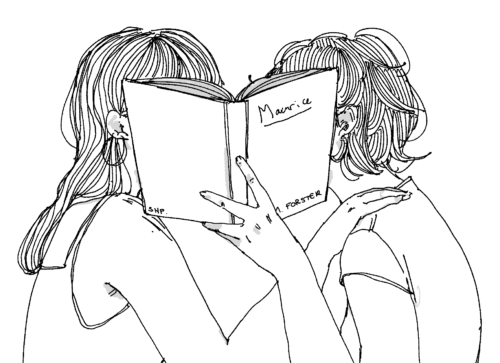
Graphic by Sam Park

Ever since I became an avid media consumer in high school, I wanted to find the Aldo to my Regan from Olivie Blake’s novel, “Alone With You in the Ether.” The Ted to my Robin from the sitcom “How I Met Your Mother”; the Seb to my Mia from the movie “La La Land.” Whether it ended in heartbreak or simply didn’t end, I wanted what the books and movies called “love,” which was almost always between a man and a woman.
Despite growing up in downtown Chicago, where my high school and the general public were openly accepting of queer identities, I always felt like staying “straight” was the easier option. Straight men vastly outnumber gay women. It is slim pickings. Not to mention the whole ordeal of coming out. Maybe it was just the traumatic experience of trying to tell my parents I was gender-queer in sixth grade, but labeling myself as a social deviant, even in an accepting community, felt out of the question.
Plus, dating a woman would certainly be harder. Even when my high school boyfriend constantly asked me to send nudes and would not take no for an answer, I convinced myself that this was just the cost of being in a straight relationship. There were fewer examples to follow—I didn’t really know what a “successful” gay relationship was. Worse was that I would need to explain it more to outsiders, namely my conservative Christian relatives who specifically told me not to get a girlfriend in college.
But then I read “Maurice” by E. M. Forster. In the novel, Maurice falls in love with another young man named Clive. Clive is of a slightly higher social class than Maurice, and increasingly feels outside pressure to make the more socially acceptable decision after he sees a former classmate’s life ruined by being outed as gay. Though Clive is deeply enamored with Maurice, he insists he is straight and marries a woman. This leaves Maurice with all-consuming loneliness until he meets another man, Alec, from a lower social class who happens to be one of Clive’s servants. Their relationship is threatened when Alec receives a job offer in Australia, but the novel ends on a happy note, with Alec giving it up to stay with Maurice.
This novel pushed me to question my own values and consider what kinds of sacrifices I would be willing to make. The hard thing about being queer is that there isn’t an easy choice about what kind of life to lead.
I thought about this further with James Baldwin’s “Giovanni’s Room,” which follows an American man named David, who travels to Paris and becomes involved with Giovanni, an Italian man. Both men are functionally escaping their lives in their home countries, but while Giovanni becomes emotionally committed to David, David insists that two men cannot build a life together.
I think that would ruin me. I had always worried that I thought of the queer part of me as an escape, some overly romanticized desire to be different. However, this novel made me consider whether or not I could imagine myself building a life with a woman.
I also read “The Price of Salt” by Patricia Highsmith. Nineteen-year-old Therese falls in love with a much older Carol, who is currently going through a divorce and a fight for custody over her child. The novel explores the tension between queerness and motherhood, as Carol gives up custody of her daughter rather than live a lie. Seeing this kind of choice, even in fiction, showed me that deviating from society is never easy.
Another element of Highsmith’s novel that I appreciated was Therese’s obsession with the older woman. It was naive and over the top; from the moment she saw her, she wanted to profess her love.
“Passing” by Nella Larsen also features this idea of obsession, in which Clare insinuates herself into Irene’s life. Irene constantly thinks about Clare, pulled between desire, repulsion, jealousy, and attraction. This mix of emotions can’t be explicitly or cleanly defined as love, but it adds a layer of complexity that the general perception of being queer doesn’t always capture. That is to say, queer relationships are complex beyond the designation of being “queer.”
Lastly, I read “Stone Butch Blues” by Leslie Feinberg. This novel is a bildungsroman about Jess, who comes of age in the butch community. From a young age, this binary between “butch” and “femme” shapes all her relationships (romantic or platonic). Near the end of the novel, her understanding of these designations is called into question.
This made me think of my own struggles with the terms “butch” and “femme,” and because it was hard for me to classify myself as one or the other, I struggled to imagine myself in a “real” lesbian relationship. But being encouraged to question my understanding of binaries helped me realize these labels don’t matter as much as I thought.
Maybe my ex-boyfriend just sucked and made me lose faith in men. Maybe I could have an easy, happy, and fulfilling straight relationship. But I realized that I do, and perhaps have always, desired a lesbian relationship more.
Queer literature helped me conceptualize different kinds of queer relationships and different ways to fit in or diverge from social norms. These novels showed me how hard being queer can be, and all the ways it might ruin my life. But they also showed me experiences I could imagine myself in, and they made me happier than imagining myself in the shoes of Regan, Robin, or Mia ever did.
Sam Park ’29 (shpark@college.harvard.edu) hopes she isn’t accidentally coming out to her parents.