Let the Games Begin (Again and Again)
Graphic by Neshama Ryman

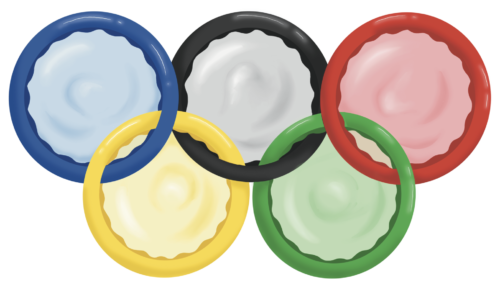
Every two years, the world’s greatest athletes gather to test the limits of the human body. These people have spent years preparing for the most competitive stage. Some events are so popular that even non-sports connoisseurs can recognize them. Others are so obscure that it seems like only a handful of athletes actually know the rules. What you may not realize is that some of the limit-testing happens after hours, and not in the lab or on the track. At this year’s Milan Cortina Winter Games, the free condoms in the Olympic Village ran out after just three days—the games lasted 16 days. Village organizers had stocked the space with 10,000 condoms for about 2,800 athletes. You do the math.
The shortage was confirmed to be due to higher-than-anticipated demand, but who can blame the athletes? Sex is a phenomenal way to blow off steam at a high-stress, high-stakes event like the Olympics.
Shockingly, this does not come close to breaking the record for the most condoms used at an Olympic village. During the 2016 Rio Games, a whopping 450,000 condoms were distributed, and the 2024 Paris Games distributed 300,000.
Many athletes insist they are only taking these condoms as jokes, gifts for friends and family, or memorabilia from the games themselves; however, with roughly 2,800 athletes, that averages to roughly 3.5 friends and family members per athlete collecting latex souvenirs. We’re not here to judge anyone, but I’m short on about four friends who collect themed condoms (besides Indy-branded ones!).
With all this rigorous training, it is important to make time for everything you want to do or need to do. So we asked ourselves all of the reasons Olympians may want to engage in some stress relief; below is a conglomeration of different reasons (excuses) that Olympic athletes have sex, and maybe why you should too.
It’s Technically Cardio
Since Olympians are infamous for never taking a day off, it makes sense that their extracurricular activities include a healthy amount of “exertion.” Sex is a rigorous activity and has the capacity to burn calories, not unlike cardio. Experts have compared sex to climbing a few flights of stairs or a brisk walk. However, these same experts also note that sex cannot replace a routine exercise regimen; luckily for these athletes, that is not a problem. Sex requires no equipment (depending on what you’re into), gets the heart rate up, and works several muscle groups at once. It is safe to say that this isn’t the worst use of time for Olympians.
Stress Relief
Training for years for an event that may last minutes, or even seconds, puts a lot of pressure on athletes. In addition to knowing that they have dedicated their lives to a fleeting performance, they are also keenly aware that their entire country is watching. Pre (or post) event sex could serve as a great distraction: it is widely linked to lower stress and a better mood, making it one of the few pre-competition rituals that does not involve a lucky pair of underwear or a sports psychologist.
Their Event Is Over
Not every athlete is competing until the closing ceremony. If they finish their events within the first couple of days, they will find themselves in the middle of a beautiful village with free food, amenities, and some of the world’s most attractive people. When the competition ends, the schedule opens up—and that newfound free time may lead to the tragic condom shortage of Milan Cortina 2026.
Better Sleep and Recovery
Athletes are obsessed with recovery, and some statistics suggest you should be too. Sexual activity, particularly partnered sex that includes an orgasm (so ladies choose wisely), has been proven to help you fall asleep faster and improve sleep quality, resulting in improved physical and mental recovery. Think of sex as another part of the wellness routine: ice baths, the beloved Normatec, and the Kama Sutra.
International Relations
At its core, the Olympics builds goodwill and sportsmanship between countries, bringing the world together. Athletes from over 90 countries have put their differences aside in the name of athleticism, discipline, and, most importantly, unity. Some athletes just take that mission more personally (or intimately) than others. While trading pins seems to be one of the Village’s most beloved traditions, it’s clear pins aren’t the only things being traded.
The next time you watch an athlete stand on a podium with a medal around their neck, remember that their Olympic experience likely included a few events that didn’t make it to your TV. Organizers promised to restock the Village, proving once and for all that the Olympic spirit cannot be contained, only rejuvenated.
As for us NARPs (non-athletic regular people), though the Olympics may not be on our horizon, we all have stress, need more sleep, and are more likely than not to skip cardio. The athletes and the “Harvard Independent” have made their case. The training is left to you. Just remember: this is the one race where nobody wants to finish first.
Salma Gheith ’30 (salmagheith@college.harvard.edu) is feeling… inspired.