Who Should We Truly Fear?
Graphic by Maya Kodali

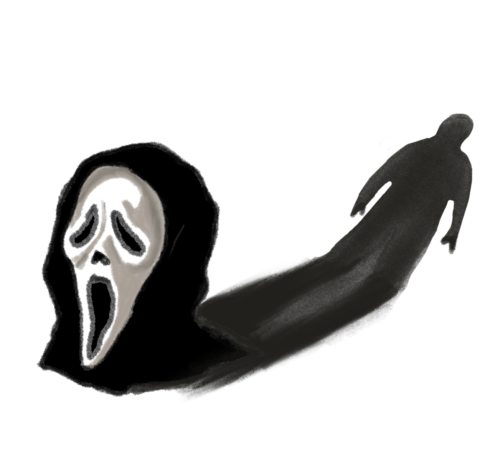
The image of a person walking home late at night is universally haunting. Horror movies have popularized this fear through tense, dramatic scenes: the long cast shadows as they maneuver around a corner. The incessant clutching of the backpack. Moving jerkily, they look behind, scanning for any stalkers or threats. With only the moon as a witness, they go on to face the sort of violence every person fears.
Their screams mesh into echoes of pain as they do on any other night.
Horror has always been my favorite movie genre—full of squelching, blood-curdling, and fearsome frights. These movies go beyond immersion, often becoming a dynamic, all-encompassing experience alongside the main characters. Viewers can feel every stab, push, hit, and bang.
When I was a kid, my first horror movie was the 1988 supernatural film “Child’s Play.” Chucky, a doll possessed by the soul of a serial killer, is given to young Andy by his widowed mother. Although Chucky is meant to be Andy’s friend, the doll suffocates him with hidden villainy and manipulation, leaving Andy vulnerable even to authority figures.
I can still recall the menacing music, Chucky’s haunting movements, and the egregiousness of adult incompetence. I was baffled by the constant failure of adults to understand the significance of what was happening and how Andy almost died before his mother, the detectives, and the psychologists believed him.
Juxtaposing the corrupt Chucky doll against Andy’s childlike innocence was the film’s way of urging six-year-old me to be more critical of abnormal occurrences in my daily life and to learn to advocate for myself. Recognizing the failure of adult belief is vital to navigating the world as a child when pitch-black shadows stalk your sleep, winds mysteriously knock over vases, and younger siblings really do hit you. It is one thing to recognize wrongdoing, but another to rally people to act against it. Never mind the cruel antics of playground bullies; six-year-old me was equipped to deal with reincarnated evil in a petite form.
“Scream,” another childhood favorite of mine, came out in 1996, well before my generation. It follows Sidney Prescott, a teenage girl who is targeted by the masked killer, Ghostface, on the anniversary of her mother’s death, just as she attempts to move on from the murder.
More than the experience of tragedy itself, the way society discusses and understands it has always intrigued me. Nothing compared to watching Sidney’s life fall apart while seeing a small town cannibalize itself in its chase for the killer. For me, Sidney represented the wildness and freedom of teenagehood (at least in the early minutes of the movie). She discussed the mundane reality of high school classes and relationships before tragedy struck.
Tragedy attracts attention, and through the media sensationalism depicted in “Scream,” I learned how incentives can outweigh genuine sympathy. At every moment of Sidney’s distress, the news media turned her life into a spectacle through cameras, reporters, and salacious tabloids.
I noticed something similar growing up in Colorado—the state where culturally significant mass shootings occurred, such as the 1999 Columbine High School massacre and the 2012 Aurora theater shooting. Through various extracurriculars, I would meet and compete against students who attended Columbine High School and walked the same halls as the victims and perpetrators. The memory of Columbine is still very much alive in Colorado.
While students and teachers approach these tragedies with sympathy and sensitivity, both traditional and social media often take a less empathetic approach. The continuous live coverage, dramatized narratives, and posthumous celebrity have transformed these mass shooting events into global media spectacles. This media formula has since become a staple of coverage of subsequent school shootings. Even as a child, I resented the public for capitalizing on freshly dead bodies. In the media, victimhood and entertainment become one and the same, dehumanizing the people (or characters) involved.
Though fictional horror and real-world tragedy are fundamentally different, both show how easily others’ suffering can become an object of public consumption. Despite all the calamity around her, Sidney gradually reclaims her agency, refusing to let Ghostface or the news dictate her life and choices. As a young girl entering her teenage years, I found myself composed and ready for the fearsome encounters the world would bring. We are always at the mercy of other people when they decide to radically alter our lives. “Final girls,” the archetypes of surviving female characters who confront and outlast the killer—offer a supportive hand—having survived too.
The Aurora Theater is still open today. Every time I went with my friends to watch a new blockbuster, I remembered the lives taken. One of the great sorrows of a world laden with misfortune is time’s casual amnesia. What time does for healing, it also does to the memories and shock of losing loved ones.
The horror community practices its own form of ancestor veneration. Though not a traditional classic, “Teeth” (2007) explores the mythical condition of vagina dentata (“toothed vagina”) through Dawn’s journey of awakening autonomy and developing her identity within womanhood. The film grapples with the myth as a way to depict violence against women in its horrific, almost comedic reality. Dawn, originally unassuming and submissive, reclaims her power by becoming the “monster” society fears in female survivors. In doing so, she critiques how cultures that avoid discussing violence create havens for predators, joining a legacy of women feared for their autonomy.
Despite Dawn’s condition, the viewer quickly realizes that the true abomination lies both in the passive moral guardians who leave young people uneducated and in the antagonists who weaponize their power. As a young girl learning to manage the changes within my own body and the peering eyes of society, I found solace in “Teeth” and the stories of other women. Horror movies use fantastical elements to present themes that remain true to life. We are often told to see humanity in despicable people. “Teeth” warns against seeing despicable people as any more powerful than a human, allowing us to reclaim power from those who abuse it.
Growing up, I saw horror movies and their enthusiasts labeled as deviants who concern themselves with morbidity to satisfy a dark itch. Simultaneously, the world outside was rife with numbing death and violence. When reality desensitizes us, horror reminds us how cruel the world can be.
Fiction traditionally presents the unseen and unknown as what people fear most. As a 19-year-old in college, I have found that my fears have adapted to my age. I no longer fear lurking dolls or haunting spirits, but now fear tangible terrors over the state of the world: military conflict in the Middle East, mounting domestic economic troubles, environmental collapse, AI singularity. Everything at once screams for my attention. How do we combat evil that we know intimately and have constructed ourselves?
Fiction translates these fears and worries into great works that alchemize danger into fantastical depictions, offering deeper insight into the horror around us. Horror, as a genre, offers a way to view the world through lenses beyond the usual ones. It blends jump scares and chase scenes with social commentary, letting us confront societal ills with theatrical distance.
Bogyphobia is the fear of bogeymen or other supernatural beings. This phobia is most common in children who see the world through a lens of monsters, superpowers, and magical beings. After watching movies like “Child’s Play,” I would enter the dream realm, terrified of whom I would encounter. But I had already seen evil lose on screen. Children already know evil exists. Horror movies remind them that it can be beaten.
Hafeezat Ghaffar ’29 (hghaffar@college.harvard.edu) is comping the “Harvard Independent.”