The Original Sin
Graphic by Taylor Bierwerth

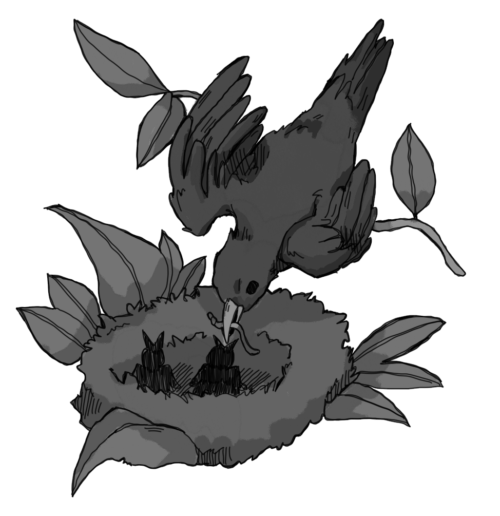
To be born is to be indebted. The moment we are expelled from the Garden of Eden, or our mother’s womb, we are signed into a life of serfdom. It seems like a favorable contract—for over a decade we are fed, clothed, bathed, and educated at no cost to us—but we never choose to sign it. What are one’s responsibilities in this contract, this thing we call unconditional love?
For a long time, a child’s piety comes unquestioned—one faithfully obeys the words of their patron. As long as this holds, the parent-child relationship continues without a hitch. At some point, however, the illusion of parental omniscience and benevolence is shattered, and one begins to question their commandments. The fine print of the parent-child contract comes into question, and neither side fully understands it.
To the teenager, agency feels like an unalienable right. The freedom to make one’s own choices seems central to human existence. To the parent, freedom exists proportional to their child’s capabilities. Until they have proven they can think critically and live on their own, it is a parent’s job to guide them. When these two mandates conflict, a tenuous undercurrent of ownership exists in the subtext of every deliberation. Both sides start by trying to ignore the obvious power imbalance and engage each other with reason.
However, when locked in an intractable stalemate, the parent avails themselves of their trump card, invoking that unconsensual contract signed in blood and amniotic fluid. For some, it takes little to force their hand; for others, it is a last resort; but in all cases, a parent can truthfully tell their child, “I own you.”
The child recoils, as if struck, at such a declaration. Their cheeks flush with vulnerability, and heat pulsates in their face. It feels like the greatest betrayal for a parent to strip away the illusion of unconditionality and demand a payment on one’s debt. To some extent, the child has no grounds upon which to take a stand. What can one say in the face of their creator and livelihood?
Most readers will relate more to the child, since they have no children of their own. However, I want to show the parent’s side through the lens of evolutionary biology. On average, humans do not produce as many calories as they consume until their late teens. By comparison, chimpanzees reach self-sufficiency at age five. Most humans will not have the means to repay the value of their parents’ investment in them, and the few who can often do not. Granted, parental care is a spectrum, and investment levels can differ greatly, but your existence fundamentally depends on others’ altruism.
The picture is complicated, though, when the author of the contract we speak of is revealed. Parental investment itself is a product of natural selection. Genes that prompt an organism to care for its offspring, who carry copies of those same genes, are passed on more successfully than genes that do not. Over countless generations, care becomes part of a species’ design. How much care evolves, however, depends on what the young need to survive.
At the opposite extreme, cod release millions of eggs and abandon them. A human produces a handful of children and raises each for nearly two decades. Our place at this extreme traces largely to the brain. A human newborn’s head barely fits through the birth canal, and a mother’s body can sustain the energy demands of pregnancy for only so long, so infants are born with brains roughly a quarter to a third of their adult size, compared with nearly 40% in chimpanzees. Most of that growth happens after birth, and the skills a large brain makes possible take years more to acquire: in studies of foraging societies, children do not produce more food than they consume until their late teens. Under these conditions, parents inclined to invest heavily had more surviving descendants than those who were not. In evolutionary terms, the devotion we experience as love secures investment.
If parental care is no more than an evolutionary inclination to pass on one’s genes, the contract’s power dynamics seem less daunting. Before this discovery, the child came to the table as a creature who didn’t intend to exist, buttressed solely by their creator’s kind heart and altruistic nature. Pulling back the curtain of unconditional love, we see that parents also seem to be victims of deterministic cause and effect. Their altruism isn’t self-serving, yet it isn’t free will either. When a child is born, they are forced into debt, but parents are also forced to invest.
Unfortunately, I have no answers. I will not delude myself into claiming I know the right balance between independence and filial piety, or the right level of unquestioning devotion one owes their parents. Much to the disappointment of my binary-biased mind, the answer is probably not absolute devotion or absolute freedom. Still, even though the solution is out of reach, I discuss the subject because I believe it is worth considering what you owe the people who gave you everything.
I also acknowledge that I have painted a dark and twisted picture of the relationship between parent and child. In practice, it isn’t always that way. Parents love their children “unconditionally,” unaware of the evolutionary forces underlying their actions, and children rebel against their parents, ignoring the terrible weight of ownership their parents have over them. Perhaps this illusion isn’t meant to be broken.
Elliot Hunter Chung ’29 (elliotchung@college.harvard.edu) is comping the “Harvard Independent.”