Speaking of Heads of Charles
Graphic by Sophia Jo

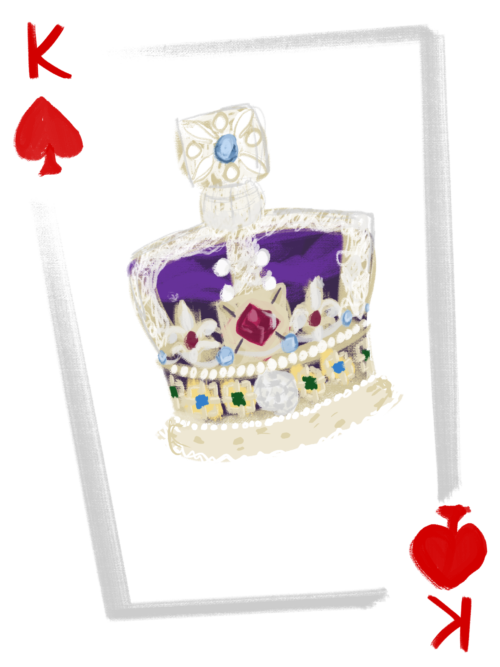
On May 6, 2023, Charles III was crowned at Westminster Abbey. He received St. Edward’s Crown at the moment of coronation, then left the Abbey wearing the Imperial State Crown. The jewels on King Charles III’s head are three things at once: religious-political symbols, masterpieces of craft, and a record of empire. You cannot admire the first two in their totality without reckoning with the colonial history of empire.
A crown is a symbol of power, and for the British monarchy it is the symbol of power. It is why the Royal Family is still allowed to exist and use the resources of the British government. They are widely regarded as the lynchpin of English unity and identity.
So what is on King Charles’s head? The obvious answer is a priceless collection of rare jewels and gold.
The real answer is a collection of trophies gathered from across the world, each marking a different chapter in the story of British imperialism.
Technically, none of this belongs to Charles himself. The monarch holds the Crown Jewels “in trust” for the nation. Because the jewels have countless competing claims, returning them raises a bigger question: to whom?
Who Claims the Jewels
The most famous jewel in the collection is not British (though few are). The Koh-i-Noor passed through Mughal emperors, Shahs of Iran, Emirs of Afghanistan, and Sikh Maharajas before Britain annexed the Punjab in 1849 and the 10-year-old Maharaja Duleep Singh surrendered it to Queen Victoria. Today, India, Pakistan, Afghanistan, and Iran all claim ownership of it, and India has repeatedly asked for its return.
The Cullinan diamonds face a similar claim. They were cut from a single diamond found in 1905 at the Premier Mine in the Transvaal. Afterward, the British colony, now South Africa, “gifted” it to Edward VII in 1907. When Elizabeth II died in 2022, thousands of South Africans signed a petition calling for the return of the largest stone.
Some stones predate the empire’s colonial ventures. King Pedro I of Castile seized the Black Prince’s Ruby, a 170-carat red spinel mined in Badakhshan, Central Asia, in 1362. In 1367, he gave it to Edward of Woodstock, the “Black Prince,” as payment for England’s help in the Castilian Civil War
Where the Jewels Fall
St. Edward’s Crown, the crown that gives Charles his legitimacy, is solid gold, made by royal goldsmith Robert Vyner for Charles II, to replace the medieval crown destroyed in 1649. It weighs 4.9 pounds and holds 444 mostly semi-precious stones: aquamarines, white topazes, tourmalines, sapphires, amethysts, and a handful of rubies. For centuries, it was set with rented stones for each coronation, then imitations for display. Its permanent stones date only from 1911. It has no documented colonial stones—ironically, the crown that legally makes Charles the King of England has the least imperial history.
The Imperial State Crown, made by Garrard for George VI based on Victoria’s 1838 crown, is the one Charles wore out of the Abbey, and the one the public sees most, at every State Opening of Parliament. It holds 2,868 diamonds, 17 sapphires, 11 emeralds, and 269 pearls. Its closed arches, a 15th-century design, signaled that England answered to no other earthly power. During Victoria’s reign, contrary to modern connotations, “imperial” also meant a literal empire spanning the globe.
Cullinan II sits at the front of its band, with the Black Prince’s Ruby just above. The back of the band holds the Stuart Sapphire, a 104-carat Stuart heirloom mined in Sri Lanka. However, it seems to have been acquired through trade rather than conquest. The Sapphire is said to come from an old piece of noble jewelry, Edward the Confessor’s ring, and sits in the cross at the top of the crown. The four pearls that accompany the jewel are widely referred to as Queen Elizabeth’s earrings and are rumored to have once belonged to Catherine de’ Medici and Elizabeth I.
The arrangement tells its own story. The Stuart Sapphire sat at the front until 1909, when they moved it back to make room for Cullinan II. A stone representing the monarchy’s early days was displaced by one acquired through conquest. The new colonial order shines brightly at the top of the crown.
The rest of the Cullinan is spread across the regalia. Cullinan I, the largest stone, tops the Sovereign’s Scepter with Cross, which was altered around 1910 to hold it. The scepter represents the sovereign’s temporal power. In 1820, George IV added an enameled rose, thistle, and shamrock to the scepter as emblems of England, Scotland, and Ireland after Ireland joined the United Kingdom. The Sovereign’s Orb, a gold globe topped by a jeweled cross, has bands which divide the Orb into three, reflecting the three continents known in medieval times. At his coronation, Charles held the world and an African diamond at once. Cullinan III, IV, and V were set in Camilla’s Queen Mary’s Crown.
The Koh-i-Noor was absent entirely. It sits on display in the Queen Mother’s 1937 crown at the Tower of London.
Keep Them or Give Them Back?
In 1851, the Koh-i-Noor starred at London’s Great Exhibition, seen by about six million visitors. Indian writers today read the display as presenting the diamond as a trophy of conquest, and Britain the proud conqueror. Ironically, crowds found it dull, because its Mughal-style cut prized weight over sparkle. So in 1852, they recut it to European taste, with the Duke of Wellington ceremonially making one of the first cuts. After Victoria was proclaimed Empress of India in 1877, the jewels became tools of empire. When George V attended the 1911 Delhi Durbar, the Crown Jewels could not legally leave England, so they commissioned a separate Imperial Crown of India, set with 6,100 diamonds. The jewels, symbols of conquest, were too precious to be in the presence of the conquered.
Britain’s defenders have a multitude of excuses. They argue the Koh-i-Noor was legally transferred under the 1849 treaty, and the Cullinan was a gift. The jewels belong to the Crown as an institution, so Charles could not hand them back on his own. With four countries claiming the Koh-i-Noor, returning it is controversial. In 2010, Prime Minister David Cameron warned that returning it to one country would leave the British Museum empty.
These arguments are easily disputed. A treaty forced on a 10-year-old after military defeat does not reflect the spirit of gift-giving, and a “gift” from a colonial government back to its sovereign raises the question of who is giving.
Cameron’s warning was less a defense of the Koh-i-Noor than an admission that Britain acquired much of its collection the same way. Britain’s own institutions seem to know it. In 2023, the palace crowned Camilla with a revoked Queen Mary’s Crown rather than the Koh-i-Noor, citing “sustainability.” Weeks later, the Tower of London began presenting the diamond as a “symbol of conquest.”
Competing claims over different precious stones are more than just part of conversations about return. Whoever the true owners of the diamond are may be debated, but the current “owners” can almost certainly be ruled out. Although the sun has set on the British Empire, the crown jewels remain a painful reminder of what it left behind.
Salma Gheith ’30 (salmagheith@college.harard.edu) is comping the “Harvard Independent.”