Hometown Series: Cambridge, MA Has the Same Architecture as My Grief
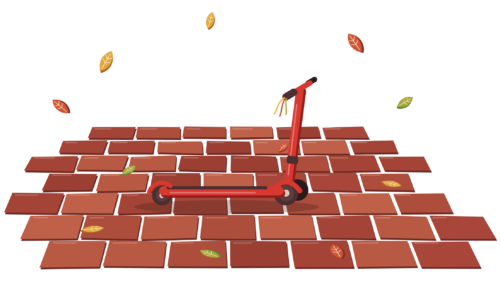
Graphic by Isra Khan

The red brick walkways in Harvard Square have always been uneven. They catch the toes of my sneakers the same way they did ten years ago. The T station still smells like stale peanuts and damp concrete. Now, though, slick glass facades and minimalist pastry shops have slid into the spaces where distinctly musty bookstores and family-owned cafes once sat. It is the modern heartbreak of any hometown: watching lived-in corners of your childhood get sanded down into the same curated backdrops.
I walked the streets of Cambridge as a toddler before moving to New York when I was seven. Even after all this time, sun-bleached memories remain. Those years were defined by the rhythmic clatter of bicycle spokes against curb cuts, or the vast green expanse of Cambridge Common, where the grass always smelled of fresh-mown stems. I remember New England’s dramatic shifts: partly cloudy days that bled into honeyed evenings, kaleidoscopes of red and yellow leaves carpeting the sidewalks, and snow tunnels dug with friends after a blizzard.
Harvard Square, in particular, had a messy charm, one that felt tailored to a child’s eye. I’d look into window displays cluttered with vintage postcards and hand-painted signs. I’d press my face against the Curious George store’s glass, mesmerized by shelves of books and toys. Every weekend, I’d smell the buttery scent of pastries at Crema Café as my parents ordered their usual coffees. And, of course, I remember the assortment of independent bookstores and magazine stalls scattered across the Square.
Just a month ago, I saw my old neighborhood for the first time in a decade. While singing 2010s anthems with my FOP-mates on a school bus, we drove past the SOCH park, the one I used to go to after school. I looked out the smeared window and saw dry dirt where woodchips once covered the ground, excavators parked where slides and swings used to be. As we rolled past the playground’s skeleton, the noise of orientation-week chatter faded. My mind went straight to Lula.
Lula was the beating heart of my childhood. She was selfless, strong, and tender, the same age as my grandma. She raised me for nine years, moving me across seven houses from the day I was born. Every day, when I went to pre-school in Cambridge, she walked with me as I zoomed down the pavement on my red plastic scooter. She cooked the same adobo and pancit that she used to make for the rest of her family back in Tacloban, Philippines. She pronounced her “V”s as “B”s and her “F”s as “P”s when she sang lullabies to me before bedtime.
Lula also loved walking to Harvard Square every day, and on weekends or holidays when I didn’t have school, we’d go together. She walked me down the aisles of the Curious George store, reading picture books to me until I learned to sound out the words myself. She bought me my favorite black-and-white cookies from Crema Café, which were always far too big for me to finish. She took me to small bookstores where we flipped through cookbooks, and if I liked a recipe, she’d make it for me. To me, Cambridge is Lula.
Those neighborhood routines are all the harder to let go of now that she is gone. When I lost the person who anchored my earliest understanding of safety, the world didn’t end. It carried on with an ordinary, insulting persistence. Yet in grief, we spend so much time mourning the specific texture of what life once was, chained to the people or places we lose.
I look at El Jefe’s replacing my favorite cupcake shop, or the empty glass kiosk that was once Out of Town News, and I feel a subtle emptiness in my stomach. Meanwhile, the diabolical three-street intersection still jams up traffic, the T station still hosts the street artists, and the red brick pavement is still uneven. The city’s architecture is too familiar, too haunting.
Eventually, the haunting gives way to a strange kind of grace. Yes, grief is stubborn—it’s a heavy stone in my chest, and it’s a sweet nectar that fills my heart. It’s also the weight of loving something enough to let it change you, even years after it stopped being yours. The people we miss and the places we used to call home are integral to our internal architecture, even if we can’t experience them anymore.
A hometown is ultimately defined by what it leaves in your bones. Whether or not it is losing its charm, Cambridge remains the canvas where my world was first drawn. Walking the same sidewalks today as a college student gives me a hollow ache. I feel fundamentally altered, much like my childhood playground. But now, I am learning how to build new storefronts in the architecture Lula left behind for me.
I have faith that Cambridge will do the same for the people who love it dearly. Because building new storefronts isn’t about accepting corporate polish or losing our old landmarks; it’s a defiant act: making new memories in bruised soil, in a place where everyone who has ever loved and lost can find their footing again.
Aadit Shrivastava ’30 (aaditshrivastava@college.harvard.edu) is filing a petition to bring back the Curious George store.