Portland Trail Blazers Fire New Announcer Over Social Media Posts
Graphic by Sarahluna Sassine

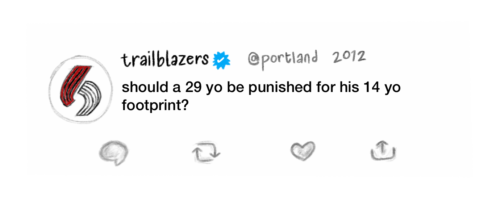
Just after noon on Oct. 1, the Portland Trail Blazers announced that they had hired 29-year-old Braiden Bell as their new play-by-play broadcaster. Only eight hours later, the Blazers fired him after old, bigoted social media posts resurfaced. This decision has left fans questioning how thorough the team’s background checks were, the ethics of the journalists who found the posts, and the reasoning behind Bell’s termination.
The Blazers initially hired Bell to replace longtime broadcaster Kevin Calabro, the team’s voice for 16 years. However, Calabro’s contract expired in June 2026, and his rejection of a new deal left the Blazers searching for a new announcer.
Bell, who had previously worked for the Phoenix Mercury, was expected to replace Calabro. However, racist and misogynistic posts on his existing social media account led to his immediate removal.
“The Portland Trail Blazers have zero tolerance for racist, sexist, or harmful comments. Social media posts made by our recently announced play-by-play broadcaster are in clear violation of team and league policies, as well as our values and expectations,” a Blazers statement released on X a day after Bell’s dismissal read. “Therefore, we will not be moving forward with this broadcaster.”
“KGW” reporter Devon Haskins discovered the online commentary and shared it with the Blazers after hearing of Bell’s hiring. Haskins proceeded to publish a story about the 2012 and 2013 posts, which included comments like “Asian people piss me off” and referred to women as “wh*ores.”
This situation now sits in the national spotlight, calling into question journalistic ethics and the extent of background checks before hiring. Moreover, should commentary from over a decade ago affect a man’s livelihood today?
The journalists who first broke the news have since received significant criticism. Many upset social media users unearthed comments by Haskins and John Tierney that resembled Bell’s teenage tweets. Although “Tegna,” “KGW”’s parent company, is conducting an internal review, neither journalist is expected to face repercussions.
The Portland Trail Blazers have also faced criticism for failing to uncover Bell’s offensive social media posts before they hired him. In a statement confirming the decision, the Blazers acknowledged this mistake. “We did not meet our own bar in this process, and for that we apologize to Blazers fans and to Rip City,” the posting read. “We believe strongly that everyone who is a part of Rip City should feel welcome and safe, and we will make sure that our new broadcaster reflects these values. We will do better.”
This isn’t the first time sports figures have faced serious consequences for inappropriate social media posts. In 2009, Larry Johnson was suspended and later cut from the Kansas City Chiefs after releasing homophobic comments on Twitter. Similarly, Jermaine Whitehead was released from the Cleveland Browns after he posted an inappropriate tweet with profanity, threats to former NFL players, and a derogatory racial term. In 2022, Kyrie Irving posted a link on Twitter to an antisemitic film. The NBA faced severe backlash, and Irving was suspended for eight games.
The difference between these three situations and Bell’s firing is that these athletes were reprimanded for tweets they posted while representing their teams. Some of these athletes weren’t even fired for these offenses; Irving was suspended for only eight games, likely because of his popularity. By contrast, Bell was punished for posts he made 14 years ago. “KGW” reported that it found no offensive tweets after Bell became an adult.
Bell himself emphasized the context of the post in an apology he issued on Oct. 2. “I am deeply sorry for the language that I used on Twitter. These tweets, while wrong, were written by me 14 years ago while I was only 15 years old and have no reflection of who I am today,” he wrote. “I do not take lightly any harm it causes now.”
Many argue that adults should not hold teens fully responsible for their actions. Adolescents are still developing emotionally, socially, and cognitively. Teens may post inappropriate things because of peer pressure, lack of understanding of consequences, or impulsivity. Fans cite these facts when stressing that the Blazers made the wrong decision; team leadership overreacted by abruptly firing Bell over his teenage words. Fans also argue that Bell couldn’t explain himself or apologize before he was let go—in other words, he wasn’t given his right to a fair trial.
The debate over whether people should be punished for past posts extends beyond the NBA and into academia. This January, Harvard University removed Gregory K. Davis from his position as the Dunster House Resident Dean over controversial social media posts. Controversial far-left tweets from years earlier resurfaced, criticizing Donald Trump and law enforcement. These messages dated from 2019 and 2021, before Davis began his tenure as Harvard staff. University affiliates criticized the dismissal, arguing that individuals should not be fired based on an aging digital footprint. Many fans of Braiden Bell would agree with this perspective on weaponizing one’s online history.
On Oct. 5, Bell officially announced that he and his attorney were seeking reinstatement. He is still waiting for an official legal response from the NBA franchise.
“Should the worst words a fifteen-year-old ever wrote decide the rest of his life?” Bell’s attorney Arnie Herz said in a statement provided to “Outkick.”
Herz also said he sent a letter to the Trail Blazers’ legal team on Oct. 4. According to him, the letter rejected any notion that Portland could revoke Bell’s employment agreement. He gave a 24-hour window to respond and resolve the situation. Fifteen minutes before the 24-hour deadline, he received a call from a Portland legal staffer confirming they received the legal correspondence and that the organization would not change its mind.
Despite this setback, the attorney stressed that he remains “very confident in our legal position regardless of what they throw at us.”
“We’re not going away. This is not going away. It’s going to stay in the news cycle,” Herz added.
It is unclear whether his efforts will succeed, as the Blazers have shown no intention so far of welcoming him back.
Abigail McKoy ’30 (abimckoy@college.harvard.edu) is comping the “Harvard Independent.”