The Black Plague Returns
Graphic by Lola Selberg

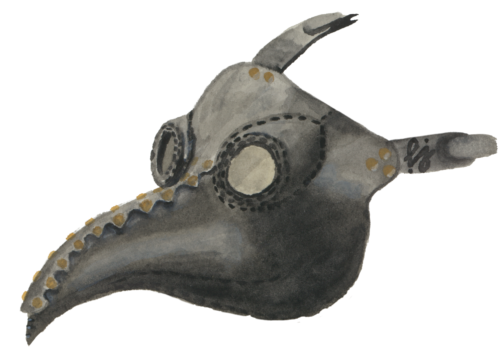
Since the COVID-19 pandemic, the world has been on edge. Whether it’s the suspected outbreaks of Hantavirus, Monkeypox, or bird flu, every couple of months something new to fear appears, a new reason to stock up on an unreasonable amount of toilet paper and canned goods. But are any of our fears justified?
On Oct. 2, 28-year-old laboratory worker Darya Shipilova died of an unconfirmed pneumonia-like illness in Russia. The incident sparked widespread fear across Siberia, resulting in the quarantine of about 200 people who were believed to have been exposed to the disease. Shipilova worked at the Irkutsk Anti-Plague Research Institute of Siberia and the Far East. This drew a lot of attention because this laboratory previously received funding from the Soviet government to develop a biological weapons program.
In April 2025, a U.S. State Department report found that Russia has an offensive biological weapons program, in violation of international agreements. The incident in the lab has raised questions as to whether Russia is finding ways to weaponize the plague, a disease thought to be left in the past of beak-shaped plague masks and medieval hygiene.
The Black Death was a devastating plague pandemic across Eurasia and North Africa from 1346-1353, killing about 25 to 50 million people in Europe (between 30% and 60% of the population). This is one of the most notorious historical disease outbreaks, and it is no wonder so many people work in and around laboratories that continue to study the bacterium that causes it, Yersinia pestis.
The plague has several varieties. Pneumonic implies the infection has spread to the lungs. Some outlets and experts have speculated that Darya Shipilova’s death was caused by a pneumonic strain of Yersinia pestis, sparking intense fear across not only Russia, but also around the world.
Many have pointed out the discrepancies between official Russian statements and local and international reporting. The Kremlin insists that the public has nothing to fear. Still, the combination of aggressive quarantines, scrubbed digital evidence, and reports of a laboratory accident gone wrong paints a far more devastating picture.
Originally, Russian media reported that Shipilova broke a test tube that contained the bacterium Yersinia pestis, fell ill with “pneumonia of an unknown cause,” and then died. Rospotrebnadzor, the Russian Federation’s national public health and consumer protection agency, maintains a highly sanitized version of events. However, the story quickly changes as they deny any link to lab activity. Officials claimed that extended testing (without specifying what kind) found no pathogens linked to her professional activity and that no incidents occurred at the Irkutsk Anti-Plague Research Institute.
Russia’s note to the World Health Organization states that it found no plague cases and that there is no risk of a global epidemic. However, several holes remain in the story surrounding the broken vial, the quarantines, and the mass panic that followed her untimely death. Although the state claimed it was just an “unknown pneumonia,” its physical response was massive. A regional hospital was entirely quarantined and halted all patient admissions and discharges, all while government officials forcibly quarantined anywhere from dozens to hundreds of Shipilova’s contacts.
On Saturday, Oct. 3, regional authorities reportedly posted a message on Telegram acknowledging “unofficial information about a confirmed plague case in the city of Shelekhov.” They deleted the post two hours later. Even as the government continued to downplay the situation nationally and internationally, the director of the Irkutsk Aluminum plant in Shelekhov posted on Telegram about a mask mandate for staff. “Better be safe than sorry,” he wrote, revealing a deep-seated local panic.
Officials have presented the situation as calm and localized, even as they cover up the rapid, forceful isolation of up to 200 people. The incident has undoubtedly raised suspicions about reports coming out of Russia, making people wonder whether or not this is a reason to panic.
The suspicion surrounding the truth of the Russian government’s claims reflects a broader pattern of inaccurate information the Russian government provides about disasters. In 1986, Sweden detected high levels of radioactive fallout and asked the Soviet embassy about an accident on April 26, 1986. The Soviet Union initially denied knowing it, only in a brief statement on April 28; in reality, the Chornobyl nuclear power plant had exploded in what is now a renowned tragedy.
A history of secrecy and dishonesty around national and international crises has bred deep distrust of Russia across the international community. The case for covering up a plague outbreak is weak. Without full transparency and communication, neither other countries nor the international community could sufficiently prepare.
Even the best-case scenario still sows seeds of doubt and distrust. If Russia is telling the truth, its long history of unreliability makes that truth hard to believe. President Donald Trump has briefly acknowledged the incident, albeit with more than a little confusion.
More outlets point out that Donald Trump and other government officials seem not to understand the difference between the pneumonic plague and pneumonia. In a comment on the outbreak, President Trump said, “It’s a rough disease. We used to be able to control it, but somehow those microbes have gotten stronger and smarter. The germs have really become relatively stronger than they were, and things that used to work on pneumonia don’t work as well anymore.” This suggests Trump may have confused the pneumonic plague with pneumonia, which doesn’t inspire confidence in how officials are communicating about the outbreak.
This response does not necessarily inspire confidence that Americans are getting accurate information from government officials; rather, it fosters a vicious cycle. Knowing accurate information depends on receiving accurate information from the Russian government in the first place. This information gap breeds fear and raises the question of who is providing the incorrect information: the U.S., Russia, or both?
Fearing a mysterious disease is not ridiculous in theory. Lab safety, future outbreaks, bioweapons, and Russian opacity are all valid concerns in an increasingly volatile political climate. However, this ignores several mitigating factors that argue against fearmongering.
The World Health Organization rated the risk of spread as low for Russia and very low for Europe. The plague is highly treatable with antibiotics, and no person-to-person spread has been confirmed. While the lack of confirmed person-to-person spread may reflect limited information, tabloid “plague panic” narratives must be scrutinized against the scientifically proven risk of the disease.
During international crises, governments often go to great lengths to ensure safety and security. But governments also use fear as a tool, shaping behavior through information. Russia and the West both shape the story; Russia uses information to downplay the risk, while Western rhetoric and media strategically sow distaste for Russia by amplifying rhetoric or questioning the government’s motives. While Trump has not directly done this in reference to the pneumonic plague, the general public has picked up on the pattern and questions Russia’s motives mercilessly.
Fear is a tool of political control. It leverages a fundamental human instinct to manipulate public behavior and reactions, further consolidating power. That may not happen immediately, but every instance of fear adds to a collection of moments that become fodder for political moves. When people are afraid, their natural desire for safety often overrides their demand for individual liberties and logic, making them more willing to accept certain rhetoric and authoritative measures, increased surveillance, or aggressive foreign policies.
So what do we have to fear? The answer is nothing and everything. The pneumonic plague itself appears to pose a low risk to the public. It is treatable, and no evidence suggests it is spreading. The lasting danger is the misinformation that surrounds the incident. When one government hides the truth and another struggles to understand it, the public fills the gap with speculation, and speculation breeds panic.
Darya Shipilova’s death may never be fully understood. But the answers about lab safety, bioweapons, and who we can trust to tell us the truth are a different issue entirely. We should not stockpile toilet paper until we get answers; instead, we should stay informed, stay skeptical, and refuse to let fear think for us.
Salma Gheith ’30 (salmagheith@college.harvard.edu) is comping the “Harvard Independent.”