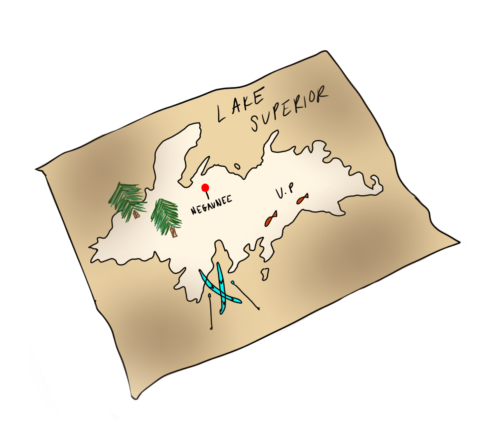
Exploring Worldwide Hometowns: Negaunee, Michigan
Graphic by Mia Stewart

Have you ever asked someone from Michigan where they’re from, only for them to show you with their hand? They probably made a mitten with one palm and explained it was the state’s outline after noticing your raised eyebrow. But this representation forgets that Michigan has another peninsula, one that often gets overlooked: the Upper Peninsula, or the U.P., as we locals call it. It makes up roughly one-third of Michigan’s landmass but is home to only about 3% of the state’s population. I’m not surprised to be one of only two U.P. students at Harvard. Many people have never visited it, let alone considered it home.
Bordered by three of the Great Lakes (Lake Superior, Lake Michigan, and Lake Huron) and covered by approximately 8.8 million acres of forest, I’m proud to be from the U.P. I’m from Negaunee, a town of about 4,650 people, just 15 minutes from Marquette, the U.P.’s largest city with a population of around 22,000.
The U.P. shares one area code—906—which is unusual for such a large area. Detroit, Chicago, and Minneapolis are the closest major cities, and each is at least a six-hour drive away. Many people in my town consider Green Bay, Wisconsin, the closest city, but even that’s a three-hour drive.
In such a remote area, with so much wilderness surrounding us, hunting and fishing are a normal part of life; they are traditions that begin from an early age. I have pictures of myself holding dead fish when I was only 2 or 3 years old; I learned to gut a deer when I was 12, something that might shock Harvard students but is completely normal in Negaunee. My grandparents’ meals often came straight from the woods. Venison, bear meat, grouse, and brook trout were common items on the dinner table.
Some years, nearly a third of my school would be absent on Nov. 15, the opening day of Michigan’s firearm deer season. If you found yourself in the building, you could expect half the staff to be replaced by substitute teachers as everyone headed to camp, hoping to use their deer tag on opening day. It was practically a school holiday.
The U.P. is also known for its snow, with some areas seeing snowfall that sometimes exceeds 250 inches a year. I spent many of my childhood winters ski-racing at Marquette Mountain. In such a small town, it’s common to stay involved in the activities you grew up doing, and I am proud to continue that by coaching younger skiers when I go home for winter break.
When I reflect on my childhood, many of my winter memories involve skiing. I remember going to the hill with my dad and sister when I was little and seeing if we could stay from open to close. Some years, we even got snow in our backyard before the ski hill opened. My friends and I would use shovels to build jumps and ski there instead.
Skiing is not the only way to spend a winter in the U.P. The sledding hill in our yard saw plenty of action, and it was not unusual to see people figure skating or playing hockey on the ice in front of the old Ore Dock on Lake Superior. But winter could also be long. I remember Halloween blizzards and throwing a fit in elementary school because my mom would not let me go trick-or-treating without a jacket.
The snow does not always disappear when winter is supposed to end, either. In March of this year, a blizzard brought 36 inches of snow to the U.P. When I got home from school last June, small snowbanks were still on the ground in our yard. This wasn’t the first year winter has lingered this long: my dad has a photo of me at age 10, standing in Lake Superior in my soccer uniform after a June practice, with my hand resting on an iceberg.
You might be wondering why people chose to settle in a place with so many trees, such brutal winters, and relatively few people. For my hometown, the answer lies beneath the ground.
In 1844, a government surveying crew led by William Austin Burt was mapping the U.P. when its compasses began behaving strangely. Vast deposits of iron ore beneath the surface interfered with the magnetic needles. This discovery revealed the Marquette Iron Range, a 33-mile-long iron ore deposit that runs through Negaunee and Ishpeming. Within a few years, the Jackson Mine opened near present-day Negaunee, launching Michigan’s iron mining industry.
Iron ore transformed the region. Shipped across the Great Lakes on lake freighters, it supplied the iron and steel industries that built the nation’s railroads, bridges, factories, and skyscrapers. Copper mining was also a major U.P. industry. The Keweenaw Peninsula (the northernmost section of the U.P.) is known as “the Copper Country” due to the large number of copper mines in the area. Mining brought immigrants from across Europe, including Finland, Sweden, Ireland, Italy, and England.
The mining industry has changed considerably since the discovery of iron ore in 1844. Many historic mines, including the Jackson Mine, have closed as deposits depleted. As the mines left, so did many of the people. Ghost towns built for the mining boom dot the western U.P.
The U.P.’s share of the state’s population has fallen from 11.5% to about 3% today. The Eagle Mine and Tilden Mine remain active, providing jobs for locals and drawing workers and their families to the area.
The mines are impossible to forget in everyday life. I remember sitting in class in middle and high school, feeling the ground shake, but no one commented on it or even looked up. It was just a blast from the Tilden Mine a few miles away.
Even my high school, Negaunee High School, was built on the site of the former Mather “B” Mine, which closed in 1979. When the building was converted into a high school, my mom’s class graduated from the new building in 1987.
Coming to Harvard was a big change from my town of 4,650 people. For starters, growing up in the U.P., cars were central to my social life. In a town where there wasn’t usually much to do, driving around with friends was one of our favorite pastimes. We would pick up food and drive along the lake with the windows down, or park at a Meijer or Target and talk for hours.
Even the way I speak can give away where I am from. I have somewhat of a Canadian twang, especially when I pronounce words with a long “a” sound. The first time I said “bagel” in front of my New York roommate, I thought she was going to faint.
Before coming to Harvard, I rarely thought about how unusual life in the U.P. might seem to “trolls” (people who live south of the Mackinac Bridge). Long winters, mine blasts during the school day, and fall hunting were simply part of growing up. Living in Boston has made me appreciate how much these experiences shaped my childhood and my connection to home. Now, when someone asks where I’m from, I use both hands to map Michigan, explaining that I grew up in the lesser-known peninsula—the place above the famous mitten.
I may not move back to Negaunee, but wherever life takes me, I will always be proud to call myself a Yooper.
Olivia Lunseth ’28 (olivialunseth@college.harvard.edu) still doesn’t know how to say “bagel” the correct way.