Painting a Nation: Mexican Muralism and the Making of a National Identity
Graphic by Cameron Bernier

In 1932, Mexican muralist Diego Rivera was commissioned to paint a mural in the center of Manhattan’s Rockefeller Center.
Fast forward two years, and workers are chiseling the mural off the wall.
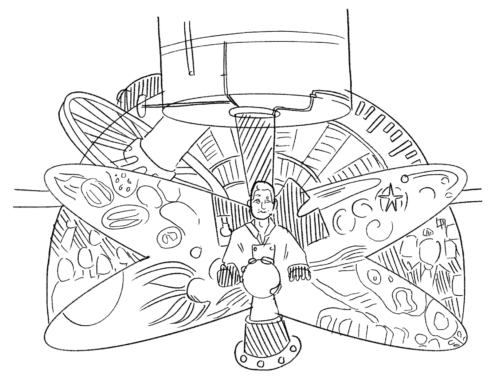
“Man at the Crossroads” was intended to depict the many sides of contemporary social and scientific culture. The piece features workmen and machinery, wealthy socialite women, a Russian May Day rally, and even a portrait of communist revolutionary Vladimir Lenin. Rivera hoped to show the struggle between capitalism and socialism, placing the viewer at the crossroads between the two systems.
Yet this same political message led to the mural’s demise. During the Great Depression, economic instability intensified growing debates over capitalism and communism. Many capitalist elites feared a shift to communism as capitalism’s failures became apparent. The Manhattan Rockefeller Center was a landmark of American capitalism, thus making Lenin’s portrait quite controversial.
As public backlash grew, Nelson Rockefeller ordered Rivera to remove the portrait. When Rivera declared he would rather have it destroyed than mutilated, that is exactly what Rockefeller did. Shortly after, workers chiseled the mural off the wall, and Rivera was fired.
Rivera, however, was not the only Mexican muralist to push the boundaries of political art.
In the 1920s, Mexico struggled to rebuild itself. The Mexican Revolution began in 1910 and left the country with a fractured sense of identity. What it meant to be Mexican in the aftermath of a revolution that exposed divisions of class and race was still an unanswered question.
José Vasconcelos, Mexico’s Secretary of Public Education at the time, sought to answer this question. In his book, “La Raza Cósmica,” he advanced mestizaje ideology, the idea that Mexico’s identity fuses indigenous, European, and African ancestries and cultures. Vasconcelos urged Mexicans to embrace their blended background and, in turn, use it as a source of national identity and pride. To spread his vision, Vasconcelos turned to the walls.
In 1921, he became a leading supporter of the government-sponsored Mexican Muralism Movement, which commissioned artists to paint the stories of Mexico’s indigenous past, colonial history, and revolutionary struggle on public buildings. At the time, most of the population was still illiterate. Politically charged murals offered an accessible way for political and historical narratives to reach border populations. Vasconcelos hoped these murals would spark national pride. Public walls became canvases that depicted how Mexicans understood their past and how they imagined their future.
Los Tres Grandes—Diego Rivera, José Clemente Orozco, and David Alfaro Siqueiros—led the Mexican Muralism Movement. From the 1920s to the 1950s, they pioneered the movement and helped establish a national identity rooted in iconographic depictions of non-European heroes in Mexico’s past. Each artist had their own individual style, yet they all shared one mission: to answer what it means to be Mexican.
Many of Rivera’s pieces told the stories of workers—farmers, peasants, miners, and industrial laborers — who had been neglected in Mexico’s official history books. He is best known for his works “The History of Mexico, Sueño de una Tarde Dominical en la Alameda Central,” and “El Cargador de Flores.” In each piece, Rivera placed the ordinary people at the center. Rivera depicted everything from the Aztec world to the post-revolution one. His message was that the ordinary worker built a powerful, culturally rich nation.
Building on Rivera, Clemente Orozco focused on class struggle and the hardships of everyday life. His most recognized works include “Prometheus,” “Catharsis,” and “Zapatistas.” Clemente Orozco was explicit in his storytelling. He wanted to show the unfiltered post-revolutionary Mexico. He did this by utilizing a highly expressionistic form of social realism. Orozco was not a man afraid to depict violence, pain, and hardship that come along with building a national identity.
Siqueiros was a former soldier who became a muralist. His work was far from subtle and deeply rooted in a left-wing perspective. He is best known for his works “Portrait of the Bourgeoisie,” “From Porfirism to Revolution,” and “Nueva Democracia.” Having participated directly in the revolution, he aimed not to tell a story, as his counterparts did, but to push people to act through his artwork. Beyond being an artist, Siquerios was also a community organizer who led unions. He even returned to the military and commanded several brigades during the Spanish Civil War.
However, the movement itself was never just black or white—for all its vibrant colors, it was full of contradictions. Since most murals during this movement were government-funded, it raises the question: Where does state-sponsored political art cross the line between resistance and propaganda? Here, the government called the shots on which stories the public walls should tell. Mestizaje celebrated the one blended race that Mexicans are a part of. Yet, some argue that this truth sidelines the identity of existing Afro-Mexican and living indigenous communities into one government-sanctioned version of a national identity.
Los Tres Grandes are also all men. Female artists, such as Aurora Reyes Flores and Frida Kahlo, often spent their careers in the shadows of their male counterparts. Experts often consider Reyes Flores the first Mexican muralist, yet they don’t place her on the same pedestal as Los Tres Grandes. Kahlo, an artistic trailblazer of the feminist movement who helped shape Mexican women’s identity, was often cast as “Rivera’s wife” rather than an art patron.
While these critiques hold truth, the contradictions are part of what makes the movement so powerful. The Mexican Muralist Movement helped display how complex and difficult it is to shape a national identity. Identity is not set in stone. It is painted, argued over, and repainted.
Today, you can visit the mural that once got Rivera fired in Mexico City. It is now known as “Man, Controller of the Universe.” It was repainted in 1934, Lenin and all, and hangs at Palacio de Bellas Artes. This is just one story of how a nation’s story may be censored, but never fully erased.
Jocelyne Delgado ’28 (jidelgado@college.harvard.edu) visited “Man, Controller of the Universe” in all its glory two summers ago.