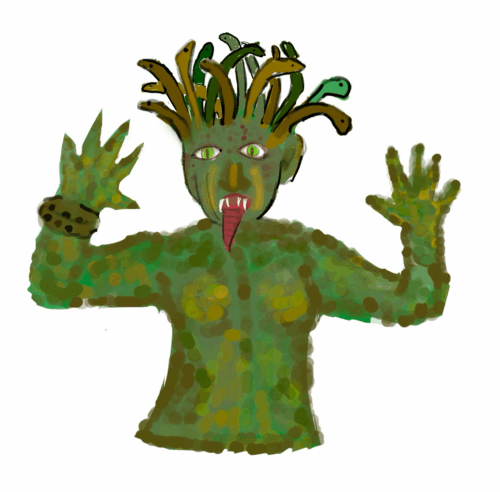
Equally Scary: Halloween as Liberation in Fashion
Graphic by Kelly Tung

Every year on October 31, the world dresses up. From oozing blood to plush fur, gleaming armor to inflatable suits, there is no limit to what people wear. For a single day, sidewalks turn into public runways. We stride through the night as designers, performers, and works of art.
Halloween may be the most democratic fashion event in the world. On this day, beauty standards are suspended; attire is ranked not by brand label but by imagination. Someone in a hand-assembled cardboard contraption can outshine a celebrity in couture. Fashion belongs to everyone, liberated from traditional rules of dress.
The concept of wearing costumes is as old as civilization itself. Baroque and Renaissance masquerade balls were arenas where aristocrats could flirt, cross-dress, or mock social order, while their identities were hidden away. Even earlier, Russian theorist Mikhail Bakhtin coined the term “carnivalesque” to describe moments when social order becomes inverted. In medieval carnivals, peasants dressed as kings, kings as fools, and the world, for a breath, laughed at itself. At a carnival, this taste of equality and freedom existed only for its duration, but it revealed how arbitrary social hierarchies truly were.
The carnivalesque would only occur on Halloween if both the famous and the ordinary people participated. The holiday’s power depends on celebrities at the top of fashion’s pyramid embracing the same tongue-in-cheek rebellion as everyone else.
In recent years, it has become standard for fashion’s highest echelons to compete for the most grotesque and the monstrous. This past Friday, Heidi Klum, famous for her elaborate costume tradition, held her 24th Halloween party at Hard Rock Cafe in New York City.
Klum’s costumes are not about glamour, but metamorphosis and self-erasure. She has appeared as E.T., an older version of herself, Princess Fiona from “Shrek,” a peacock, and, this year, as a reptilian Medusa. Her husband, fittingly, was a warrior frozen to stone. In each transformation, Klum’s costumes, swollen, wrinkled, or exaggerated, challenge the standard of equating fashion with beauty. As a supermodel, she turned this topic on its head.
Halloween blurs the hierarchies of class, beauty, gender, and propriety. Costumes transform taboo subjects—death, horror, and sexuality— into play, inviting us to confront what frightens or unsettles us most. Children become monsters, and supermodels step into the shoes of aliens. When a kid dresses as the president or a grandmother as a vampire, they reject society’s expectations of how one should look or how one should age. For queer populations, Halloween is often a rare day when people can circumvent gendered dress code legislation. “I looked in the mirror and saw the grown-up I dreamed of being,” Lazarus Letcher, a reporter for the Source New Mexico, writes regarding how the holiday helped her reconcile her gender at birth with the gender she wanted to be.
This year, queer communities flocked to the internet to show off extravagant costumes to highly specific cultural references with the tagline, “I hate gay Halloween, what do you mean you’re ___?” By encouraging people to lean into costumes created often for their own humor, Halloween both promotes self-expression and externalizes the gay culture for everyone to see. A costume allows people to show off their personality, and then be noticed and discuss their preferences in conversation. The masquerade becomes empowerment, offering a chance for people to inhabit what society often ignores.
Costumes also refocus attention on the craftsmanship behind fashion. Heidi Klum’s metamorphoses take hours of prosthetics and special effects; they require planning, detailed assembly, and expertise. Hand-painted by fifteen individuals, her most recent Medusa costume took five months to execute, with repeated rounds of trial and error by sculptors, fabricators, and special-effects artists. Animatronic snakes, eerie green contact lenses, and razor-sharp acrylic teeth integrate technology with artistry.
What makes Halloween so special is its collectivity: the mass costume display on our streets. It is fashion’s most inclusive collaboration; part costume design, part storytelling workshop, part civic theater. On Halloween, everyone walks the runway. We celebrate the DIY spirit with duct tape, face paint, thrift-store tulle, and recycled objects. The aesthetics vary—blood, sequins, latex, plastic, inflatables—but the intent is consistent: to try being something else, even if only for a night.
There’s something hopeful about this. The simple act of stepping into someone else’s body is, at heart, an expression of empathy and a desire to understand through intent and imitation. Fashion, often accused of being insular or sterile, need not be so. Halloween restores its wild heart, reminding us that fashion is always about the fun of dressing up. Our clothes are costumes, and identity itself is a performance requiring effort and imagination. The night’s visual cacophony reveals fashion stripped of pretension and returned to its pure function: self-expression and transformation. Beneath the glimmer and gore, Halloween suggests that the freedom to look absurd is, ultimately, the freedom to be human.
Cloris Shi ’29 (clorisshi@college.harvard.edu) dressed up as a goat, a part of a trio costume of the Monty Hall problem.