Kitchen Sink No. 8
Graphic by Caleb Boyce

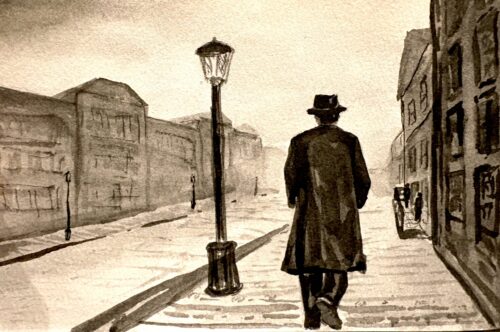
The bitter wind had been blowing against my face for so long that I had stopped feeling it. My teeth ached. The collar of my coat was wet and was chafing a raw line along the back of my neck. I walked on.
I had been in my room reading Henley. Then I was on the street. Then, before the door. Like a dog’s meander back towards its former home.
The oak door was at the bottom of three stone steps and had no handle on the outside. A man on each side of it, both large enough that the steps looked undersized, architectural errors. The one on the left had a mark tattooed on his neck in a script I did not recognise. He looked at me, and I could not tell whether I had been assessed and permitted or simply not worth the effort of stopping.
Inside, the heat sat on my skin. Candles on every surface, the flames leaning in a draft, and the whole room lit the color of old brandy.
I sat at the bar. The wood was dark and scarred, stained and restained. Behind the barman, a row of bottles with no labels and above them a sign in Cyrillic, the letters angular and crowded. The barman set a glass in front of me without being asked. I drank.
The vodka arrived clear and cold and went down without asking permission. I drank again.
She was sitting two stools from me. I became aware of her before I looked. Something in the air had shifted. She was not looking at me. She was looking at her glass, or at the middle distance behind her glass—I could not tell which.
She had dark hair cut shorter than was customary, and on the inside of her left wrist, at the place where the pulse sits closest to the surface, something was tattooed in the same script as the sign. I left it alone.
Without looking up, she said, You have been here before. I said I had not.
She looked at me then. Her eyes were the color of river water, grey-green, indeterminate, the kind of colour that changes with the light. She said, Perhaps not you.
I turned back to my glass. She slid one stool closer, and I felt the warmth of her before I registered the motion, which was an odd order for things to happen in.
Her name was Vera, though she offered it uncertainly, as if she had not used it in some time and was checking whether it still fit. She poured us both more vodka from a bottle she had produced from somewhere, and she said, Drink this and stop thinking so hard. I can see it from across the room.
I wanted to tell her she was wrong. But she was exactly the kind of person you could only tell true things to. So we drank. I asked how long she had been in England, and she said long enough. I asked, long enough for what, and she said long enough to know that everyone here is sorry and no one will tell you what for.
I laughed. It came out strange, like I hadn’t used the muscles in a while.
She was watching me when I stopped. Not the usual watching—no arrangement behind her eyes, no sentence being prepared. She was studying me. Something about her expression reminded me of a person trying to recall where they had seen a face before.
You do that, she said. Do what I said. Leave, she responded. She made a small gesture with her glass, a circle. You were here, and then you were not, and now you are again. Where do you go?
I lied. She knew it, and she let me keep the lie, the way you let a child keep a secret that barely qualifies, and this was worse than if she had pressed.
We talked about other things, or she talked, and I filled in what I could. I told her I was at the University and she said Yes, I can tell. I asked how. She said, You have the posture of someone who has been told to sit still for a very long time. And then she said, Who is the other one?
I said, what other one.
She shrugged. The one who came in before you did. He sat where you are sitting, and he drank three glasses, and he did not speak to anyone, and then you arrived.
I told her I had no idea what she meant. This was true. She looked at me, and I think she believed it, which seemed worse, although I wasn’t quite sure.
…
We left. We were inside, and then we were in the cold, and then her arm was through mine. She walked quickly, and I followed because following was easier than deciding.
Her room was on the third floor of a building that smelled of damp stone and something resinous I could not name. A lamp, a bed, a table with things on it. On the wall, a piece of paper with a few lines of Cyrillic pinned without a frame; the paper yellowed at the edges.
She undressed without performance, absent-mindedly, each motion practical and unhurried, her attention already somewhere else in the room. Her body was lean and unhurried, and she moved through the small room with the ease of someone who has made peace with the dimensions of her life. Across her left shoulder and down over her breast, a dragon had been drawn in ink so dark it was almost black, its tail curling under her ribs and ending somewhere at her hip, I could not yet see. It moved when she moved. When she came to me, she put both hands on my face and held me there, steady, and I had the feeling of being read.
She went to the table and opened the small tin. A glass vial, a length of rubber tubing, and a needle that caught the lamplight along its edge. She prepared it without hurry, her hands steady and familiar with the sequence—the rubber around my arm, the tap of two fingers against the vein, the small necessary violence of it—and I understood that she had done this many times, that this was a thing she carried with her the way other women carried a comb or a letter they meant to post.
I should have said no. I opened my mouth to say it, and what came out was, what is it. She said, It will stop the noise. I said what noise. She looked at me, and there was something in her face that was not quite pity and not quite recognition, and she said, the noise you make when you think. I can hear it from here. You have been making it all night.
She came to me and took my arm and turned it so the inside faced up, and I let her. The rubber went around my bicep, and she pulled it tight with her teeth, and her free hand found the vein in the crook of my elbow with a sureness that made my stomach turn, not from disgust but from the intimacy of it, the way she knew exactly where the blood ran close. The needle went in, and I watched it go and felt almost nothing—a sharpness, then a give, then her thumb on the plunger, slow and even.
For a moment, nothing. I was aware of her withdrawing the needle, of her pressing something soft against the puncture, of her fingers loosening the tubing. I was aware of the lamp. Then the lamp was not the lamp.
It began in my hands. A warmth that had no origin, that simply arrived the way a blush arrives, from inside, all at once, flooding outward through the wrists and up through the arms and into the chest where it sat and opened like something unfolding. My jaw loosened. I had not known it was clenched. My shoulders dropped an inch, perhaps two, and muscles I had carried tight for so long I had mistaken them for bone began to let go, one by one, a series of small surrenders I had not authorised and could not stop.
The room softened. The edges of things became less insistent, and somewhere between one breath and the next, a tightness I had carried so long I had mistaken it for my own shape simply fell away.
I heard myself make a sound. Not a word. Something from further back than words. Vera touched the side of my face, and I felt her fingers individually, each one a separate point of heat, and the sensation travelled through me slowly, too slowly, arriving in stages, and I thought: so this is what it is like when the mind stops outrunning the body. This is what other people feel.
Then the thinking itself began to come apart. A thought would begin, and I would lose the end of it. I would reach for a word and find it had moved. Vera said something, and by the time the sound reached me, it had shed its meaning somewhere in transit and arrived as only a warm shape, and I welcomed it.
The room had become very large, or I had become very small within it. The ceiling was a great distance above me. Vera’s body beside me was the only thing still solid, still specific, and I pressed against her because she was the last fixed point and everything else was adrift.
We lay together on the narrow bed, and for a while nothing happened, and I thought, this is nothing, and then her mouth was on my throat, and something gave. The ceiling was very far away and also very close, and her body was warm against the length of mine, and the lamp made the room the colour of old amber, and I was not afraid. I turned my head, and the dragon on her shoulder seemed to shift in the low light, incrementally, as though it had moved while I wasn’t paying attention and had no intention of being caught at it.
Then the other things came. Not visions—they weren’t as organised. More like memories that did not belong to me, pressing through from somewhere adjacent—seeping, uninvited, the kind of damp you discover only when the plaster has already darkened. A field. The particular flatness of it, the grey sky above it sitting low and heavy. Cold ground under my hands. The smell of something burning and the sound of it too, the specific sound of a fire that is not contained, that crackles as it decides to spread into something pervasive.
And yet my hands knew the temperature of that ground. My lungs knew the smoke. Somewhere in my chest, a feeling was assembling itself—heavy, certain, old—of having done something that could never be taken back.
Vera’s hand was on my arm. I did not know how long it had been there.
The room came back wrong. The lamp was on the table, but I could not remember which side of the bed the table was on. The ceiling was the ceiling. I was breathing as though I had been running.
Where did you go?
I said I don’t know. She did not ask again. She put her hand flat on my chest, over the sternum, and held it there until my breathing matched the pressure of her palm, and neither of us spoke, and I understood that she had done this before, not for me, but for someone, that this was a thing she knew how to do.
Later, slow and heavy from whatever she had given me, I pressed my face against her neck and heard her breath catch.
I said something. I heard myself say it. She turned her head and looked at me, and I could not retrieve what I had said because by the time I had finished saying it, the words were gone, not faded but actually gone, as if they had been said by someone standing very close behind me, someone whose mouth was almost at my ear.
What did you call me? I said I did not know.
She propped herself on one elbow. The dragon shifted on her shoulder. She looked at me for a long time—not the measuring look from before but something else, something closer to recognition, and I felt a coldness in my chest that had nothing to do with the room.
You called me a name, she said. Not my name.
I said nothing. I could feel the shape of where the word had been in my mouth, the ghost of it, but the word itself was gone.
She reached out and touched the side of my face. Not gently. Precisely. Then she lay back down and looked at the ceiling and did not speak, and her silence had the quality of a decision being made, and I was afraid of every possibility it contained.
Something like sleep came. When I surfaced, the lamp was lower, and she was breathing slowly beside me, and I was sitting upright at the edge of the bed, dressed, both boots laced, as though I had been about to leave and had simply stopped somewhere in the middle of the decision. I did not remember standing. I did not remember the boots. I looked at my hands. They could have been anyone’s. I turned them over slowly, examining them for evidence.
They told me nothing.
I undressed again and lay back down. Outside the window, the city was silent. Not the silence of late hours. The silence that follows something.
…
In the morning, she gave me tea without asking, and I drank it standing at the window. The fog had not moved. Through it, the rooftops were suggestions only, the chimneys, the angles of slates.
On the table beside the tin, there was a piece of paper—it had appeared in the night, or I had failed to see it before. A few lines in English, the handwriting almost mine but wrong in the slant, as though my hand had been held at an unfamiliar angle. A name, an address perhaps. I looked at my right hand. Ink on the side of my smallest finger. I folded the paper into my pocket before she could see it.
Vera came to stand beside me at the window. For a moment, neither of us spoke. You talked in your sleep, she said. Quite a lot, actually.
I asked what I had said.
She picked up her tea. Things that did not make sense, she said. Something about a field. And a name—the same one you called me.
I set my cup down because my hand was not steady. She watched me do this. She said, You were very upset. I said I did not remember dreaming.
She nodded and looked out at the fog. I searched her profile for some indication of what she intended to do with all of this, and her face gave me nothing. She drank her tea.
You are looking for something, she said.
Yes. But I do not know what.
I let myself out. On the stairs, a man coming up nodded at me as though we had met before. I nodded back. Perhaps we had.
I walked home. The cold had settled into me somewhere during the night, and I could not tell anymore where it ended, and where I began. The street ran west and widened, and the lamps had gone out. My footsteps on the stone were the only sound. Between each step a silence that lasted slightly too long.
Written by Luke Wagner ’26 (lukewagner@college.harvard.edu)and Jonah Karafiol ’26 (jonahkarafiol@college.harvard.edu).