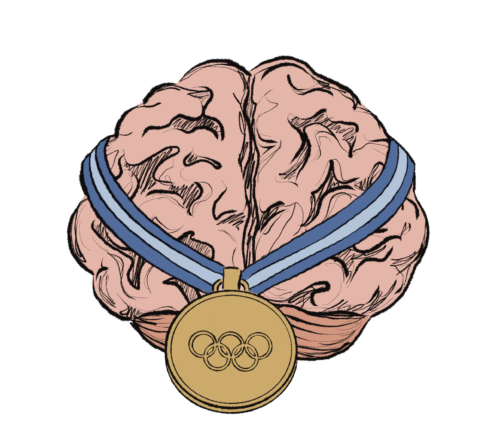
A Winning Mindset or Winning the Mind?
Graphic by Neshama Ryman

At the highest levels of sport, athletes generate massive attention, whether in professional leagues or national and world championships. However, nothing quite captures the public’s fascination with competition like the Olympic Games. Success stories catapult athletes to permanent cultural fame—think Usain Bolt, who broke world records and cemented the start of his legacy as the fastest man in the world at the 2008 Beijing Olympics, or the “Miracle on Ice,” when a young, amateur U.S. ice hockey team upset the professional Soviet Union team for the gold medal at the 1980 Lake Placid Games.
But what about the athletes who miss the mark? What do they get? Disappointment, and sometimes, vitriol from their own fans. In the 2021 Tokyo Olympics, Simone Biles—who many consider to be the “greatest of all time” in the artistic gymnastics community—stunned the world when she decided to pull out of most of her events after difficulties with a mental block known as the “twisties.” Social media blew up, claiming that Biles was “weak” or that she “failed her country.” More recently, the Australian middle-distance track team faced a swarm of online hate after they failed to qualify for the final.
How do athletes get past this constant fixation on “win” or “lose”? Over the past few years, sports psychology has become the answer. Sports psychology helps athletes improve both their mental and physical game at every competitive level and has been shown to reduce anxiety and improve competitive advantage.
“Your cortisol levels go up, and your entire body is now hypervigilant to the point where you’re actually making mistakes because you’re hyper-focused on things,” Harvard psychologist Michael Hollander told the “Harvard Gazette.” “And trying to do two things at once rarely, rarely works. Your focus is gone, and you stumble.”
Nowadays, athletic trainers focus on regulating the prefrontal cortex and amygdala, which are responsible for decision-making and emotions, respectively.
It is no wonder that sports psychologists are in high demand. The U.S. Bureau of Labor Statistics estimates that from 2021 to 2031, psychologist employment will grow by 14%, with an 8% increase in demand for sports psychologists. To put that in perspective, the Bureau projects employment in computer and information technology occupations to grow by 14.6%.
As a high-performance athlete in synchronized figure skating, I’ve been lucky to be backed by a federation that prioritizes the mental health of its skaters. U.S. Figure Skating’s sport psychology team is run by Dr. Caroline Silby, a former competitive figure skater.
In every discipline, Team USA skaters and coaches have access to one-on-one counseling, workshops, and therapy sessions, among other offerings.
My team, the Haydenettes, has regular psych sessions with Dr. Lauren McHenry throughout the season to improve our pre-competition prep, teamwork, and effectiveness during practice. The content and format of our sessions vary. Sometimes, we sit in a circle and discuss issues the team has been having or anxieties about a certain element or upcoming competition. Other times, we break into groups to debate our goals for the next training block or write personal, anonymous notes in response to a given prompt.
What I’ve found extremely effective is the policy of “what is said in the bubble, stays in the bubble.” In other words, we, along with McHenry, keep the specifics of our discussions and what individuals have shared during the sessions private. We feel empowered to be honest during the sessions. We can bridge the occasional communication gap with our coaching staff, as it can be hard or awkward for skaters (or any athlete on a team) to voice concerns or comments about how practices are run.
Another positive impact sports psychology has had on our performance is our consistency and stress management on competition day. Earlier in the season, we reviewed how anxiety manifests in the body and ways to regulate our nervous system. Personally, I’ve adopted visualization and breathing exercises to help calm my nerves before I take the ice. Through our psychology sessions, we’ve also improved how we practice on and off the ice, leading to more reps, greater confidence, and, finally, successful performances.
This mental tenacity has paid off—my team has won a medal at every single competition this season, domestically and internationally. And if you want to see the success of sports psychology from other U.S. Figure Skating athletes, look no further than Amber Glenn and Alysa Liu.
Glenn, a three-time U.S. national champion, an Olympian, and one of the few U.S. women to ever land a triple axel in international competition, has been open about her mental health journey. After struggling with depression and self-comparison, Glenn began seeing results when she worked with sports psychologists to manage her anxiety instead of simply medicating it. Alysa Liu, the 2026 Olympic gold medalist, has spoken out about how changing her intrinsic motivation—a key component of sports psych sessions—helped her view skating as something she could enjoy, not a job she had to perform.
Nevertheless, some athletes discount the importance of sports psychology or resist even the notion of seeking psychological treatment. A 2000 survey by Long Island psychologists found that only 10% of subjects had seen a sports psychologist, despite 100% of respondents feeling they would benefit from doing so. The authors noted that many athletes have coping mechanisms they prefer over seeking professional help, such as superstitious behaviors, performance-enhancing drugs, or conditions like eating disorders or exercise bulimia. Additionally, a 2021 paper discovered that individuals in team sports found it more difficult to participate in counseling and showed increased “stigma tolerance,” the belief that they will be perceived negatively if seeking sports psychology.
Athletes can deal with fear of failure, high expectations, fragile self-confidence, and breakdowns in trust when it matters most. Sound familiar? A 2025 survey by Healthy Minds discovered that 23% of Harvard students reported experiencing anxiety, and 22% reported signs of depression. “Mental health on this campus sometimes feels very invisible,” a member of Active Minds commented to the “Independent” last year. “It’s something that a lot of people struggle with, but not many people are willing to talk about.” Just as athletes do, students face mental challenges that can constrain us from fulfilling our potential.
“Athletes must find pleasure in ‘being’ versus ‘achieving’,” Silby said in a 2023 interview.
Sports are so much more than winning a medal or making a team; they are the experience and joy we feel while preparing and competing. It’s not every day that you get to be healthy enough to train with your teammates and friends, and I think sports psychology has put that into perspective.
The same goes for attending Harvard: for most students, attending the College has been our dream for many years, and the resources we have here to fulfill our academic goals are unparalleled. Sports psychology and therapy can help us focus our plans and appreciate the process of achieving them. So why not work towards enjoying every second of your time as an athlete—or student?
I’ll finish with this quote from the 2026 Norwegian biathlete Vetle Sjaastad Christiansen: “That’s what we’re going to remember when we get old. It’s not necessarily the physical gold medal, but it’s the gold medal of memories. And we had thousands and thousands of them these past weeks and months.”
Caroline Stohrer ’28 (carolinestohrer@college.harvard.edu) thinks everyone should try therapy at least once—even if they’re a NARP.