We Just Don’t Care: U.S. Baseball
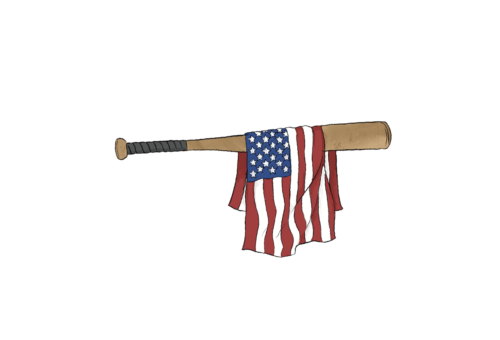
Graphic by Neshama Ryman

While many Major League Baseball players are returning to form during spring training, countries from around the world united to compete in the World Baseball Classic. As a nearly two-week tournament, the Classic features Hall of Fame locks, top prospects, and some players who aren’t even professional ballplayers. With the chance to represent their country on a big stage separate from the MLB, players take the Classic with the utmost seriousness. And yet, the country that hosts the largest professional league doesn’t seem to want any part of it—why?
The World Baseball Classic is still a relatively new tournament. Beginning in 2006, the Classic was not the first major baseball tournament, but more of a revival; Olympic Baseball existed but was declining in popularity. Like the Olympics, the WBC would occur every four years. Even though the tournament was founded by the MLB, an American sports league, the U.S. team has only won once in 2017. The 2023 finals featured a showdown between the United States and Japan, who ended up taking it all.
Fast forward to today, and the United States has a dangerous lineup, yet many doubted the depth of the pitching talent. While Team USA made a deep push to the finals, they were defeated by Venezuela. And though critics were right to have concerns about the pitching, the issue was larger than that. Restrictions on when pitchers could play, and leadership that failed to show up resulted in the United States coming up short.
What in the World is Insurance?
Mar. 26 marks the start of the MLB regular season. Few teams are eager to have their players risk wear and tear in a tournament that doesn’t help the team. Pitchers especially face extreme restrictions on how much they can throw per game and how many games they can play.
But the biggest restriction MLB players face is obtaining insurance for the team. The insurance guarantees that an MLB team’s investment won’t be wasted if a player is injured. Pitchers have the highest requirement for insurance, with their salaries guaranteed for four years as opposed to the two for position players. But once a pitcher is guaranteed insurance, they aren’t given full autonomy. Teams still limit when a pitcher can actually play, and because games occur back-to-back, there is little time for a pitcher to fully recover.
Team USA had arguably the two best pitchers in the world with Paul Skenes and Tarik Skubal, both of whom won the Cy Young Award last season for their respective leagues. Yet, neither of these players pitched in the championship game; granted, Skenes pitched in the semi-finals against a monster Dominican Republic team.
Logan Webb, the star pitcher from the Giants, also sat out, having played in the quarterfinals. Instead, Nolan McLean, a top prospect for the Mets, started against Venezuela. McLean is a great pitcher, but he’s young, having made his MLB debut only last year. Of the U.S.’s two losses in the Classic, McLean started both.
However, Webb could—and should—have started. There were seven days of rest between the game against Canada and the match against Venezuela, plenty for a pitcher. So why didn’t he start? This was because the Giants only lent him for two games, nothing more.
A similar case occurred for relief pitchers. To start the ninth inning, Garrett Whitlock entered the game tied at 2-2. Whitlock is a phenomenal relief pitcher—there’s no doubt, but Mason Miller, an all-star, who many tout as the top relief pitcher in the league, remained inactive. It’s easy to say in hindsight that Whitlock was not the answer, as he gave up the winning run off a double, but still, anyone would have preferred Miller. Why didn’t he close the game? Because the Padres only allowed him to be used in a save situation.
“O Captain! My Captain!”
The tournament follows a pool format, where all teams compete in separate groups before a few are selected based on record to advance to the elimination stages. Before their final pool game against Italy, the U.S. team believed they had already clinched a spot, but they had not. They lost to Italy and risked being knocked out if Mexico were to beat Italy in a low-scoring game.
Following the loss, team manager Mark DeRosa said he had misspoken about their spot in the tournament. He also admitted that a few players had been up late the night before the match against Italy, partying after a win against Mexico. How do players representing their country manage to make this mistake? Poor leadership.
Blame easily fell on DeRosa, who is not a professional manager but rather a studio analyst for the MLB. DeRosa displayed an arrogant, blasé attitude and made many disagreeable choices, but he is not the only one who fell short. Where was the captain to keep the United States team in line?
Aaron Judge, the star player for the Yankees and almost guaranteed lock for the Hall of Fame, served as captain of the U.S. team. Many on the roster have credited Judge as being an inspiration with his no-nonsense, collected attitude; however, he, alongside veterans like Bryce Harper, should have corralled the team and confirmed whether they were a lock for elimination rounds.
Moreover, Judge has been further criticized for giving a weak motivational speech before the tournament began, suggesting that the U.S. stars could not find the spark necessary to mount a comeback. Instead, Team USA was too busy listening to an ex-Navy SEAL, dedicating their performances to honor U.S. troops, and creating a too-tough attitude.
In a tournament designed for friendly competition and appreciation of talent from around the world, the United States opted for a no-fraternization policy to “stay locked in.” Cal Raleigh received backlash for refusing to acknowledge his Mexican teammate in the MLB after just making a deep postseason run. But where was this “lock in” when the U.S.’s place in the tournament was at risk? Or in the championship game?
If You Ain’t First, You’re Last
Talking about the many restrictions imposed by teams, two-time NL MVP Bryce Harper admitted that the Classic is “not the Olympics.” While many misunderstood him, he (unfortunately) is correct. As a country, the United States does not care about the tournament.
While players and fans alike in countries such as Japan, Korea, or Venezuela cancel all work or see huge economic gains from the tournament, the United States’ stance is one of apathy. As such, there is no pressure on team managers to make exceptions for players to participate, nor on players to go through the process of obtaining eligibility and insurance. I don’t expect MLB teams, which are more concerned with profits and their chances of winning the World Series, to care about the tournament, but Team USA and its players could have done more.
Gold medal-winning Venezuela and their manager Omar López defied teams’ instructions for pitchers. For them, given the recent political strife and the lack of sporting wins on the global stage, this victory superseded the team’s wishes. A former National League MVP and star for the Atlanta Braves, Ronald Acuña Jr., was on the roster, though injured, when the Braves won the World Series in 2021. Despite having that championship ring, he admitted that winning the World Baseball Classic was the “number one [achievement] in his career.”
I’m not advocating for DeRosa or any other team to blatantly ignore the teams’ wishes; I use these examples to show that other countries care more about the tournament than the United States. They are representing their country on the grand stage, something they couldn’t do outside of individual success on an MLB team. Perhaps U.S. players don’t have the same perspective serving as motivation, given their position as members of the nation that operates the league.
Tarik Skubal, now a back-to-back American League Cy Young winner, pitched one game. A singular pool game against Great Britain. Skubal, who will enter free agency in 2027, is expected to sign a huge offer, so the pitcher wants to preserve his health for when payday comes. However, the pitcher still took up a roster spot that could have gone to many other players.
Silver is great, but it isn’t enough for a team of this caliber. The flaws are multifaceted, stemming from both fans and players. As fans, the United States needs to give a damn. Care about this tournament. Why celebrate a sport you’ve never heard of in the Olympics? Because you’re American. So what if you’ve never played, heard of, or cared about the sport? Those are your countrymen. The same philosophy applies to this tournament: these are the world’s greatest baseball players; we should hope to prove that we have the better players.
The players, on the other hand, need to recognize what the honor means. I cannot advocate against sound financial decisions, but there comes a time when legacy is on the line: step up and make your country proud. If you’re going to be unfriendly and disrespectful to the competition, back it up with the win. If you’re going to bring in an ex-Navy SEAL to motivate his team through a retelling of his supposed killing of Osama Bin Laden, back it up with more than bravado. If you’re going to wear the jerseys from the U.S. men’s gold-medal game, back it up. Otherwise, these displays of valor transform into displays of blatant arrogance and offense.
One can only hope that this loss in the finals—as well as the one in 2023—will inspire players to return and dominate the tournament. So many elite pitchers were left off the roster. Hopefully, next time they will be able, or maybe more importantly, want to compete.
Tyler Dang ’28 (tylerdang@college.harvard.edu) congratulates Venezuela on a well-deserved victory without any aid from a U.S. president.