In Full Bloom
Graphic by Mia Stewart

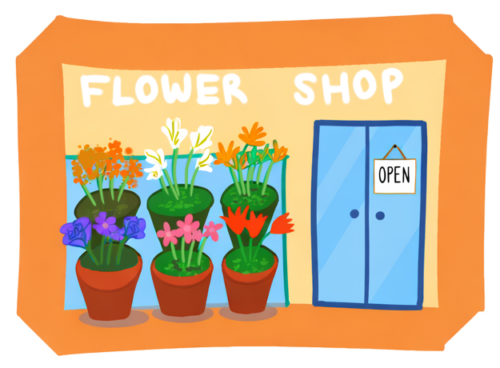
Harvard Square has always been a place of constant motion—students rushing to class, tourists pausing at storefronts, and locals weaving through the familiar maze of brick and cobblestone. Amidst the churn of coffee shops and bookstores, two flower shops have quietly bloomed. Petali Flowers and Brattle Square Florist have each carved out a small, fragrant corner in the Square, offering a personalized experience centered on human connection—something that neither large retail chains nor online services can widely replicate.
Cambridge is home to just over 121,000 residents, with nearly 30,000 enrolled in local college or graduate school and more than 40,000 students attending schools across the city, shaping its daily rhythms and filling its streets. By daytime, the population rises closer to 200,000 as workers and visitors flow in and out, compressing the Square into a steady circulation of faces, errands, and quick encounters.
Flowers account for a significant portion of residents’ spending: Americans spend nearly $69 billion annually on flowers and plants, with average spending exceeding $260 per person, and about 65% of consumers purchasing flowers at least occasionally. In a bustling place like Harvard Square, Petali founder John Selletto saw a clear opportunity to start a business that would likely take root—and founded the store on an impulse with almost no prior experience.
Selletto, who opened Petali in June of 1989, didn’t always dream of becoming a florist. He and his brother had been traveling throughout the American Southwest, sourcing goods to sell, before landing in Smith Campus Center, which was then called the Holyoke Center. “There was a big open space there [in the Holyoke Center]. So I just ran upstairs, and I asked him if I could have that space. And [he] said, ‘What do you want to do?’ I said, ‘We’ve got a flower shop [and] zero experience.’ We’ve been winging it ever since,” Selletto recounted to the “Independent,” smiling.
That improvised spirit has carried Petali through 35 years of business. “We’ve never had a meeting,” he said. “There’s no plan for this business.” Instead of strategy, Selletto maintains a commitment to authenticity: no advertising, ever, and no corporate structure. Just good flowers, Pinyon incense burning somewhere in the back, and calm music playing on loop. “We take [the flower shoppers] out of their space and into this space,” he explained. “They get absorbed in it and forget about all their problems.”
Selletto believes the shop’s staying power comes down to something deceptively simple. “We’re really nice to people,” he said. “We say ‘hi’ to them. We say ‘thanks for coming in,’ even if they don’t buy anything.”
Across Brattle Street, Stephen Zedros has spent even longer in the business. He started coming into Brattle Square Florist as a child, helping his parents and grandparents close up the shop. After attending Boston University, Zedros came back to help out on one busy weekend and never really left. “They weren’t answering the phones properly, putting people on hold for five minutes. It was crazy,” he recalled. That was 55 years ago.
The Brattle Square Florist has been in the Square for over a century, occupying three different locations until finally making its way to its current home next to L.A. Burdick Chocolates. “[It] used to be where Lovestruck was way back 100, 105 years ago. And then it was 31 Bradley Street … And we came here about 44 years ago.”
Both men know the rhythms of the Square better than almost anyone. July and August bring quiet; students leave, faculty disperses, and Cambridge empties. For Petali, the steady drumbeat of walk-in customers—particularly on Fridays, Selletto noted, when people come in looking for ways to make things right with a significant other—keeps the shop afloat across the lean months. “That’s all year round,” he said. “Somehow, people think flowers will get them out of being in trouble.”
For Brattle Square, weddings and summer parties carry July and August, while spring—with its cascade of Easter, Passover, Mother’s Day, proms, and graduations—is the most active season. “This is when we go really crazy,” Zedros said. “All the colors, pinks, yellows, pinks, yellows, purples. This is our busy season. So all [events] combined … we do a lot of centerpiece work, and it’s creatively inspiring, but also a lot of volume.”
By the time spring arrives, both shops fill with the same flowers: tulips, hyacinths, daffodils, cherry blossoms, and the lush, jewel-toned ranunculus that Selletto immediately named as his favorite for the season. “Cloni ranunculus—it’s an Italian flower,” he said. “All different colors. Really beautiful, weird flowers.” Besides his distinct love for ranunculus, Selletto tends to resist picking favorites at all, preferring to let the season decide. “In May, everybody is looking for the peony,” he said. “Each season, the flowers shift—what’s here now won’t be here in a couple of weeks.”
In the quieter months, however, the flower shoppers walk in with a different tone—less celebratory, more reflective—and the shop adapts accordingly. “So you may do some weddings in July and August and keep yourself busy,” Zedros explained. “And in January, January actually [has] a lot of funerals … It’s very busy.” The shift, he noted, feels almost intangible, shaped as much by emotion as by season. “I think [one] gets through the holidays of December and maybe Thanksgiving, and you get to January … It’s funny how it happens. It’s very interesting … a psychological thing too.”
For Harvard students, the Square can feel like an extension of campus—another backdrop for p-sets, quick meals, and passing conversations—rather than a place with its own cycles of care and memory. But both Selletto and Zedros see students as part of that flow, whether they realize it or not. And the impact of flowers on people is deeply significant. “We definitely make people smile. I mean, flowers do something,” Selletto said.
Inside the shops, the Pinyon incense and calming music coalesce into something larger as the days get warmer. “Because everybody’s cooped up in the wintertime, and you get a couple sunny days and warm days, and everybody comes out. Everybody wants flowers in their life,” Selletto added. The business has grown through something less visible but more vibrant: people returning to “have some kind of color and springtime in their life,” he noted.
Zedros, too, returns to the people behind each purchase when asked about his favorite part of being a florist. “Everybody’s got really nice stories,” he said. “Really nice stories.”
Cindion Huang ’29 (cindion_huang@college.harvard.edu)will be paying more visits to these shops as spring (and flowers!) continue to bloom.