Decisions, Decisions
Graphic by Trischelle Afihene

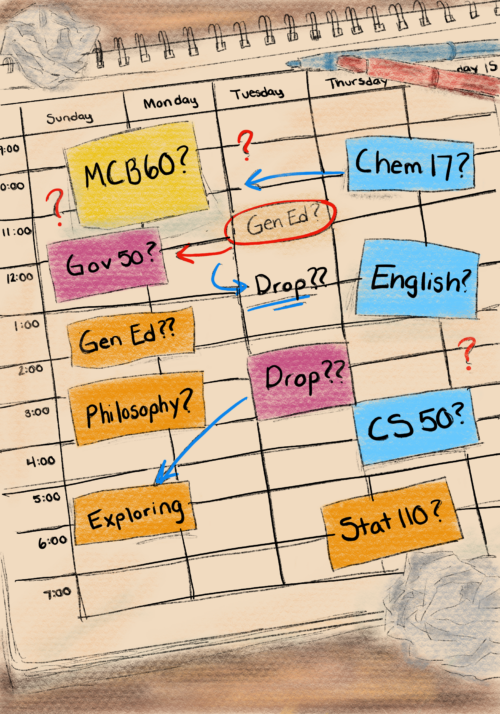
Riding the high of Harvard College Housing Day, first-year students have quickly been confronted with another pivotal College milestone: course registration. On Wednesday, April 1, the course registration portal opened for first-years, sophomores, and juniors to select their fall 2026 classes. For first-years, these choices carry added weight, with the looming October concentration declaration deadline looming.
As they build their schedules, students face a fundamental decision: spend one final semester exploring potential fields of study or double down on the requirements of an intended concentration—a challenging choice in a College that offers more than 50 concentration options.
Before formally enrolling for fall semester classes, first-years must meet with their pre-concentration advisors to discuss academic options and interests. This is a requirement to lift the advisory hold placed on each student’s portal before registration. Students work with their academic advisor to plan their schedule for the upcoming semester—and sometimes tentatively for the next three years. After meeting with their advisors, first-years have until April 15 to register for classes.
Academic advisors guide students through the process of selecting a concentration and fulfilling its specific requirements with the classes they will take in the fall. Many students have already decided on their intended concentrations. “I want to do a double [concentration] in Government and Philosophy with a secondary in Global Health and Health Policy,” Noor Ali ’29 said to the “Independent.”
“I’m going to try to knock out my requirements first,” added Ali. For her, the choice to double-concentrate with a secondary limited her ability to take classes unrelated to her chosen fields of study. Students who try to balance multiple fields of study have less flexibility to use course selection to explore. In addition to the average 10 to 14 courses required per concentration, undergraduates must fulfill Expository Writing, General Education, Divisional Distribution, Language, and Quantitative Reasoning with Data requirements. As a result, students with more concentration requirements must focus on efficiently selecting their classes.
Some students knew exactly what classes they would be taking, well before the beginning of the class registration period. “I’m going to look through the courses that relate with [Molecular and Cellular Biology], but also things like GenEd requirements,” Ava Rae Moss ’29 said. This sentiment was shared by many who aim to balance requirements for their intended field with broader College curriculum demands.
Some students, on the other hand, remain unsure of both their intended concentration and fall class selections. “Right now, I’m a bit undecided. I’m thinking either Econ [and] Stats, Econ [and Computer Science], or maybe Applied Math,” Emily Jing ’29 said. She, however, is not using her classes to help her decide which concentration to pursue. “I’ll look at all the requirements, and then I’ll choose my classes based on that,” said Jing. Even without a clear intended concentration, Jing’s focus on fulfilling her requirements early on echoed the sentiments of other first-years.
Across both students with clear plans and those still exploring, fall registration is also focused on how each student’s schedule will fit together in terms of workload, weekly in-person time commitments, and content.
All these considerations lead to the fall semester when Concentration Declaration Day arrives. All Harvard students come in undeclared, allowing first-years to explore all that Harvard College has to offer. Students may enter the College with the intention of studying a specific concentration, but formal declaration does not happen until sophomore year. This past year, the deadline to declare was Oct. 10. After the deadline, students are still able to change their concentration, and about one-third of undergraduates end up switching concentrations. Students who want to change their concentration can do so by working with their respective department advisor.
The Harvard Undergraduate Association usually hosts Concentration Declaration Day festivities, which it has organized since 2023, providing Joe’s Pizza and signs bearing the names of each concentration for students to take pictures with. This upcoming October, current first-years will flood the steps of Widener Library as eager sophomores, ready to officially take on their concentrations.
At the same time, these decisions are influenced by other shifts in student life. As course registration approaches, other changes in student life begin to unfold. Students adapt to new social dynamics following Housing Day, while summer plans such as internships, research, or travel come into consideration.
For many students, decisions about what to study become tied to these wider considerations, as academic interests are weighed against future career opportunities. “Because I’m doing Social Studies, a lot of my summer plans revolve around exploring that,” Timmy Tran ’29 said.
Katherine Lam ’29 (katherine_lam@college.harvard.edu)and Miriam Tsegay ’29 (miriamtsegay@college.harvard.edu) are still deciding what to take next fall.