“Asian Women I Know”
Graphic by Clara Lake

From March 25 to 29, the Harvard Asian Student Arts Program presented “Asian Women I Know,” a one-hour play written by Mira Jiang ’26 and directed by Crystal Manyloun ’26. Inspired by a real dim sum dinner between Jiang, Manyloun, and their friends, the two transformed a meaningful conversation into a fully realized production.
“Having both of us create the play together, we were able to bounce ideas back and forth with each other, add specific details from our own experiences, and try to capture the essence of the original dinner conversation to the best of our ability,” Manyloun shared in a post-production interview with the “Independent.”
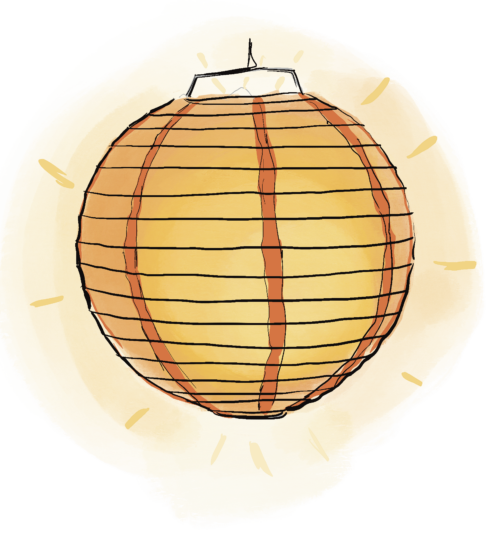
The lights come up on a vacant table in a dim sum restaurant in Boston Chinatown with a classic white silk tablecloth and red chairs. A round paper lantern hangs above the table. In the foreground of Harvard University’s Agassiz Theater, three more tables seat a few audience members, immersing them in the play as if they were fellow patrons of the dim sum restaurant.
“I really wanted the audience to feel like they were at the restaurant with us. I wanted the audience to feel like they were invited into the conversation and not just eavesdropping,” Manyloun detailed.
A waiter, played by Michael Xiang ’26, walks among the tables, dressed in a typical Chinese-style black and red waistcoat. He hums “Mo Li Hua,” or “Jasmine Flower,” a popular Chinese folk song, embodying the oftentimes aloof waiters of Asian restaurants who show little concern for ingratiating American customer-service standards.
The five women enter the restaurant excitedly. Anna (Maggie Peng ’28), who is likely based on Jiang herself, sets the scene. They are seniors at Harvard, and it is their first time exploring Chinatown. Already, the friction between their Asian and American identities is alluded to—the girls are going to dim sum for dinner, despite the fact that it is traditionally a brunch meal. Anna calls out “wu wei!” meaning “table for five,” in American-accented Mandarin, to which the waiter hardly reacts.
As they take their seats, Anna introduces her friends to us, as the paper lantern lights up in a different color for each woman. Jasmine (Phoebe Zhang ’26) lights the stage purple—she wears bold makeup and a leather miniskirt, fitting the “Asian Baby Girl” stereotype (an Asian woman with a Westernized style), and is an aspiring singer-songwriter. Vivien (Grace Liu ’26) is represented by a blue hue, and Anna describes her as “the smartest girl I know,” a math genius. The next color is pink for Kitty (Kaitlyn Mady ’29), a bubbly cheerleader. Star (Grace Zhou ’28) is teal, a kind-hearted and gentle woman with a secret passion for creative writing. Finally, the lantern turns red for Anna, but her introduction is interrupted, obscuring her backstory and motivations.
Throughout the play, the lantern changes color for each character’s flashbacks, a consistent symbol that tracks how their stories shape their perceptions of their Asian-American identities, thanks to Lighting Designers Ethan Li ’28 and Alex Nugent ’28. The similar color of their outfits also reflects these motifs, designed by Kacy Bao ’26. Furthermore, the characters represent a diverse range of Asian ethnicities—Jasmine is from Laos, Kitty is Vietnamese, Star is Korean, while Vivien and Anna are both Chinese.
Importantly, food was placed at the very center of the play. Each showing, the dim sum table was filled with full meals for the cast to eat throughout the act. “Many people came up to me and the actors after the show, asking: ‘Is that real food on stage?’ which I found really funny. Yes! It was real food,” Manyloun explained.
“The order of food eaten by each cast member was very specific, especially since we wanted to end scene 15 with only one piece in each dish for the girls to take that final bite,” she continued. The food choreography included five portions of noodles, six egg tart halves, four sesame balls, five red bean mochi, three strawberry mochi, and three rice rolls.
Their conversation starts with any friend group’s favorite topic—recent romantic interests. The scrutiny turns on Star, as her friends, especially Kitty, disapprove of her on-and-off relationship with her white boyfriend. Star tells a story about one of their dates, and we are whisked into a flashback in which she directly addresses the audience, a teal lantern shining overhead.
Xiang plays Star’s boyfriend, dressed in a basketball jersey and a backward baseball cap, a complete transformation from a tired, Chinese dim sum waiter. Star tells us that she was wearing uncomfortable shoes that night, trying to convince her boyfriend to sit down on a bench. However, she never directly asks to sit, constantly repeating, “only if you want to,” demonstrating how Asian women are often conditioned into taking up less space.
Returning to the restaurant, the characters’ conversation turns towards the greater phenomenon of white men dating Asian women, mentioning terms like “yellow fever” and citing ideas like the “Oxford study.” They discuss the story trope of an American military man going to Asian countries and falling in love with a docile, exotic Asian woman. Examples of this trope can be found as early as the 1904 opera “Madama Butterfly.” The characters call into question the ethics of interracial relationships and whether they are inherently flawed, especially when white men pursue a fetishized idea of an Asian woman.
The following scenes detail the experiences of Vivien, Kitty, and Jasmine. Vivien tells the story of how she was known as “BMV” among her peers in the high school Science Olympiad, an acronym for “Ballistic Missile Vivien.” The nickname came from one particularly difficult Science Olympiad tournament, during which Vivien confidently solved a problem like a missile.
The triumph and pride of Vivien’s nickname is contrasted by telling the origin of Kitty’s nickname at the same time. She tells us that “Kitty” is short for “Katherine,” which was bestowed upon her by her strict and unforgiving cheerleading coach. The other students on the cheer team would call her “Hello Kitty” in mockery, but Kitty never realized they were bullying her for her race in high school, instead believing they were making her feel included.
Jasmine then gives a lecture on the “ABG,” or “Asian Baby Girl,” stereotype. She explains that the name originally stood for “Asian Baby Gangster,” referring to Asian women in metropolitan areas who participated in gang activities in the 1980s. They diverged from the stereotype of quiet and submissive Asian women, but eventually became a stereotype of their own—now associated with being the equivalent of “dumb blonde” of Asian women and fetishized once again. Jasmine sings a song about how the ABG aesthetic empowers her, while expressing frustration with the white male gaze and sexualization of Asian women.
Each scene evoked both an understanding of the diversity of experiences Asian women may have while also offering points of connection for the audience. Even if viewers could not directly relate to the stories of each woman, they nonetheless could see themselves in the traumas each person held and shared—whether it be the ever-present fetishization of Asian women or choosing to ignore bullying for the sake of finding belonging.
“In creating the characters and structure together, there were many moments in our creative process where we found ourselves learning from each other’s experiences and perspectives,” Manyloun shared. “For example, the ABG stereotype and history was a topic that Mira was less familiar with, but I was more familiar with, especially since I grew up discussing these topics with my Laotian family.”
The conversation shifts towards the well-known stereotype of Asian “tiger parents” and how Asian children are pitted against each other for their academic achievements from a young age. Star’s experiences with being compared to her cousin Cici, played by Liu, are depicted as a game show. The hosts of the show, played by Peng and Xiang, make the two compete for a crown by testing their multiplication tables, piano playing, and college acceptance results. In a twist of events, Star, who failed both the multiplication and piano competitions, is accepted to an Ivy League school and earns the crown, while her cousin attends a state university. However, when the game show ends, the cousins discuss their post-graduation plans. Cici takes back the crown as she lands a comfortable consulting job, while Star must attend medical school for several more years.
With a cast of only five members, each actor showed an incredible range of talent and character, from Asian parents to game show hosts to cheer captains. In particular, Xiang, who mentioned that it was his first time acting in his program’s biography, transformed from a waiter to a boring boyfriend to a father.
Finally, the show reaches a climax when Anna’s story is revealed. She desires to connect with her Chinese heritage, as she can only speak broken Mandarin and knows nothing about the country, deciding to travel to China after college. However, her mother opposes the idea, as she feels that Anna is ungrateful for the sacrifices she made to immigrate to the United States. As a scientist, Anna’s mother was questioned in 2018 during the “China Initiative,” an operation by the Department of Justice to counter Chinese espionage in academic circles, which relied heavily on racial profiling and intimidating interrogation techniques.
In a flashback, Peng plays Anna’s mother as she is questioned, then returns to playing Anna, who is being scrutinized by non-Asian people around her. The scene grows ominous as her friends slam their fists on the dim sum table, making the dishware rattle loudly. The women approach Anna and begin to tug on her arms in opposite directions, shouting insults about not being American or Asian “enough.” Anna collapses in exhaustion, and the red lantern above her fades to black.
Perhaps the reason for obscuring Anna’s story when the other women are introduced is to demonstrate that her narrative does not fit into any of the existing Asian archetypes. Jasmine represents the “ABG,” Vivien the successful student, Kitty expresses being “whitewashed,” Star is socially conditioned into staying quiet—Anna is none of these, a more realistic portrayal of an Asian woman.
When the lights come up again, the waiter is ready to settle their bill. During the show, he had not forgotten to attend to his other tables, passing us menus and fortune cookies. Anna invites us to break our fortune cookies together. She counts down from three to read our fortunes out loud.
The choice to center the show around a dinner conversation and a genuine meal was intentional. “I started thinking about how, as a meal progresses, people start to get more comfortable with each other and more full,” Manyloun said. “This naturally led Mira and I to develop the structure of the play, specifically the sequence of vignettes, to become more and more ‘full’ as the play progresses.”
That feeling of welcome, of communion, is one that each person remembers too well. Each of us has shared stories at the dinner table and listened to the stories of loved ones in turn. This play marks another meal to be remembered. It was a gift to be welcomed to the meal of Asian women we’ve now come to know.
Courtney Hines ’28 (courtneyhines@college.harvard.edu) and Ellie Guo ’29 (eguo@college.harvard.edu) know a lot of Asian women.