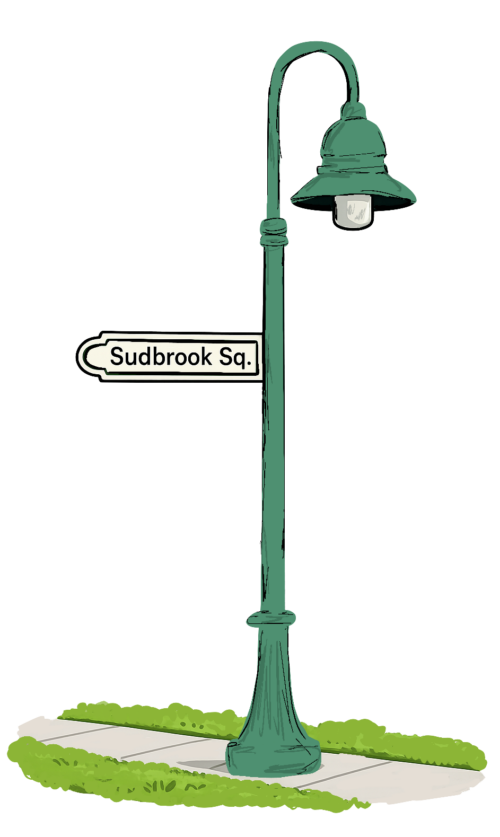
Exploring American Hometowns: New Albany, Ohio
Graphic by Annelise Fisher

Dear Sudbrook Sq.,
You sounded like “Hawaii Five-0” on a Friday night and smelled like monkey bread on Christmas morning. You felt like rollerblading where cars never passed and juggling a soccer ball until the soles of my feet stained black. You were my childhood home, a place of refuge and familiarity. But now painted white, with new shutters and a Chevy truck parked where a Mazda 6 once sat, I’m not sure if this place made me or if I made it.
I moved in when I was five; it’s the only home I remember. From a preschooler to a teenager, the house adapted to my shapeshifting. The beanbags, once used as a landing mat for somersaults, turned into seating for movie nights with friends. The blinds that I used to shut tight for an irrational childhood fear of an intruder stayed open as I grew older, sunlight peeking through as I got ready for school. The closet, once used for dress-up and playing “house,” turned into a space for homecoming dresses when my sister left for college.
Beyond the memories it contained, objectively, it was a child’s dream home. There was a huge granite island large enough for pizza making, slippery brown hardwood floors that I could slide around on, and four whole garages!
Eventually, it became just a place where I lived. The novelty of such a beautiful home wore off, and I backed out of the driveway or flew up the stairs with little appreciation. I ran in to grab a snack before practice and wouldn’t return until nighttime.
As teenage daughters do, I thought myself too ambitious for suburban life. I felt like the broader community, teachers, and family watched my every move, leaving no room for failure. The white picket fences our town was known for began to suffocate me, less charming and more confining. Conversations that once felt effortless started to become monotonous, while academic and athletic pressure quietly built.
Although I felt larger than the town, the house outgrew my family all too quickly. Sister by sister, we moved away in pursuit of something greater, leaving behind memories for my parents to live in. Rooms once consumed by joyful laughter could not be replaced by television echoes.
New Albany is a suburb of Columbus. It has a small “downtown” area, consisting of a Starbucks where middle schoolers would walk to every Friday after school; a library; and a Rusty Bucket, known among my friends as the restaurant with the best ranch dressing. Since 1971, Eagles Pizza has sat five minutes away from the public high school, with slices that easily rival Joe’s. Over time, the town expanded, now including a Target, Playa Bowls, and endless trails for walking the dogs. It has all four seasons, making both pool days and snow days feel out of a movie. Actually, “Business Insider” named New Albany America’s number one suburb due to crime rates, education, and other factors, leading me to believe the quote, “You don’t know what you’ve got ‘til it’s gone.”
I arrived in Cambridge, Massachusetts, ready to embark on a “new life.” When I admitted I was from Ohio, I was met with laughter and judgment—the state flattened into a TikTok punchline of cornfields and Jake Paul. Faced with these inaccurate perceptions, I found myself growing defensive, quickly realizing just how much New Albany meant to me.
Walking the same paths is peaceful, not mundane. Seeing the same smiling faces in grocery stores is comforting, not repetitive. The stillness I once resisted is now something I search for, but I come up empty-handed in the chaos of the city.
But with every beautiful childhood home comes the inevitable: downsizing.
I returned from an overwhelming freshman year to a house in a new suburb, Bexley, with creaky floors and one fewer bedroom, signaling that our family had moved on.
It wasn’t all bad, though. There was a pool in the backyard, and the neighborhood was closer to Columbus, but farther away from the version of home I had known and from the friends that made my town special.
I used to judge those who returned home after college. I couldn’t fathom raising my kids on the same streets where I learned to ride a bike. To me, staying meant settling—choosing comfort over ambition.
But somewhere between semesters in Cambridge, that narrative unraveled.
Sick of my complaining about driving more than five minutes to see my best friend, after a year in Bexley, my parents moved back behind the white fences—back to New Albany, the town I had once been so eager to escape. And yet, when I return, it no longer feels simple.
It’s impossible to feel like I fully belong. I am an entirely different person from who I was in high school, and Cambridge now holds the version of me that has changed. But leaving didn’t make my Ohio town smaller—it made my perspective larger.
The predictability, the quiet, the familiarity—these are not limitations, but anchors that keep me grounded.
I was mistaken. I tried so desperately to outgrow my home, and for a while, maybe I did. But home is not something to challenge or escape. It is something to return to—changed, but still there.
New Albany, Ohio, you were never just the backdrop of my childhood. You were the constant I pushed against, and now, the place I measure everything else against.
So I don’t know if you made me, or if I made this image of you.
But I do know this:
My big-city dreams and go-getter lifestyle haven’t disappeared—but neither has the quiet pull of home when Harvard becomes overwhelming. Cambridge may be where I am becoming someone new, and New York City or Washington, D.C. may be where this growth continues.
But you are where I learned what friendship, love, heartbreak, ambition, and everything deeply human are. When I leave now, I don’t feel like I’m escaping. I feel like I’m leaving a part of me that I hope to hold close no matter where I am in the world.
Paige Cornelius ’28 (paigecornelius@college.harvard.edu) thinks that everyone should come visit Ohio.