A New, Green Era
Graphic by Emma Crago

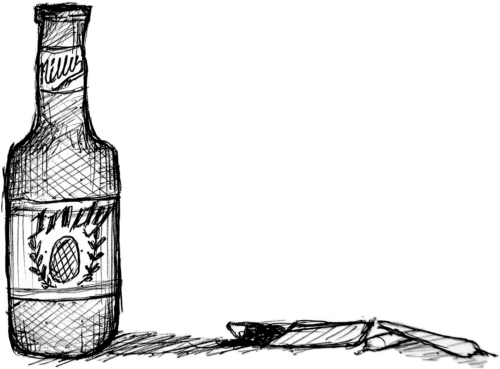
Don Draper drank at his desk. Jay Gatsby glamorized the Roaring 20s—and his odd love life—with extravagant cocktails and parties. James Bond downed enough vodka martinis to need a new liver. Hollywood has always known how to make a vice look aspirational, and for alcohol, it went all out. With bottles popping to celebrate or escape, alcohol slipped its way into the routine of every romanticized lifestyle on the big screen. Cannabis—also known as weed, pot, gas, or za, arrived at the party a little late, having done nothing wrong other than being a bit “loud” in an olfactory sense.
Behind the smell, cannabis holds promising medicinal uses, an overdose body count of zero, and a lack of chemically addictive properties. Yet the U.S. federal government, in its infinite wisdom, classifies it as a Schedule I substance, having “no currently accepted medical use and a high potential for abuse.” It shares this title with heroin. Meanwhile, alcohol kills roughly 95,000 Americans each year and is chemically addictive. You can pick some up at any gas station in most states.
So how exactly did we get here? If you couldn’t tell already, the answer to this question is remarkably untethered from science. It’s instead about politics and a century-long anti-drug campaign from which alcohol was spared—while cannabis, on the other hand, was front and center. This normalization of alcohol over weed is something we should stop uncritically inheriting. It’s time to challenge the narrative.
Take a moment to think about how deeply embedded alcohol is in modern-day culture. We pop open bottles of champagne to celebrate birthdays and watch football games with a Bud Light in hand. The wealthy show off their sophisticated wine collections and aged whiskey. If you go back far enough, our relationship with alcohol only deepens. Wine symbolizes the blood of Christ in Christian communion and blesses the Jewish Sabbath—the ancient Greeks even built a God around it. If you can believe it, beer might actually be one of the oldest prepared drinks in human history. It seems like the ancient Mesopotamians knew how to live it up. Alcohol is rare in that it’s something that transcends the rigid structure of our society that often draws out differences. Both the billionaire and blue-collar worker crack open an ice-cold beer after a hard day’s work. It’s simply something people do.
Weed was handed a different set of cards, and it shows. If you smoke weed, people don’t see it as something casual. You’re probably a stoner, a slacker, and have no direction in life. This stereotype has been challenged, with very few studies showing the possibility of a causal relationship between cannabis use and decreased motivation; most indicate that low motivation is a feature of addiction rather than the cannabis itself. However, society didn’t arrive at this false narrative on its own—it was strategically fed to us.
It first began with Harry J. Anslinger, America’s very first commissioner of the Federal Bureau of Narcotics. At the beginning of his tenure, Anslinger believed weed consumption was unproblematic, even regarding the idea that it drove people to violence as an “absurd fallacy.” His rhetoric quickly changed, and it’s evident as to why: Anslinger saw an opportunity to weaponize cannabis against the marginalized. His most notable remarks include that most consumers were of African American, Mexican, or Filipino descent, and that “Satanic” jazz and swing music were a result of their use. It’s clear what kind of person Anslinger was, and I therefore rest my case regarding him.
And so began the Reefer Madness campaign. What used to be called cannabis was now “marijuana,” meant to further its relation to Mexican immigrants, and the public officially deemed it a national threat. The plant was officially criminalized by the Marihuana Tax Act of 1937 after the film Reefer Madness put a cherry on top of Anslinger’s propaganda. The movie featured innocent teenagers taking part in murder and suicide after sparking up a single joint. While today’s critics consider it one of the worst movies ever made, it worked remarkably well as propaganda at the time.
But wait—just four years before this criminalization, the United States watched Prohibition spectacularly collapse. For thirteen years, the government tried to strip alcohol from American life, but failed because society wouldn’t allow it. The speakeasies and bootleggers made it clear that alcohol was too deeply woven into daily life to be pulled out. The government learned its lesson and has left alcohol untouched since then. But cannabis, now criminalized, had a long journey ahead of it.
Nixon doubled down in 1971 with the “War on Drugs,” which his own Domestic Affairs Advisor later confirmed was to vilify Black Americans, hippies, the anti-war left—essentially anyone who fit into their idea of the “dangerous” counterculture on the rise. Reagan’s “Just Say No” campaign followed, which was so stupid it made “Reefer Madness” look nuanced in comparison; the slogan originated from his clearly prodigous wife, Nancy Reagan, during a conversation she had with an elementary schoolgirl. Bush and Clinton then put it all into law, starting one of the country’s most prominent periods of mass incarceration. This enforcement, as it had in the past, fell along racial lines: Black Americans are now nearly four times more likely to be arrested for a cannabis offense than their white peers, despite comparable usage rates, due to the legacy of Nixon’s campaign.
Take a look at what happened here. Cannabis was never demonized because science demanded it, but because Anslinger needed a tool for racial control, and Nixon needed a weapon against political enemies. The scheduling of cannabis as a substance with “no accepted medical use” was unscientific and rooted in a racist agenda. That should bother us.
The early 2000s saw the light at the end of the tunnel as various states legalized medical use. In 2012, two states, Colorado and Washington, legalized recreational use. Fast-forward to today: recreational use is legal in 24 states, medical use in 40. Public support of legalization sits at around 60% nationally.
Beyond the laws, American culture surrounding cannabis has seen a huge shift in the right direction. The counterculture stereotype assigned to weed in the 30s slowly started being replaced by a sense of normalcy. We’ve all scrolled on TikTok or Reels and seen @natashahasthemunchies down 60mg before walking into an Indian restaurant or @bigjohngolfs “fog it up” (all heart) before running a half-marathon. Sure, their daily, or perhaps hourly, consumption may be slightly excessive, but what’s important here is that people aren’t labeling them as “hippie stoners” as they would have decades ago. Perhaps the most important note is that cannabis use among adults aged 65 and over has almost doubled in recent years; those who once only knew “Reefer Madness” as the truth and taught their children to “Just Say No” have quietly started reconsidering.
Look at any college campus, and you can also see the shift. Cannabis use among college students has increased substantially in recent years, while alcohol consumption has diminished. If you ask me, this makes sense. Black out on a Friday night at a frat, spend hours in the bathroom, and wake up at 2 p.m. the next day—well, your Saturday is ruined. Good luck getting work done with your stomach on edge, head pounding, and hangxiety eating you alive. Let’s imagine things had gone differently: you and some friends smoked a joint, DoorDashed Taco Bell, and drifted to sleep at a reasonable time. Saturday is a new day, unscathed by the decisions made yesterday.
The more you think about it, the stranger it becomes that, out of the two, alcohol is considered the one that fits into a productive and successful life. Even moderate drinking can lead to shrinkage in brain regions responsible for cognition and learning. On the other hand, adult cannabis use may not be linked with cognitive decline. None of this is to say that weed is harmless and without risks. The legalization of recreational cannabis has various implications, especially taking into consideration the effects on the developing brain. In fact, it appears that necessary research might be falling behind the commercialization in recent years. These are the conversations worth having. However, the health risks, which are still not fully understood, have never been the real reason behind the tough battle towards legalization. The driving force had a name: Harry Anslinger, Richard Nixon, John Ehrlichman, George Bush, Bill Clinton.
We’ve collectively decided that alcohol, despite the risks, is worth keeping in our grocery stores and daily life. It’s about time we apply that same standard to cannabis. Not because it’s perfect, but because the propaganda against it was wrongfully justified.
Draper had his Old Fashioned, Gatsby had his champagne, and Bond had his shaken, not stirred, martini. They all dodged the awful rhetoric. Rightfully so, cannabis might just be getting its turn in the rotation.
Luka Hernandez Palmer ’29 (luka.hernandezpalmer@mail.mcgill.ca) is an undergraduate student at McGill University studying biochemistry. He’s smoking that Harry Anslinger pack.