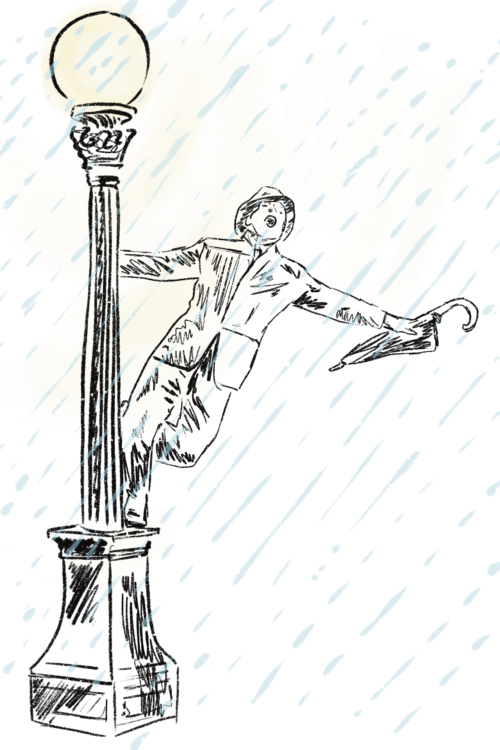
Aesthetic Nostalgia in “Singin’ in the Rain”
Graphic by Clara Lake

It seems like the best time to live is always the past. Romanticizing the aesthetics of bygone days happens in every culture, every year. “Singin’ in the Rain,” one of the most beloved films of the 20th century, is no exception to this nostalgia.
What often goes forgotten is that “Singin’ in the Rain” is set in 1927, during the tenuous transition from silent films to movies with sound. A common misconception is that the titular song debuted along with the movie in 1952—but actually, it was written in 1929, along with most of the film’s songs. In fact, only two original numbers were written specifically for the movie. The film is filled with stereotypical Jazz Era imagery—big band music, knee-length flapper dresses, and a speakeasy scene.
Why choose to recreate a moment that happened only 25 years prior?
Though it was only a couple of decades, it probably felt like ages ago to the mid-twentieth-century viewers of “Singin’ in the Rain.” There had been two major crises since 1927: the Great Depression and World War II. Adults who had grown up amidst global conflict longed for a more comprehensible and stable world order, regardless of how idealistic it was. Furthermore, given the film’s themes of rapidly advancing technology, looking back becomes a way to imagine simplicity, when the most complicated part of a movie was adding sound.
“But as we become further removed from a period, it’s easier to decouple moments from larger historical narratives and to indulge in the idea that times really were better before any given technological innovation,” film critic Lindsey Bahr wrote for the “Atlantic” in a 2012 reflection on the movie.
However, despite the impulse for 1920s nostalgia, “Singin’ in the Rain” deliberately portrays the era anachronistically, satirizing both it and the corrupt show business. In the film, a movie executive watches as a new singing film is being made, in what is known as the “Beautiful Girl” montage. Women model anachronistic flapper-style costumes with neon colors, shimmery fabrics, and exaggerated jewelry while the unnamed singer narrates.
“You can never be too modest,” the singer comments on a 1920s-style swimsuit. “You’ll knock them down at dinner, if your gown just drips with fringe,” he continues as a woman in a bright crimson flapper dress with floor-length fringe appears. In a moment of dark humor, the singer introduces a woman in a black flapper dress with flowing tulle fabric—for divorce court.
These scenes are clearly directed to a 1950s audience, who would find the costumes gauche and tacky, while still understanding that this design choice was meant to poke fun at older trends. It was also a moment to show off the technological prowess of the 50s—searingly bright Technicolor and the relatively novel green screen (terrible by today’s standards).
This satirical element disrupts the film’s nostalgic quality, emphasizing the evolution of filmmaking technology rather than evoking a simpler time. The historically inaccurate costuming, more of a flapper-culture stereotype mixed with 50s trends, reminds viewers of how far movies have progressed since silent films.
Moreover, “Singin’ in the Rain” seems to be aware of itself as a musical on the silver screen. This is apparent when the characters’ attempt at a talking film, “The Dueling Cavalier,” flops at the previews due to the actors’ unappealing speaking voices, so they decide to convert the disaster into a movie musical, “The Dancing Cavalier.” There is also a disruption of the suspension of disbelief for the audience that makes the movie meta. Typically, we understand that the songs in musicals, whether on screen or on stage, are simply a dramatic and more exciting way to convey an event or conversation. People do not actually break out into song and dance in the universe of musical theater characters—they are merely expressing that they feel like doing so.
However, in “Singin’ in the Rain,” musical numbers do not remain constrained within performance and are referenced in casual conversation. Shortly after Don Lockwood, the film’s protagonist, performs “Good Morning” with Kathy and his best friend Cosmo, Cosmo later asks Kathy to sing the song’s main melody again to illustrate a point he is making to Don. This implies that the characters are aware that they have just sung and danced, but who is the audience that they are performing for? The song “Singin’ in the Rain” also makes its reprise, this time sung by Kathy, who ostensibly has no knowledge of Don’s wild dancing through the pouring rain.
The movie wants us to know that it is meta—the film ends with a billboard of Don and Kathy promoting their newest film, “Singin’ in the Rain.” To a 1950s audience, the film is primarily entertaining, with its lively and catchy songs, but also satire, offering commentary on the movie industry. The time setting is not only for nostalgic purposes—being a Hollywood film, it must distance itself from contemporary show business to safely criticize it.
But ironically, today, we associate the iconic film with the glamour of old Hollywood. Long, extended scenes filmed in stunningly bright Technicolor, well-fitted suits, and black-and-white saddle shoes just fall short of being absurdly patriotic—it all screams American affluence and post-WWII optimism. The satire goes over our heads.
Though the film was released over 70 years ago, contemporary culture cannot let go. In the 2016 film “La La Land,” director Damien Chazelle ’07 constantly references the imagery and visuals of “Singin’ in the Rain.” Not only is it a movie musical featuring jazz songs, but the costumes are just as bright and loud; classic black-and-white saddle shoes make an appearance in tap dance numbers. Ryan Gosling’s character, Sebastian, even swings around a lamppost exactly as Gene Kelly does in the iconic “Singin’ in the Rain” number.
“‘La La Land’ is a contemporary story about dreamers, but Chazelle wanted to tell it in the vein of an older Hollywood musical, inspired by old Hollywood filmmaking,” cinematographer Linus Sandgren said in an interview with “Kodak.”
Even more recently, “Vogue” released an article titled “Does Old Hollywood Style Still Resonate in 2026? Top Stylists Say Yes” in January 2026. “Old Hollywood style in 2026 isn’t about cosplay or nostalgia—it’s about selective glamour,” stylist Fabio Immediato said. 1950s culture is alive today, not as a temporary fondness for the past, but as a lasting influence on our aesthetic values.
Watching “Singin’ in the Rain” today takes on a different context than it would have in the 1950s. This is exemplified by the fact that it did not win any Academy Awards and was not nominated for “Best Picture” in 1952. The official Oscars website today describes it as “the most perfect example of the classic studio musical.” At the time of its premiere, it was a fun family musical with a mediocre satire; now, it is one of the most recognizable films of all time.
I have even experienced a slight shift in how I perceive the film. I was first introduced to it by my middle school music teacher in 2019, when 1950s aesthetics were a bit stronger than they are now, especially with the popularity of artists like Lana del Rey, who leaned into the Americana sound and old Hollywood imagery. Rewatching it now, I feel like the distinctly 50s elements in the film are a little less easy to romanticize, as current trends reflect the aesthetics of the 70s and onward.
As the decades pass and pop culture changes, “Singin’ in the Rain” will continue to be viewed and experienced differently. People will admire and become nostalgic for different times; the 1950s will be pushed further into the past. Nonetheless, what makes the film timeless is the sheer amount of talent on screen, which will never go out of style.
Ellie Guo ’29 (eguo@college.harvard.edu) forgets how weird 1950s movie musicals can be.